


Tim Curry as Herkermer Homolka in Congo (1995)
Vitals
Tim Curry as Herkermer Homolka, desperate Romanian treasure-hunter
Central Africa, Fall 1994
Film: Congo
Release Date: June 9, 1995
Director: Frank Marshall
Costume Designer: Marilyn Matthews
WARNING! Spoilers ahead!
Background
After last week’s back-to-back losses of Dolly Parton and Tim Curry, my Letterboxd has been ablaze with fans rewatching 9 to 5, Clue, Steel Magnolias, and The Rocky Horror Picture Show. While I’ve seen all but the latter (which seems best experienced among a knowing theater audience), I wanted to tackle my own blind spots in these legends’ filmographies… which led me to the Razzie-nominated Congo, adapted from Michael Crichton’s novel of the same name.
A characteristic survival adventure from director Frank Marshall, Congo follows an expedition led by a talking gorilla (“I know it’s not Mr. Ed”) into the Congolian rainforest in search of a communications team who disappeared near the “Lost City of Zinj”. The movie likely deserved many of its negative reviews at the time of its release, with at least some admitting its goofy camp makes it a fun watch. And with a cast that includes Laura Linney, Ernie Hudson, Joe Don Baker, Bruce Campbell, Adewale Akinnuoye-Agbaje, Delroy Lindo, Joey Pants, Jimmy Buffett, and Tim Curry… of course it does.
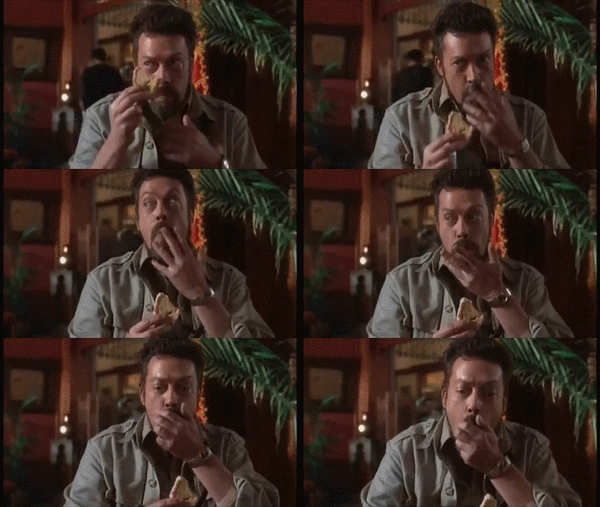
Curry delightfully chews the scenery (and sesame cake) as Herkermer Homolka, “formerly of Romania, free from the chains of Ceaușescu, traveling the world and doing good.” This last bit of his introduction rightly comes into question until Hudson’s Errol Flynn-esque guide Monroe Kelly clarifies that “he is a Romanian and he has done a lot of good… but mostly for Mr. Homolka.”
What’d He Wear?
After introducing himself to primatologist Peter Elliott (Dylan Walsh) in a three-piece suit and tie, Herkermer Homolka dresses appropriately for their upcoming expedition in full safari gear.
Homolka boards their flight to Uganda in a khaki cotton safari jacket, uniquely styled with storm flaps that are smoothly integrated onto single-button flaps to close the inverted box-pleated pockets over the chest. The jacket also has inverted box-pleated bellows pockets over the hips with more traditional single-button flaps. Short pleats behind the shoulders follow the jacket’s function-forward design by allowing its wearer a greater range of arm movement, and the button-down shoulder epaulets also nod to the jacket’s sporting purposes. Five large horn buttons fasten up the front to a shirt-style point collar. The sleeves may be finished with a button, but Homolka keeps the mundone and rolled up his forearms.

Say what you will about Herkermer Homolka, at least he’s not the only one on the expedition not appropriately dressed in safari gear. (Ahem, Dr. Elliott.)
Homolka first echoes his safari jacket with a light khaki cotton short-sleeved bush shirt, styled with a front placket, shoulder epaulets, and inverted box-pleated chest pockets that close with single-button flaps.

Once they’re in Tanzania, Homolka ties a black-on-tan cotton kerchief around his neck that adds a dash of rakish functionality by catching sweat dripping down his neck through the jungle humidity. The tribal-inspired print includes irregular black crosses and abstract geometric figures.

As the expedition leads our heroes into hotter territory, Homolka trades his full-sleeved safari jacket for a sleeveless bush vest made from a light khaki cotton drill. Perfect for stashing diamonds pilfered from King Solomon’s mines, this vest offers even more cargo space than his jacket did with two flapped bellows inverted box-pleated pockets over the chest, large open-top patch pockets over the hips with slanted openings, and a smaller patch pocket between them on the left side. The vest also has a flat camp collar, a drawcord to cinch the waist, and shoulder epaulets that reinforce the safari-informed styling—each fastened down with a tarnished brass snap like the four large snaps up the front.
Homolka first wears the vest over his original short-sleeved shirt, eventually swapping this for a second long-sleeved bush shirt that is otherwise identical with its front placket and twin flapped chest pockets.

Homolka always tucks his shirts into nearly matching khaki cotton flat-front trousers, appropriate for his safari-informed style with inverted box-pleated cargo pockets over the thighs supplementing his slanted side pockets and flapped back patch pockets. The trousers have a full fit through the legs down to plain-hemmed bottoms finished with flat-felled seams. He holds them up with a plain dark-brown matte leather belt that closes through a round gold-toned singel-prong buckle.
As their expedition continues into Zaire (now the Democratic Republic of the Congo), Homolka pulls on a wide khaki cotton web utility belt with blackened brass hardware: the single hook-style buckle and pairs of grommets running the length of the belt. This particular piece feels more like cosplay as—unlike Kelly, who holsters his M1911A1 onto his utility belt—Homolka never attaches a holster or any other equipment onto it.

Homolka initially wears Mephisto Cruiser walking shoes, characterized by their low-cut, moc-toe, derby-style speed-lacing design and easily identifiable by the white-lettered tags along the outer lace panels. These comfort-oriented shoes were introduced in the 1970s by the French footwear brand Mephisto and still manufactured today.
Homolka’s Cruisers are crafted with black pebbled grain leather uppers, laced through six sets of gunmetal D-ring eyelets and set on black heavy-duty rubber lug outsoles. He wears them with thin dark-brown cotton lisle socks on the plane, followed by black socks the following day.

Homolka and Kelly confer in their khaki safari jackets, with Homolka’s Mephisto Cruisers contrasting against Kelly’s Grasshopper/Wallabee-style boots.
Around the time that Homolka swaps out his safari jacket for a vest, he also switches his Mephisto Cruisers for more traditional hiking boots. These have weathered brown grain leather uppers, derby-style lacing, black rubber outsoles, and a more subdued moc-toe construction than the Cruisers.

Some wear their heart on their sleeve, but Herkermer Homolka wears his soul on his pinky. We meet the character as he looks over a mystical gold ring that eventually finds its place on his left little finger with a matching gold tightly wound expandable coil-spring band. He wears it presenting a large amber-colored oval stone, presumably cut from the same mineral as the eyes guarding Zinj.
The surface of the ring revolves to show a flatter but ultimately more meaningful side, cut with ten pseudo-hieroglyphic etchings surrounding a green “open eye” cabochon that matches symbols guiding seekers to Zinj… including one in Amy the gorilla’s artwork.

Homolka wears a distinctive gold-finished wristwatch with a round dial against a subtly tonneau-shaped case on a gold expanding band. The champagne dial is detailed with gold applied hour markers and a broad vertically graduated black stripe across the center. The manufacturer isn’t obvious from how the watch appears on screen, though it resembles Seiko quartz watches marketed to women in the 1970s.

Briefly seen as the cynical tour guide Eddie Ventro (Joe Pantoliano) leads the expedition across the explosive tarmac of the Ugandan airport, Homolka wears a set of small, gold-framed retro-style sunglasses with circular lenses and tortoiseshell arms.

Only seen in one brief vignette as the group treks through the jungle, Homolka completes his all-khaki kit with a matching cotton bucket hat that has a long, narrow chin-strap.

What to Imbibe
The obvious choice to accompany Congo would be a Martini like Dr. Elliott serves to Amy aboard the plane to Uganda.

“She’s allowed one, it’ll calm her down,” Dr. Elliott explains to Homolka’s amusement.
You could also accompany it with some sesame cake, but—

How to Get the Look

Tim Curry as Herkermer Homolka in Congo (1995)
Herkermer Homolka dresses the part of a seasoned expeditioner in his head-to-toe khaki safari gear, adding rakish continental refinements with his printed neckerchief, retro wristwatch, and Mephisto Cruisers.
- Light-khaki cotton five-button safari jacket with point collar, shoulder epaulets, two inverted box-pleated chest pockets with single-button storm flaps, and two inverted box-pleated hip pockets
- Light-khaki cotton drill snap-front bush vest with flat camp collar, shoulder epaulets, two inverted box-pleated bellows chest pockets with flaps, left inset patch pocket, and two slanted-entry patch hip pockets
- Light-khaki cotton short-sleeved bush shirt with front placket and two inverted box-pleated chest pockets with single-button flaps
- Black-on-tan tribal-printed cotton neckerchief
- Light-khaki cotton flat-front trousers with belt loops, slanted side pockets, two inverted box-pleated cargo pockets with single-button flaps, two flapped patch back pockets, and plain-hemmed bottoms
- Dark-brown matte leather belt with round gold-toned single-prong buckle
- Khaki cotton web utility belt with blackened brass single-hook buckle and grommets
- Black pebbled grain leather Mephisto Cruiser walking shoes with moc-toe and six sets of gunmetal D-ring eyelets
- Dark-brown cotton lisle socks
- Light-khaki cotton bucket hat with long chin-strap
- Gold-framed retro-style sunglasses with small round lenses and tortoise arms
- Gold pinky ring with revolving symbolic face and coil-spring band
- Vintage quartz watch with gold-toned tonneau case, round black-on-champagne gradiant dial, and gold-toned expanding band
Do Yourself a Favor and…
Check out the movie. It may not be the most critically acclaimed, but consensus seems to agree it’s one of the more entertainingly “bad” movies out there.
The Quote
Cliches usually contain some element of truth.