


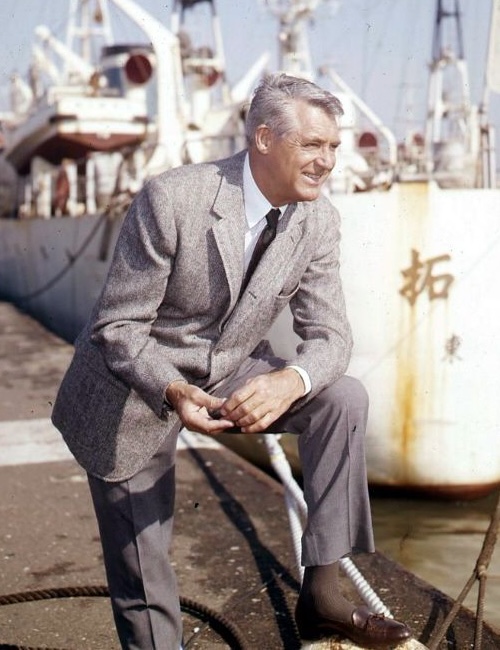
Cary Grant on set in Japan during production of Walk, Don’t Run (1966)
Vitals
Cary Grant as Sir William Rutland, charming industrialist and matchmaker
Tokyo, Fall 1964
Film: Walk, Don’t Run
Release Date: June 29, 1966
Director: Charles Walters
Costume Designer: Morton Haack
WARNING! Spoilers ahead!
Background
Cary Grant died 40 years ago today on November 29, 1986, having spent his last twenty years retired from acting after his final screen appearance in the comedy Walk, Don’t Run. Already frustrated by being paired with leading ladies a fraction of his age—which led to Audrey Hepburn’s character in Charade reconfigured to be more romantically aggressive than Grant—the actor happily took a more avuncular role in Walk, Don’t Run, serving as a matchmaker for the two younger leads played by Jim Hutton and Samantha Eggar.
Grant stars as Sir William Rutland, a prominent English businessman who arrives in Tokyo two days earlier than expected and is thus unable to secure lodgings, as his hotel room isn’t ready yet as the city overflows with tourists and athletes ahead of the 1964 Summer Olympics. Having no luck with the obnoxious and obsequeious embassy clerk Julius Haversack (John Standing), Sir William chances upon a room being sublet by the finnicky young Christine Easton (Eggar)—who turns out to be Haversack’s fiancée and had actually been seeking a female roommate.
Christine: But you’re a man!
Sir William: Yes, I suppose so.
Christine: I prefer sharing an apartment with a woman.
Sir William: Well, so do I.
Christine ultimately acquieses to Sir William’s insistance on renting her spare room… though she certainly didn’t agree to his impulsively inviting the American athlete and architect Steve Davis (Hutton) to split the space as well! In the grand rom-com tradition, Steve and Chris eventually fall for each other, culminating in a final act set during the Olympics where Sir William sets aside his fascination with lady-shotputters to literally walk the extra mile for his new young friends’ fledgling romance.
Filmed partially on location in Tokyo, Walk, Don’t Run bridged a gap between Grant’s thirty-year career during the classic Hollywood era and a shifting filmmaking style represented by more youthful talent like composer Quincy Jones and a brief appearance by a young George Takei—whose iconic debut on the original Star Treak series would premiere less than two months after Walk, Don’t Run was released. Grant himself paid subtle homage to his own career on screen, singing the theme from An Affair to Remember and whistling the theme from Charade while getting ready after Sir William’s first night at Christine’s apartment.
What’d He Wear?
Even with all his eccentricities, Sir William maintains the conservative wardrobe of an English businessman, exclusively tailored in gray and dark-blue two- and three-piece suits that he pairs with white or off-white shirts and subdued ties. Even at his most dressed-down, when attending the Olympic Games with Christine and Julius, he still looks dignified in a tweed sports coat and tie that would become one of Cary Grant’s final complete* on-screen outfits.
Aside from his dressing gown and pajamas, this jacket is the only time Cary Grant appears on screen not dressed in a full suit (or at least the components of one.) The woolen cloth is a gray-and-black herringbone tweed, undeniably stylish but also a seasonably smart choice for the 1964 Summer Olympics, which—despite their name—were actually held in October to avoid Tokyo’s midsummer heat and humidity and subsequent typhoon season. It was almost certainly tailored for Grant himself, following a classic configuration of a single-breasted cut with notch lapels tapering to a 3/2-roll that Grant appropriately wears with just the second button fastened. The jacket also has a single vent, vestigial two-button cuffs spaced apart at the end of each sleeve, straight flapped hip pockets, and a welted breast pocket where he tucks his eyeglasses when not wearing them.
Sir William maintains a tasteful tonality with mid-gray woolen trousers, styled with side pockets, jetted back pockets, and plain-hemmed bottoms. Though the waistband remains generally concealed by his buttoned jacket and its limited screentime, the trousers almost certainly follow the examples of his others with buckle-fastened side-adjuster tabs rather than belt loops.

Sir William exclusively wears light, solid-colored shirts, even in this less formal context where he sports an icy pale-blue poplin shirt that follows his typical design of a plain button-up front and button-fastened cuffs. The point collar frames the four-in-hand knot of his black tie, patterned with satin-finished stripes spaced apart in the “downhill” direction that alternate between a subdued burgundy and black-on-black.
He continues wearing his usual accessories of a wristwatch and eyeglasses. His watch has a small yellow-gold case, likely 34mm or smaller, with a round white dial and a black leather strap. His reading glasses have glossy black frames with a trio of hinge pins on each side.
The latest addition to his look is a plain flat cap made of light olive-brown wool, subbing in as a sporty alternative to his usual black and brown felt trilbies. He continues wearing it even after stripping off the rest of his clothes to power-walk alongside Steve.

*You’ll recall that I said this was one of Grant’s final “complete” on-screen oufits? Well, Sir William’s matchmaking designs depend on his impulsively stripping down to his skivvies to join Steve as he struts through the streets of Tokyo during his 50-kilometer walk competition. Dedicated to his new friends’ long-term happiness, he does just that—emerging from a taxi dressed in his plain white cotton crew-neck short-sleeved undershirt tucked into pale-cream cotton boxer shorts.
Undershorts of this era were considerably more complicated than today’s elastic-waisted boxers, as demonstrated by Grant’s screen-worn shorts. Sir William’s double-pleated boxers fasten in the front through two buttons along the waistband, plus a strap across the back that fastens at each end through one of two buttons. Though certainly available for purchase by civilians around the world, this style specifically evokes underwear issued by the French Army through the 1950s and ’60s (as evident in this eBay listing.)

Given the very, very public setting, Sir William would have been sure that the buttons fastening his undershorts’ waistband were tightly in place.
A publicity photo of Grant on location in Japan (seen at the top of this post) depicts the actor wearing a smart set of brown leather cap-toe tassel loafers and similarly toned socks. However, by the time we finally see Sir William’s shoes during this sequence, his feet are brashly clad in black-and-white spectator shoes and white cotton lisle socks extending halfway up his feet. It’s hard to imagine that a conservative dresser like Sir William would have naturally been wearing these shoes and socks with his tweed jacket and tie, but we never actually see otherwise on screen, so perhaps the Olympic games bring out a jauntier side in the owner of England’s largest factory.
We never see the shoes too closely, but they appear to also be tassel loafers, styled with black moc-toe gunwales, white vamps, and black laced tassels.

How to Get the Look
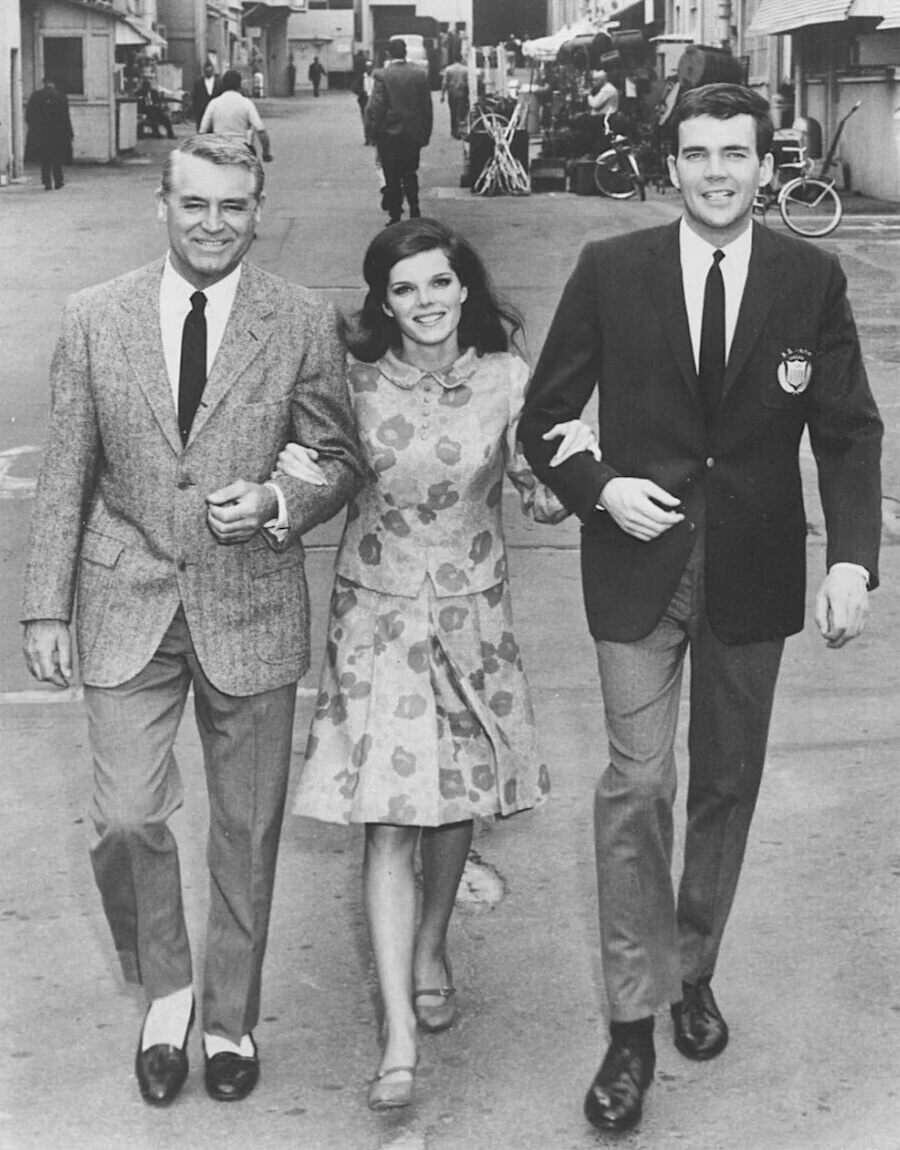
Cary Grant, Samantha Eggar, and Jim Hutton filming Walk, Don’t Run (1966). Note how Grant uniquely wears the bottom two of his jacket’s three buttons fastened.
It feels hilariously fitting that quintessential 20th century style icon Cary Grant would conclude his screen career in his underwear… but, before we get to that point, Sir William reflects Grant’s typical sense of smart, confident style in his classic tweed sports coat, striped tie, trousers, and loafers. (Especially when considering the brown leather loafers Grant was photogaphed wearing and not the black-and-white ones he wears for ostensible comic value during the race.)
- Gray-and-black herringbone tweed single-breasted 3/2-roll sport jacket with notch lapels, welted breast pocket, straight flapped hip pockets, spaced 2-button cuffs, and single vent
- Ice-blue poplin shirt with point collar, plain front, and button cuffs
- Black tie with subdued satin-finished “downhill” spaced-apart stripes alternating between burgundy and black
- Gray wool flat-front trousers with buckle-fastened side adjusters, side pockets, jetted back pockets, and plain-hemmed bottoms
- Brown leather cap-toe tassel loafers
- Brown dress socks
- White cotton crew-neck short-sleeved undershirt
- Pale-cream cotton boxer shorts with button-fastened waistband and back strap
- Light olive-brown woolen flat cap
- Black glossy-framed eyeglasses
- Gold dress watch with small round white dial on balck leather strap
Do Yourself a Favor and…
Check out the movie.