

For the final entry of BAMF Style’s Week of Weddings, we’re examining one of the cinema’s most iconic characters.

Marlon Brando as Vito Corleone in The Godfather (1972)
Vitals
Marlon Brando as Vito Corleone, powerful Mafia boss and father of four
Long Island, NY, August 1945
Film: The Godfather
Release Date: March 15, 1972
Director: Francis Ford Coppola
Costume Designer: Anna Hill Johnstone
Background
You’ve come across the scene a million times, whether actually watching it, seeing photos, or hearing your friends quote it. And indeed it is one of the most quotable sequences in film history.
I’m gonna make him an offer he won’t refuse.
With no further introduction (because do we really need it?), here is Vito Corleone at his daughter’s wedding… on the day of his daughter’s wedding.
What’d He Wear?
For the lavish wedding of a powerful Mafia boss in the 1940s, it should be evident that there would be no stops. This was the golden era for the mob: the wars of the ’30s were long past and the massive investigations of the ’50s were far into the future. It was a reason to celebrate. Appropriately, The Godfather made this evident by opening with a celebration. The groomsmen are in black tie, with the family patriarch leading the way in the finest attire.
The patriarch himself, Don Vito Corleone, sports a sharp black vintage tuxedo. The jacket is single-breasted, closing with a low single-button stance. The unique “cran Necker” (or Parisian) lapels are satin-faced with a satin-edged collar.

“And then they will fear you.”
When it comes to making people feel fear, I’d probably go to the Don for advice too.
Additionally, the dinner jacket is ventless with jetted hip pockets and three uncovered buttons on each cuff.
Underneath the jacket, mostly concealed when the jacket is buttoned, is a full-backed black waistcoat. The waistcoat features slim shawl lapels, also with satin edges, and a high and tight three-button stance. The buttons appear to fasten only the top half of the vest, leaving the bottom half buttonless. If anyone has any details on what this is called (or if it’s true), please contact me. The waistcoat fastens at a low V-shaped opening.

“So wait, let me get this straight… you played Boo Radley?”
The formal black trousers have a sharp center crease and plain-hemmed bottoms. Naturally, they feature satin stripes down each leg. Perhaps as a small concession to 40s styles, the pants are roomy with a slight bagginess. Or maybe the Don just liked to be comfortable in his dinner pants. Maybe the tailor made him an offer he couldn’t refuse (Like 50% off or something like that.)
The Don’s shirt is white with a stiff plain front bib featuring a detachable wing collar and single cuffs. The cufflinks are round and silver. Two of his shirt studs are also visible. Although they appear different in several lights (sometimes appearing to be diamonds, sometimes silver, and sometimes black), I have concluded that they are small round diamond studs with a silver rim. Diamonds would be very fitting for a mob boss.

The Don kept fishing for compliments about his new cufflinks, but Johnny Fontaine didn’t mention them at all. It’s amazing that he lives through the whole movie after such an insult.
The rest of the Don’s black tie accoutrements live up to their name: a black silk bow tie, black patent leather shoes, and black dress socks. The bow tie is non-adjustable, adding an extra level of class and sophistication to a wingtip collar.

Our first look at Don Corleone. If you thought meeting your father-in-law for the first time was intimidating, imagine what Carlo’s experience would’ve been like. Almost makes him a sympathetic character, no?
Don Corleone’s wristwatch isn’t seen much in this scene, but it appears to be a tank watch with a rectangular silver case and a dark leather strap, likely black. He also wears a silver wedding band on his left ring finger, signifying his eternal devotion to his wife Carmela and the rest of his family. To honor his daughter for her wedding celebration, he also wears a red rosebud in his left lapel.

Stuff like Febreeze wasn’t around in the 1940s, so men like Don Corleone would sniff the flower in their lapel if someone else in the room started cutting muffins.
Unseen in this context in the film but evident from production and behind-the-scenes photos, Don Corleone wears a wide-brimmed black homburg when he steps outside.

Whereas his two older sons opted for double-breasted dinner suits, as were fashionable during the late 1930s-early 1940s, Don Corleone keeps his look classic with a 1-button peak lapel tux.
Did you know? The costume department only had three tuxedos on hand so they gave Al Pacino a Marine uniform to wear and wrote it into the movie?
(I made that up.)
All in all, the attire is very appropriate for a well-to-do mob boss in the mid-1940s, particularly one who is just past middle age. The suit has a neo-Edwardian look but also nods to ’40s style with the wider lapels without dipping into the extreme fads. He keeps his look clean and classic.
Go Big or Go Home – Wedding Edition
The Venue
Since the Corleone family lives on a fucking compound, they decided to host the wedding themselves. This makes sense, as you could probably fit nine churches, six banquet halls, and one or two well-sized hotels on their compound.
The compound (can’t get enough of this word!) was supposed to be located in an upper class section of Long Beach, Long Island, New York and had been the Corleone home since Vito built it in the 1930s. In reality, it was off Longfellow Road on Staten Island.

No family photo is complete without Diane Keaton in a huge hat.
(Especially a family photo taken on a goddamn compound.)
It has all the basics for a good wedding though: a dance floor, a stage, a few tents, pitchers of wine for overweight capos, an office for bakers and undertakers to request favors, and a nice cozy upstairs room where the bride’s brother can take advantage of a young woman who’s heard rumors about his prowess.
The Refreshments

In addition to the aforementioned pitchers of red wine – which any Italian wedding would be doomed without – Don Corleone treats his special guests to their own refreshments. As mentioned specifically in Mario Puzo’s 1969 book, Corleone and his associates smoke De Nobili cigars and drink Strega, a yellow Italian liqueur.

Although the Don certainly approves of celebratory whiskey.
Salut!
Notable Guests
You’ve got the usual: huge family showing, Dad’s work friends (including the scary one who once might have threatened to kill a bandleader), the bridesmaids all bedecked in pink, and—OMIGAD—is that Johnny Fontaine?!
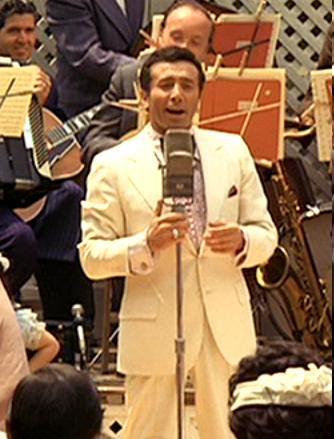
Yes. Yes it is.
The appearance of the fictional Johnny Fontaine at the Corleone family wedding would be like if Sinatra showed up in real life. Rumor has it that they wanted to get Sinatra to actually play Johnny (a role that was based on Sinatra’s own story!), but Sinatra was miffed about not getting the part of Don Corleone and refused. Thus, Coppola went with the somewhat-less-famous and possibly-mob-connected Al Martino, who indeed played the part well.
Fontaine’s arrival was the great surprise appearance of the day for the guests, other than the unwelcome visit from the FBI, jotting down license plate numbers in the parking lot until an angry Sonny (James Caan) arrives and gives them what for.
The Music
Well, since Johnny Fontaine shows up, he may as well sing, right? Fontaine croons “I Have But One Heart”, the 1945 song that provided Vic Damone with his first hit.

The father-daughter dance.
Surrounding Johnny’s performance is a parade of traditional Italian wedding music, including “Luna Mezz’o Mare” (“Lazy Mary” to you Amerigans) sung by Mrs. Corleone and an old, old, old man.
How to Get the Look

Marlon Brando as Vito Corleone in The Godfather (1972)
If you really want to emulate Don Corleone, just try to match his style, not his rather illegal habits of racketeering, corruption, and being shot.
- Black single-breasted 1-button dinner jacket with wide satin-faced cran Necker lapels (with satin-edged collar), 3-button cuffs, no breast pocket, welted hip pockets, and a ventless rear
- Black full-backed waistcoat with a high & tight 3-button front and slim satin-edged shawl lapels
- Black formal trousers with a sharp center crease, plain-hemmed bottoms, and a satin stripe down each leg
- White stiff plain front bib shirt with a detachable wing collar and single cuffs
- Diamond shirt studs with a silver rim
- Round silver cufflinks
- Black silk bow tie
- Black patent leather oxford shoes
- Black silk dress socks
- Red rosebud boutonniere (left jacket lapel)
- Silver wedding band (left ring finger)
- Steel tank watch on a black leather strap
- Black wide-brimmed homburg with a black grosgrain ribbon
Do Yourself a Favor and…
Check out the series.
The Quote
…A man who doesn’t spend time with his family can never be a real man.

Marlon Brando once told Michael Keaton he needed to spend more time with his family. The result? Mr. Mom.