Moonrunners: Kiel Martin’s Fringed Buckskin Jacket and Blue Jeans

Kiel Martin in Moonrunners (1975)
Vitals
Kiel Martin as Bobby Lee Hagg, daredevil moonshine driver and part-time guitar picker
Georgia, Fall 1973
Film: Moonrunners
Release Date: May 14, 1975
Director: Gy Waldron
Costume Designer: Patty Shaw
WARNING! Spoilers ahead!
Background
Two rambunctious and fast-driving cousins speed through a fictional county in the deep south, running moonshine for their uncle Jesse while evading local sheriff Roscoe Coltrane and his connections to a corrupt local crime boss who drives a white Cadillac—all set to the music and homespun voiceover of outlaw country legend Waylon Jennings. And no, I’m not talking about The Dukes of Hazzard.
Four years before the Dukes debuted on CBS, Gy Waldron’s B-movie Moonrunners premiered in drive-in theaters across the South fifty years ago tomorrow on May 14, 1975.
Moonrunners could have been lost in the traffic jam of cheap ’70s hick flicks about moonshine and muscle cars until it was plucked from potential obscurity by Warner Brothers’ perplexing—but indeed prophetic—suggestion that it could form the basis for a successful TV show. Now best known as the rawer progenitor to The Dukes of Hazzard, Moonrunners has essentially all the same elements and characters but distilled into a dirtier, hornier jar of shine—seasoned with the visceral authenticity that comes from filming on location in rural Georgia and not a WB backlot.
Filmed through the fall of 1973 across parts of Coweta, Meriwether, and Pike counties, Moonrunners was partly inspired by Waldron’s own experiences growing up in rural Kentucky as well as memories shared by former moonshine runner Jerry Rushing, who also served as the film’s technical advisor and would appear in bit parts in both Moonrunners and the fourth episode of The Dukes of Hazzard.
Rushing had been born into a family of moonshiners and gained a reputation for skillfully speeding his heavily modified 1958 Chrysler 300D—named “Traveler” after General Robert E. Lee’s horse—through the mountains of North Carolina alongside fellow bootleggers (and future NASCAR stars) Junior Johnson and Wendell Scott. (Though acknowledged in Moonrunners‘ opening titles, Rushing’s lack of credit on the considerably more successful CBS series resulted in a lawsuit where he received an undisclosed settlement.)

Jerry Rushing (1937-2017)—former bootlegger and real-life inspiration for the Haggs and the Dukes—makes a cameo appearance as one of Jake Rainey’s burly bodyguards in Moonrunners.
“The next time you see the moon out, not everybody asleep… some folks are workin’,” Waylon Jennings’ narration begins, before kicking into Billy Joe Shaver’s “Slow Rollin’ Low”. (Though the film later features the version commercially released on Jennings’ 1974 album This Time, the sped-up version over the opening credits was recorded specifically for Moonrunners.) As Waylon sings, the round shape in the corner that could have been a moon separates into two, then four, as we see it’s two sets of fast-moving headlights: a police cruiser chasing a Plymouth Fury into the parking lot of a backcountry juke joint called the Boar’s Nest—another name that should be familiar to fans of The Dukes.
Here, we meet the Hagg cousins from the fictional Shiloh County—the smart-mouthed “moon driver” Bobby Lee and laconic lothario Grady, portrayed respectively by Kiel Martin and James Mitchum. Martin would later find wider fame as the troubled detective J.D. LaRue on Hill Street Blues, while Mitchum’s first screen credit was as a teen in the very similar Thunder Road (1958), co-starring opposite his famous father Robert Mitchum.
Described as “moonshiners, trouble-makers, and trash,” by one of the arresting deputies, the Hagg boys drive for their widowed uncle Jesse (Arthur Hunnicutt, in his penultimate screen credit), an old-timer whose recipe for moonshine predates the Revolutionary War and who “believes in two things: God and whiskey.” Released after 30 days in jail for a barroom brawl in neighboring Pikkens County, Bobby Lee hooks up with voluptuous runaway Beth Ann Eubanks (Chris Forbes), who joins the family’s fight against the corrupt Shiloh County sheriff Rosco Coltrane (Bruce Atkins) and ruthless liquor syndicate bigwig Jake Rainey (George Ellis).
The general plot and characters would be reworked for the sanitized adaptation The Dukes of Hazzard, which premiered in January 1979 and ran for seven seasons on CBS until the final episode aired in February 1985. Bobby Lee and Grady Hagg and the stock car Traveler were transformed into Bo and Luke Duke driving a ’69 Dodge Charger named the “General Lee”; Uncle Jesse and Sheriff Roscoe P. Coltrane remained, though the characters of Beth Ann and Boss Hogg were reimagined as the boys’ leggy cousin Daisy and the white-suited county commissioner Boss Hogg.
Alas, Martin’s giggling hotheaded himbo and Mitchum’s laconic follow-up to his debut turn in Thunder Road were never going to be plastered on kids’ lunchboxes or coloring books, but this odd little slice of Southern life has a beating heart—and enough Waylon beats—to make it worth the watch for anyone who thinks they might be interested.
What’d He Wear?
Bobby Lee and Grady Hagg may not be as wardrobe-constrained as their small-screen successors, Bo and Luke Duke—whose outfits hardly varied across The Dukes of Hazzard‘s seven-season run—but each cousin in Moonrunners maintains a distinct and consistent personal style that reflects his character.
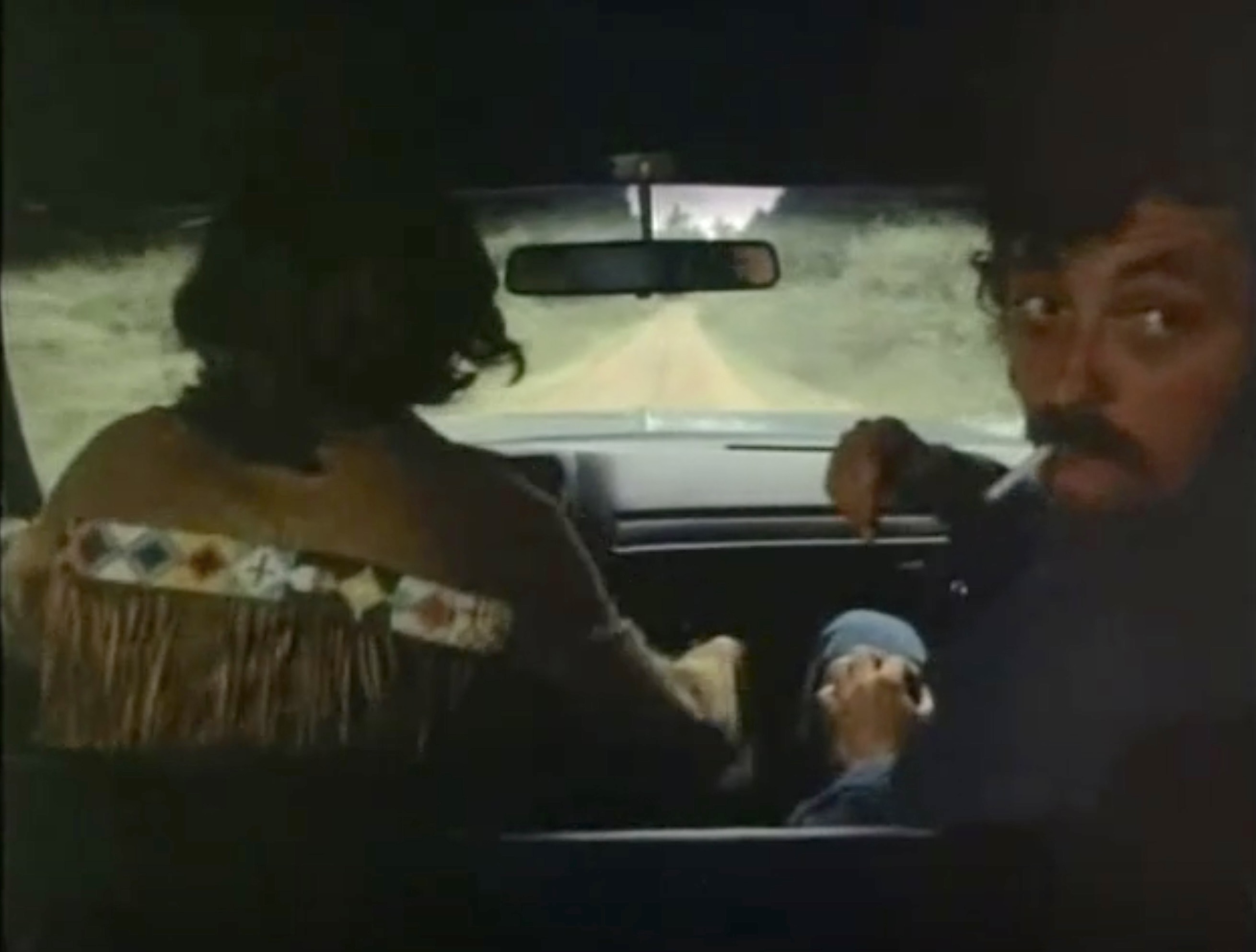
The taciturn Grady sticks to a “Canadian tuxedo” formula, typically layering a blue denim trucker jacket over matching jeans and rotating through snap-front shirts in either blue denim or white. By contrast, Bobby Lee presents himself with more flair, from his longer hair that seems to require constant combing to his standout buckskin jacket—heavily beaded and dramatically fringed across the arms and back.

Buckskin garments trace their origins to Native American traditions, crafted from raw deer hides tanned with brain tissue and smoked over wood fires for softness, strength, and their signature golden hue. Like many indigenous innovations, buckskin was eventually adopted—and often appropriated—by settlers, frontiersmen, and cowboys. It’s easy to imagine the fictional Hagg clan continuing this tradition as they honed their famous moonshine deep in Appalachia for centuries before and after the Revolutionary War.
Whether Bobby Lee’s jacket nods to this rugged heritage or reflects his flair for countercultural screen icons like Dennis Hopper in Easy Rider or Jon Voight in Midnight Cowboy, it feels both personal and performative—suggesting he’s more plugged into pop culture than his kin.
His hip-length buckskin jacket lacks buttons or closures, its front edges reinforced with stitching. Short side vents and a shirt-style collar give it some conventional structure, but it’s otherwise defined by long fringe under each sleeve and across the back, paired with rows of decorative beading mirrored on the chest.

Bobby Lee’s beaded adornment reflect traditional Native American patterns, echoing the general geometric style of colorful diamonds, crosses, and arrows found in Plains and Plateau tribes’ beadwork and nodding to the American counterculture’s fascination with indigenous aesthetics through the late ’60s and early ’70s.
Bobby Lee rotates through three different long-sleeved shirts with his buckskin jacket and jeans. The first, worn during his arrest in Pikkens County and subsequently meeting Beth Ann upon his release, is patterned in a taupe-brown and white gingham check. This shirt has a fashionably long point collar, which appears to actually be a button-down collar though Lee foregoes fastening the collar points to the body of the shirt as this gives him a more devil-may-care look. The shirt has a button-up front placket, breast pocket, and squared button cuffs.

Luckily, Bobby Lee had the foresight to remove his fringed jacket before a rowdy biker emptied a PBR over his head at a roadside bar. Beer washes out of gingham shirts much more easily than it does buckskin!
The day after his return home, Bobby Lee debuts an indigo-blue denim long-sleeved shirt. Unlike the button-up shirts, this two-pocket shirt follows more of the western-influenced tradition with its snap (or “popper”) buttons and pointed yokes across the front and back. The white-finished snaps fasten up a front placket, plus three on each squared cuff and one to close each chest pocket flap.

Initially layered under the denim shirt, then on its own (with and without the fringed jacket), Bobby Lee’s sole pullover shirt is a dark navy-blue “ringer”-style tank top, so named for the baby-blue ringed crew-neck and armholes.

A lesser-seen item from Bobby Lee’s closet is a light stone-colored shirt, which follows the same design as his gingham shirt with a long button-down collar (clearly worn with the points unbuttoned), button-up front placket, breast pocket, and button cuffs.

When Sheriff Rosco and his deputies are laying in wait for Bobby Lee and Zeebo, they’re tipped to look for a man with “long dark hair, blue pants, brown shirt,” a description fitting Bobby Lee’s buckskin jacket and blue jeans that was presumably afforded to them by the moonshine supplier Roy (Bob Hannah) at Bobby Lee’s request to raise the stakes during his and Zeebo’s race.
Bobby Lee wears at least two sets of jeans over the course of Moonrunners, with his primary pair made from a mid-blue denim, configured with the standard belt loops and five-pocket layout but with flared boot-cut legs that both accommodate his boots while also adhering to the excessive fads of the bell-bottom era. He holds them up with a brown leather belt that closes through a large brass rectangular buckle.

Waylon narrates that “a lot of them boys would turn their mother’s picture to the wall any day for a pair of Justin boots,” when describing the custom-made grand prize for the winner of Grady and Zeebo’s stock car derby. The brief glimpses we get of Bobby Lee’s dark-brown leather square-toed cowboy boots aren’t enough to determine if they’re made by the Texas-based Justin or another company, but Moonrunners makes clear how much these good ol’ boys appreciate their good ol’ boots.

While loading the Fury’s trunk with more moonshine for their next run, Bobby Lee wears a light-brown sueded leather button-up vest over his gingham checked shirt.

During Jake Rainey’s barbecue and a subsequent police chase, Bobby Lee follows his cousin Grady’s sartorial example by going triple denim with a dark-indigo trucker jacket pulled over his blue denim snap-front shirt and blue jeans. In addition to the newly seen jacket, the jeans are also a divergence from his usual denim—styled with wider belt loops and cargo pockets positioned over the thighs, just below the usual curved hand pockets. These additional patch pockets have narrow rectangular flaps that each close through a single rivet button.

The cut and styling of Bobby Lee’s six-button, two-pocket trucker jacket echoes the contemporary Levi’s “Type III” model, though we don’t see enough of it to get a glimpse of the telltale red tab that would be sewn along the left pocket flap.
What to Imbibe
In addition to their expected regular regiment of Uncle Jesse’s moonshine, the Hagg boys drink plenty of beer. “I don’t drink,” Beth Ann tells Bobby Lee as she pulls her bright-red ’71 Chevy sedan into a road house parking lot. “Me neither—beer ain’t drinkin’,” he responds.
As might be expected, the Haggs prefer all-American lagers like Budweiser and Miller High Life. Bobby Lee pulls a bottle of Bud from behind the bar at Jake Rainey’s truck stop, taking the time to chug the contents before breaking the bottle over Jerry Rushing’s head, then drinking another can at home while debriefing with Beth Ann and Grady about their uncle using Beth’s Chevy to deliver a moonshine load himself. During Jake’s barbecue, he drinks a can of High Life—as Miller had began offering the beer ounce toted as “the Champagne of Bottled Beers” in cans following World War II.

The Car
“I drive better under pressure,” Bobby Lee assures Roy when requesting that he tip off Sheriff Coltrane before he and Zeebo run their competing loads through Shiloh County. The Haggs keep a dark-blue 1971 Plymouth Fury four-door sedan as their primary moon-running car.

As fans of Stephen King would know, Plymouth had ben using the “Fury” nameplate since the late 1950s when it was a sub-series of the Belvedere before becoming its own model in 1959. It evolved through the ’60s before the fifth generation launched for the 1969 model year after a significant facelift that visually aligned it with other Chrysler C-body full-size models like the Dodge Polara.
In addition to the existing Sport Fury performance trim, this fifth series carried over the Fury I, II, and III trim lines from previous generations, available in two- and four-door hardtops, two-door convertibles, four-door sedans, and station wagons. A six-cylinder 225 cubic-inch engine was standard across most models, while the Sport Fury’s base engine was a 318 V8. Three-speed manual transmissions remained standard, with Chrysler’s bulletproof three-speed TorqueFlite automatic optional for all trims, body styles, and engines.
By 1971, engine options for the four-door Fury sedan include the base 225 Slant Six, 318 V8, the new LA 360 V8 (which became Chrysler’s largest production “small-block” V8), two variants of the 383 V8, and the high-output 440 “Super Commando” V8. While it’s lost to history which V8 mill powered the Haggs’ Fury, it appears to have a manual transmission as demonstrated by when Bobby Lee and Grady spot the revenuers’ yellow sedan chasing them down a dirt road and Bobby Lee desperately reaches down toward a floor-mounted shifter. As the factory 440 V8 was only mated to TorqueFlite automatic transmissions in ’71 Fury sedans, it’s more likely that the Haggs’ Fury was powered by one of the 318, 360, or 383 cubic-inch options.
In addition to lacking “III” or “Sport” badges and the Sport Fury’s distinguished front fascia, the Haggs’ screen-used sedan presents a plainer trim, simpler grille, and “dog dish” hubcaps that suggest an entry-level Fury I trim, likely painted in the Plymouth factory GA4 “Formal Blue” or EA9 “Dark Blue Poly” paint codes. This is consistent with the bootleggers’ preference for an unadorned powerhouse, sacrificing style for performance. (For the sake of discussion, let’s assume the Haggs went with the highest performing engine available to be factory-mated to a manual transmission: the 383 “Commando” V8.)

The grille of the Haggs’ ’71 Fury informs that they’re likely driving a Fury I rather than the more distinguishable Sport Fury or upmarket Fury II and III models.
1971 Plymouth Fury I
Body Style: 4-door sedan
Layout: front-engine, rear-wheel-drive (RWD)
Engine: 383 cu. in. (6.3 L) Plymouth “Commando” V8 with Carter 2-barrel carburetor
Power: 290 hp (216 kW; 294 PS) @ 4400 RPM
Torque: 375 lb·ft (509 N·m) @ 2800 RPM
Transmission: 3-speed manual
Wheelbase: 120 inches (3048 mm)
Length: 215.1 inches (5464 mm)
Width: 79.6 inches (2022 mm)
Height: 55 inches (1397 mm)
Perhaps in tribute to its cinematic origins, the third episode of The Dukes of Hazzard features Bo and Luke running shine in a blue 1975 Plymouth Fury sedan said to belong to their mechanic pal Cooter (Ben Jones, who also appeared in a small role in Moonrunners.)
This decision was likely made to accommodate the pregnant Mary Kaye Porter (Jeannie Wilson), who could not as easily slip through the windows of the General Lee with its welded-shut doors, as well as to allow the car to be destroyed in the episode’s finale without sacrificing the Duke boys’ beloved ’69 Charger.
The Gun
Like their counterparts on The Dukes of Hazzard, Bobby Lee and Grady tend to use bows-and-arrows rather than guns. “Ain’t no other way, I’m on probation,” Bobby Lee informs a Pikkens County deputy who taunts him as “a big, bad bow-hunter” at the start of the movie. “Ya see, when you’re on probation, the law don’t allow you to own a gun, even to hunt with. How ’bout that?”
The cables and dual stabilizers suggest a compound bow, with a distinctive squared-off center section of the riser and a relatively thin limb profile that likely narrow Bobby Lee’s bow to a contemporary model from Bear Archery.

Bobby Lee bemoans that he’s not even allowed to own a gun “to hunt with”, though he and Grady seem to prefer their bows for destroying rivals’ property with flaming arrows rather than feeding their family.
However, Bobby Lee and Grady don’t share Bo and Luke’s duties to the law and aren’t afraid to arm themselves with shotguns when the need arises, particularly during the climactic scene toward the end when they raid Jake’s warehouse and destroy his liquor, blowing it apart with pump-action shotguns. Based on the grooved walnut fore-end, trigger guard shape, and smooth 28″-long barrel, the shotgun is likely a Mossberg 500A Field Model, a 12-gauge civilian sporting model produced between 1965 and 1973.

How to Get the Look

Kiel Martin in Moonrunners (1975)
Unlike the simpler, rougher characters in his orbit, Bobby Lee’s constant internal battle for his identity as a musician vs. mountain moonshiner is reflected in his wardrobe of a flashy fringed buckskin jacket, flared blue jeans, and the rotation of shirts accompanying them.
- Golden tan fringed buckskin jacket with beaded chest and back rows, shirt-style collar, and side vents
- Brown-and-white gingham check cotton long-sleeved shirt with long button-down collar, button-up front placket, breast pocket, and button cuffs
- Blue denim jeans with belt loops, five-pocket layout, and flared boot-cut legs
- Brown leather belt with large brass rectangular buckle
- Dark-brown leather cowboy boots
Do Yourself a Favor and…
Check out the movie, available on DVD (and at Cooter’s Place locations) and streaming at the Internet Archive.
The Quote
I ain’t cut out to be a businessman! I mean, I only been at it one day, and I’m plumb wore out.
Discover more from BAMF Style
Subscribe to get the latest posts sent to your email.
You must be logged in to post a comment.