Tagged: 1950s
Written on the Wind: Rock Hudson’s Beige Tweed Jacket for a Fall Picnic
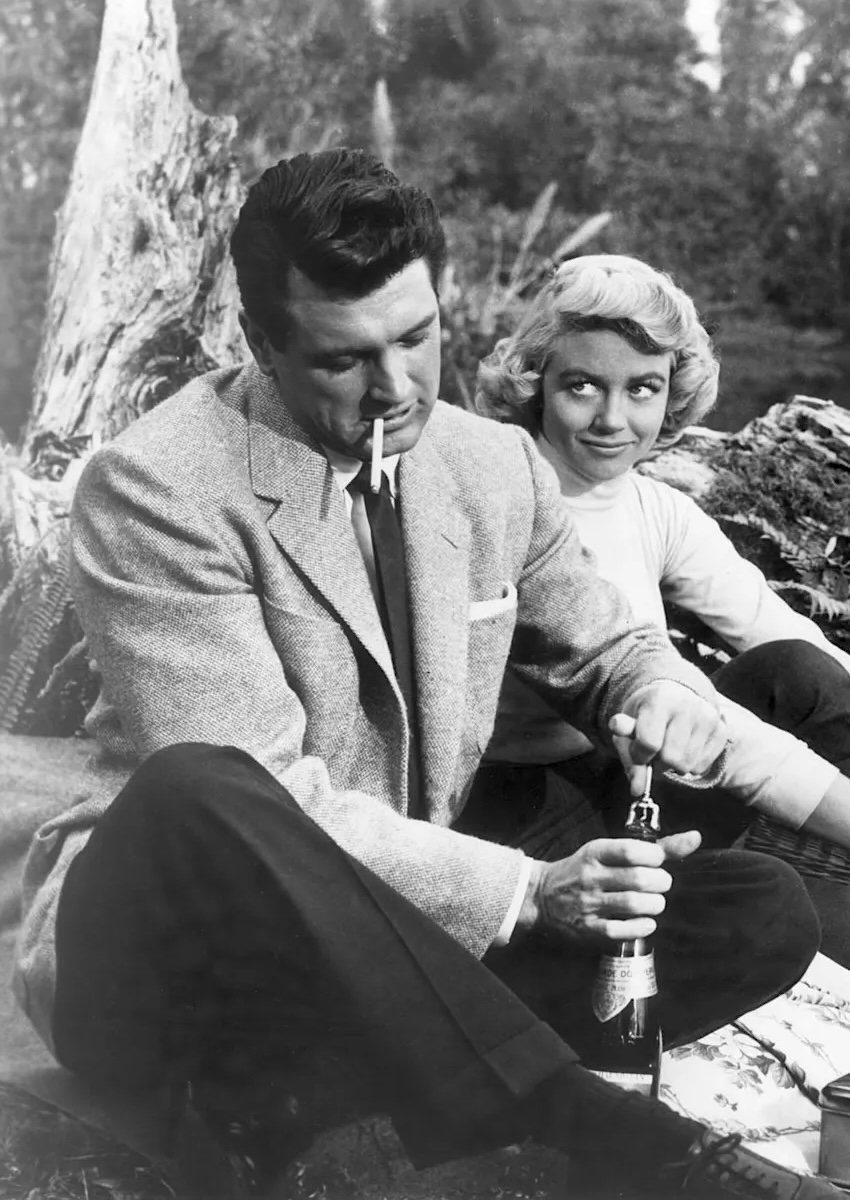
Rock Hudson and Dorothy Malone in Written on the Wind (1956)
Vitals
Rock Hudson as Mitch Wayne, oil company geologist
Texas, Fall 1956
Film: Written on the Wind
Release Date: October 5, 1956
Director: Douglas Sirk
Costume Designer: Bill Thomas (credited for gowns)
WARNING! Spoilers ahead!
Background
German-born director Douglas Sirk’s third in a trio of lushly photographed melodramas starring Rock Hudson, Written on the Wind, premiered in London seventy years ago this week on October 5, 1956.
This Southern Gothic melodrama follows a Texas oil dynasty, adapted from Robert Wilder’s 1946 novel of the same name—a roman à clef inspired by the scandal surrounding torch singer Libby Holman and the mysterious 1932 death of her tobacco-heir husband, Zachary Smith Reynolds, at his family’s estate. Threats from the Reynolds family kept a film adaptation out of production for a decade, until screenwriter George Zuckerman transplanted the drama from a North Carolina tobacco dynasty to a Texas oil family, evidently distancing it enough from its real-life inspiration for production to proceed.
Zuckerman and Sirk’s narrative centers on the family of oil baron Jasper Hadley (Robert Keith), including his irresponsible playboy son Kyle (Robert Stack) and self-destructive daughter Marylee (Dorothy Malone, who won the Academy Award for her performance). Both grew up alongside Mitch Wayne (Rock Hudson), an honest, hardworking geologist who remains employed by the family and earns Jasper’s admiration for his work ethic. While Marylee lusts after Mitch, Mitch longs for Lucy (Lauren Bacall), a company secretary whom Kyle impulsively marries after meeting her on a business trip.
Despite all the romantic turmoil, Mitch does find time for a covert lunch among the fall foliage with Marylee, who jokes, “There’s nothing like a picnic! I’ve brought everything but rain and ants.” Continue reading
Aldo Ray’s M-1943 Field Jacket in Nightfall

Aldo Ray in Nighfall (1956)
Vitals
Aldo Ray as Art Rayburn, aka Jim Vanning, commercial artist and war veteran
Jackson Hole, Wyoming, Winter 1956
Film: Nightfall
Release Date: December 5, 1956
Director: Jacques Tourneur
Costume Designer: Jean Louis (credited for gowns)
WARNING! Spoilers ahead!
Background
Today would have been the 100th birthday of Aldo Ray, born September 25, 1926. A tough and resilient U.S. Navy veteran of World War II, the raspy-voiced Ray often incorporated these traits into his characters—perhaps most skillfully in Jacques Tourneur’s 1956 thriller Nightfall, released 70 years ago this December. The film has been celebrated as a favorite by crime fiction experts James Ellroy and Quentin Tarantino, the latter citing it as inspiration for Bruce Willis’ character in Pulp Fiction.
Based on a 1948 novel by David Goodis, Nightfall both follows and subverts many film noir tropes; though often photographed against bright, snowy countryside rather than exclusively urban shadows, Ray’s protagonist Art Rayburn is cut from the noir mold, forced to reinvent himself (as commercial artist Jim Vanning) after running afoul of criminals. Continue reading
Summertime: Rossano Brazzi’s Gray Suit

Rossano Brazzi as Renato de Rossi in Summertime (1955)
Vitals
Rossano Brazzi as Renato de Rossi, antique store owner
Venice, Summer 1954
Film: Summertime
Release Date: June 21, 1955
Director: David Lean
Costume Designer: Rosi Gori (uncredited)
WARNING! Spoilers ahead!
Background
Prolific Italian actor and director Rossano Brazzi was born 110 years ago tomorrow on September 18, 1916. An on-screen fixture of Italian cinema since the late 1930s, Brazzi rose to global fame after three consecutive roles as a suave Italian romancing American women visiting his country in The Barefoot Contessa (1954), Three Coins in the Fountain (1954), and Summertime (1955).
The latter paired Brazzi opposite Katharine Hepburn, who portrayed American secretary Jane Hudson visiting Venice at the end of her lifelong dream vacation to Europe. Over evening drinks in Piazza San Marco, she spies the dashing antiques dealer Renato de Rossi (Brazzi), who romantically pursues her with goblets and gardenias until the two embark on a brief but passionate aestival affair.
With summertime officially ending after this weekend, let’s explore how Brazzi dressed for, well, the ending of Summertime. Continue reading
The Killer Inside Me: Casey Affleck as Texas Deputy Lou Ford

Casey Affleck in a promotional image for The Killer Inside Me (2010)
Vitals
Casey Affleck as Lou Ford, diabolical deputy sheriff and sadistic sociopath
West Texas, Summer 1952
Film: The Killer Inside Me
Release Date: June 18, 2010
Director: Michael Winterbottom
Costume Designer: Lynette Meyer
WARNING! Spoilers ahead!
Background
The trouble with growin’ up in a small town is everybody thinks they know who you are…
…begins Casey Affleck’s narration as West Texas deputy sheriff Lou Ford in The Killer Inside Me, Michael Winterbottom’s 2010 adaptation of Jim Thompson’s 1952 novel of the same name. Ford exemplifies a favorite Thompson trope: the amoral Southern lawman who masks his murderous, psychopathic personality behind a dim, folksy exterior; imagine Barney Fife was secretly Ted Bundy, and you’ve got Thompson’s novels like The Killer Inside Me and, my personal favorite, the darkly comic Pop. 1280.
The cinematic possibilties of this rich plot naturally brought Hollywood calling, beginning with 20th Century Fox optioning The Killer Inside Me shortly after its publication with Marlon Brando, Elizabeth Taylor, and Marilyn Monroe to star. Despite this dream cast, setbacks kept The Killer Inside Me out of production for two decades. It finally arrived on screen in 1976, just six months before Thompson’s death, with Stacy Keach now playing Deputy Ford and the action transferred to 1970s Montana.
But Burt Kennedy’s 1976 adaptation wasn’t enough. Quentin Tarantino and Dominic Sena showed interest in directing, with rumors of Leonardo DiCaprio and Brad Pitt to star. When a more faithful adaptation of The Killer Inside Me finally premirered at Sundance in January 2010, it starred Casey Affleck—born 51 years ago today on August 12, 1975—as Lou Ford. Continue reading
Marlon Brando’s Snakeskin Jacket in The Fugitive Kind

Marlon Brando in The Fugitive Kind (1960)
Vitals
Marlon Brando as Valentine “Snakeskin” Xavier, guitar-playing drifter seeking redemption
Mississippi Delta, January 1959
Film: The Fugitive Kind
Release Date: April 14, 1960
Director: Sidney Lumet
Costume Designer: Frank L. Thompson
WARNING! Spoilers ahead!
Background
For National Snake Day on July 16th, let’s celebrate the famous snakeskin jacket that Marlon Brando wore as Valentine “Val” Xavier in The Fugitive Kind, adapted from Tennessee Williams’ 1957 play Orpheus Descending—itself a modern retelling of the ancient Greek myth of Orpheus and Eurydice. Continue reading
Cliff Robertson’s “Big Kahuna” Beach Style in Gidget

Cliff Robertson and Sandra Dee in Gidget (1959)
Vitals
Cliff Robertson as Burt “The Big Kahuna” Vail, beach bum and Korean War Veteran
Malibu, California, Summer 1959
Film: Gidget
Release Date: April 10, 1959
Director: Paul Wendkos
WARNING! Spoilers ahead!
Background
Now that it’s summer, let’s flash back to the beach party movie that started it all. Before Frankie and Annette and before we ever followed Elvis to Hawaii, there was Gidget.
Czech-born writer Frederick Kohner was inspired to pen a novel by his daughter Kathy, who was nicknamed “Gidget” (a portmanteau for “girl” and “midget”) while learning to surf on the beaches at Malibu. Gidget, the Little Girl with Big Ideas became a top seller after it was published in 1957, so Kohner sold the rights to Columbia Pictures—awarding five percent of the $5,000 sale to Kathy—where screenwriter Gabrielle Upton adapted it for the screen. With journeyman director Paul Wendkos at the helm, Gidget was shot in just 26 days through the early summer of 1958, primarily on location at Leo Carrillo State Park in Malibu.
Gidget was a breakthrough role for Sandra Dee in the titular starring role as 16-year-old Francine Lawrence, who doesn’t share her girlfriends’ interest in man-hunting and rather wants to spend her summer learning how to surf. She makes a splash at the local beaches, where the regular surfers adopt her as their mascot. The boys like “Moondoggie” (James Darren) all idolize the beach-dwelling “Big Kahuna” (Cliff Robertson), who describes himself simply:
I’m a surf bum! You know: ride the waves, eat, sleep—not a care in the world.
A Face in the Crowd: Andy Griffith’s Silky Shirt, String Tie, and Sport Suit

Andy Griffith as Larry “Lonesome” Rhodes in A Face in the Crowd (1957)
Vitals
Andy Griffith as Larry “Lonesome” Rhodes, folksy yet power-hungry media personality
Memphis to New York City, Spring 1956
Film: A Face in the Crowd
Release Date: May 28, 1957
Director: Elia Kazan
Costume Designer: Anna Hill Johnstone
WARNING! Spoilers ahead!
Background
Today would have been the 100th birthday of Andy Griffith, born June 1, 1926. Already somewhat known as a comedian for routines like his breakthrough 1953 monologue “What It Was, Was Football”, Griffith made his explosive screen debut in Elia Kazan’s excellent 1957 drama A Face in the Crowd, a devastatingly prescient depiction of how susceptible American culture is to populism and celebrity cycloning into demagoguery. Budd Schulberg adapted his own short story “Your Arkansas Traveler” into the screenplay centered around Larry “Lonesome” Rhodes, a charismatic drifter-turned-demagogue plucked from obscurity by radio producer Marcia Jeffries (Patricia Neal) who ascends out of control into an influential public figure. Continue reading
Sterling Hayden’s Four-Pocket Sport Jackets in The Killing

Sterling Hayden in The Killing (1956)
Vitals
Sterling Hayden as Johnny Clay, professional armed robber and ex-convict
Los Angeles, Fall 1955
Film: The Killing
Release Date: May 19, 1956
Director: Stanley Kubrick
Wardrobe Credit: Jack Masters
WARNING! Spoilers ahead!
Background
Stanley Kubrick’s third directorial feature The Killing arrived in select theaters 70 years ago today on May 19, 1956. The limited release hurt its box office, though it was well-received by critics and even received a BAFTA nomination for Best Film. In addition to establishing Kubrick as a more mainstream talent, it remains a quintessential example of heist film noir, influencing filmmakers like Quentin Tarantino who described his own debut Reservoir Dogs as his own take on The Killing.
Kubrick collaborated with pulp novelist Jim Thompson on the hard-boiled screenplay, adapted from Lionel White’s novel Clean Break. The action centers around recently paroled Johnny Clay (Sterling Hayden), who is already planning his next heist: the two-million-dollar robbery of a thoroughbred racetrack. Johnny’s scrappy gang includes two track employees, a crooked cop, a self-destructive former associate, and a sharpshooter whose job will be to shoot the favored horse and create chaos that distracts from the robbery. Continue reading
The Godfather: Moe Greene’s Golden Las Vegas Tailoring

Alex Rocco as Moe Greene in The Godfather (1972)
Vitals
Alex Rocco as Moe Greene, brash mob-connected casino operator
Las Vegas, Summer 1954
Film: The Godfather
Release Date: March 14, 1972
Director: Francis Ford Coppola
Costume Designer: Anna Hill Johnstone
WARNING! Spoilers ahead!
Background
Do you know who I am? I’m Moe Greene! I made my bones when you were going out with cheerleaders!
Despite his inflated opinion of himself and his importance to the city, Moe Greene actually had little to do with Las Vegas being founded 121 years ago tomorrow on May 15, 1905.
Portrayed by Alex Rocco in The Godfather, the fictional character Moe Greene was inspired by the real-life gangster Benjamin “Bugsy” Siegel, who was born nine months later on the last day of February 1906. Something of a celebrity gangster, Siegel’s profligate control over the fledgling Flamingo casino during its first months of operation convinced his Mafia Commission partners that he was likely responsible for skimming millions from the mob, resulting in Bugsy’s assassination.
Siegel was sitting in his girlfriend Virginia Hill’s Beverly Hills living room when he was peppered with .30-caliber rounds from an M1 Carbine, including one that launched his left eye several feet from his socket. This would be reflected in The Godfather when an anonymous hitman corners Greene during a massage and fatally shoots him through the eye—an execution method immortalized as “the Moe Greene special” during the first season of The Sopranos. Continue reading
Glenn Ford’s Tanker Jacket in Human Desire

Glenn Ford in Human Desire (1954)
Vitals
Glenn Ford as Jeff Warren, railroad engineer and Army veteran
El Reno, Oklahoma, Fall 1953
Film: Human Desire
Release Date: August 6, 1954
Director: Fritz Lang
Costume Designer: Jean Louis (gowns)
WARNING! Spoilers ahead!
Background
Glenn Ford was born 110 years ago on May 1, 1916. The Quebec-born actor specialized as everymen with a tough side, making him the ideal star in classic film noir like Gilda (1946) and The Big Heat (1953) as well as westerns like 3:10 to Yuma (1957) and the school-set social drama Blackboard Jungle (1955) that featured both “Rock Around the Clock” and a young Sidney Poitier. In addition to being one of the most popular and bankable stars in the United States for a decade, Ford also enlisted in the Marine Corps during World War II and returned to service with a Navy Reserve commission in 1958.
While I always liked Ford’s screen presence which reminds me of my grandfather, the Golden Globe-winning actor’s complicated personal life as a serial womanizer included four marriages that all ended in divorce and—according to his son Peter’s biography—affairs with at least 140 Hollywood actresses, including an on-and-off romance with Gilda co-star Rita Hayworth that lasted four decades. He also recorded all of his home’s phone calls (resulting from a paranoid belief that his first wife Eleanor Powell would discover his frequent infidelity), supported candidates on both sides of the political arena, and was busted for illegally raising 140 white leghorn chickens.
Hardly the best-known from either its stars or director, the solid 1954 film noir Human Desire reteamed Ford with director Fritz Lang and co-star Gloria Grahame one year after their previous collaboration in The Big Heat. Continue reading
You must be logged in to post a comment.