This Property Is Condemned: Robert Redford’s Depression-era Cap and Corduroy

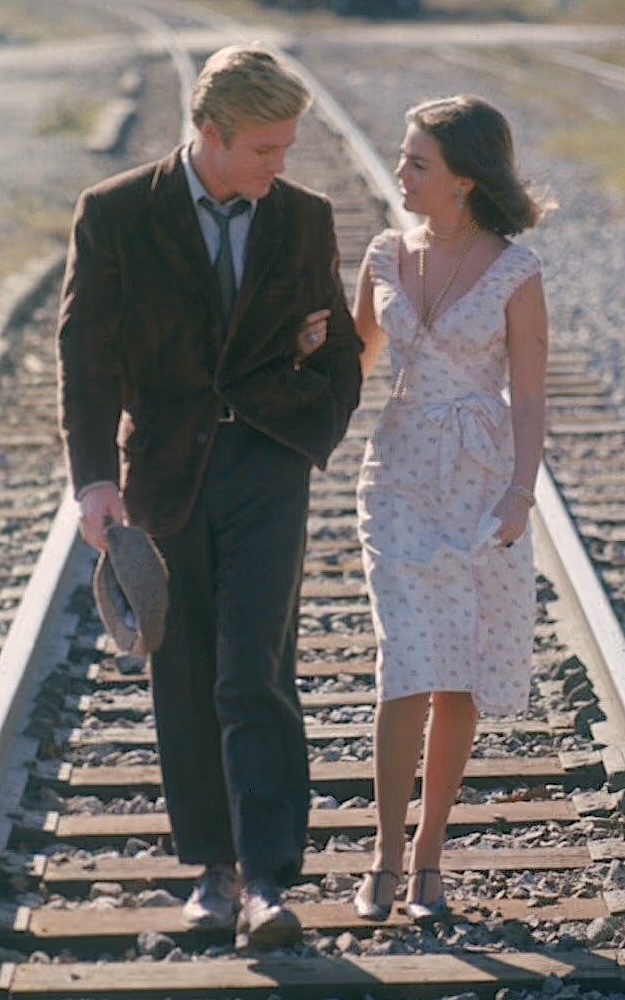
Robert Redford and Natalie Wood in This Property Is Condemned (1966)
Vitals
Robert Redford as Owen Legate, railroad representative
Mississippi, Summer 1931
Film: This Property Is Condemned
Release Date: August 3, 1966
Director: Sydney Pollack
Costume Designer: Edith Head
WARNING! Spoilers ahead!
Background
Robert Redford was on the verge of stardom when he was cast as the romantic lead opposite Natalie Wood in This Property is Condemned, released sixty years ago this week on August 3, 1966 and marking the late actor’s first of seven collaborations with director Sydney Pollack.
Set in the fictional Mississippi town of Dodson (but actually filmed in the Gulf Coast city of Bay St. Louis) during the Great Depression, Redford stars as Owen Legate—a representative of the railroad that provides much of Dodson’s economic base. He literally drops into Dodson by the night train, dusting off his trousers and striding up to a raucous boarding house where the owner’s daughter, Willie Starr (Mary Badham), introduces him to rent a room from her mother, Hazel (Kate Reid), during Hazel’s 43rd birthday party. She comments “a buck is a buck” when he pays for a week’s worth in advance, prompting him to quip back “if you’re lucky” to her delight.
His room and board secured, Owen lingers around the periphery of the party, eating fried chicken and eventually meeting Willie’s older sister Alva (Natalie Wood). The popular Miss Alva sets her flirtatious sights on Owen, until he insults her by implying that “if you come with the room, if you’re included with the two meals, then let’s get on with it.”
Despite their rocky start, Alva remains Owen’s only ally over the long, hot weekend as he completes his unpopular errand: shuttering the struggling Dodson line of the railroad, resulting in several employees losing their jobs and the town losing a major source of cash flow. By Sunday morning, Owen’s job is done with a black eye and bruises (and Alva’s love bites) to show for it. Alva has resolved to join him on his train back to New Orleans, but he overhears Hazel misrepresenting Alva’s excitement to join her in Memphis to marry another man and confronts her in the the shower, all but throwing the train ticket in her crying face.
Francis Ford Coppola, Fred Coe, and Edith Sommer co-wrote the screenplay, adapted and expanded from Tennessee Williams’ one-act play of the same name, though the script was unfinished by the time filming started—one of many issues plaguing the troubled production. Intended to be Natalie Wood’s comeback as a serious actress, This Property Is Condemned failed to connect with audiences or critics and—despite her Golden Globe nomination for Best Actress—Wood retreated from the screen for three years until starring in the zeitgeist-defining Bob & Carol & Ted & Alice.
What’d He Wear?
Despite being the Depression-era equivalent of a corporate lackey, Owen Legate’s laidback manner keeps him from looking overly buttoned-up even in his three-piece suits. Given how much he resents the job, Owen appears far more comfortable in his worn-in corduroy sport jacket and slacks. These hard-wearing traveling clothes show the rigors of riding the rails and help Owen fit in like Dodson’s latest arriving drifter rather than a railroad representative.
Foreshadowing the flat caps that Redford would later wear in period films like The Sting (1973), The Great Gatsby (1974), and The Natural (1984), Owen tops his look with a brown and tan houndstooth tweed newsboy cap, crafted with the characteristic eight-paneled soft crown and cloth-covered top button. This humbler headgear reinforces his image as an elevated vagrant rather than the line-cutting company man who would wear a more businesslike fedora or homburg.

Owen’s corduroy sport jacket with odd trousers and a tie was certainly a viable look for American men by the 1930s, though Edith Head’s costume design also gives the up-and-coming Redford a modern relevance with this look that would have felt contemporary to 1960s audiences—and, indeed, still stylishly resonates sixty years after the film’s release.
The wide-waled corduroy cloth is a warm russet-shaded brown, cut in a classic single-breasted configuration with three matching horn buttons on the front, echoed by two smaller vestigial buttons on each cuff. The notch lapels have appropriately sporty swelled edges, and the ventless back feels true to 1930s fashions. Owen’s jacket also includes the conventional details of a welted breast pocket and straight flapped hip pockets. The wide, padded shoulders and roped sleeveheads would become a hallmark of Redford’s on-screen tailoring, adding a dashing structure to the actor’s already athletic physique.

Owen arrives wearing a pale slate-gray lightweight cotton work-shirt with a spread collar, single-button cuffs, and two button-through chest pockets. Dark-blue plastic buttons contrast against the lighter fabric on the front placket, cuffs, and pockets. The informal nature of his work-shirt harmonizes more cleanly with the coarser fabric and sportier style of his corduroy jacket than when he wears it with his gray three-piece suit. He wears the shirt over plain white ribbed cotton sleeveless undershirts, a style preferably known as an “A-shirt” (for “athletic shirt”) rather than the more perjorative “wife-beater” nickname it would ultimately receive.
His almost ubiquitously loose tie is patterned with black bar stripes in an “uphill” direction, alternating with wider gray stripes crowded with small black diamonds like ants on a log.

Owen enjoys the Starr family’s hospitality with late-night fried chicken during Hazel’s birthday party.
Owen orphans the trousers from his gray three-piece suits with his corduroy sport jacket. In a continuity error, he arrives in Dodson wearing the trousers from his solid dark-gray suit but then relaxes up in his rented room in the trousers from the charcoal suit with muted, wide-spaced stripes that he later wears in New Orleans. (While it’s possible he may have changed trousers… he probably didn’t.)
Regardless, both flat-front trousers are similarly styled with belt loops, straight pockets along the side seams, jetted back pockets, and turn-ups (cuffs) with a short break. Owen holds these trousers up with a plain black matte leather belt that closes through a dulled silver-toned single-prong buckle.

Owen sports brown leather plain-toe derby shoes, with these uppers and the hard leather soles showing the wear of his travels. The significant contrast of his light-gray socks against his darker trousers is most visible when he’s leaping from the train into Dodson at the start of the movie.

Shoes on the bed? Come on, Owen.
Owen’s sole accessory is an era-correct 14-karat gold-filled tonneau-shaped wristwatch—an Art Deco-informed style commonly produced through the 1920s and ’30s by American watchmakers like Bulova, Elgin, and Hamilton, with the latter being my strongest candidate for Redford’s screen-worn watch. Secured to a brown leather strap, Owen’s watch has a beige dial detailed with gold-appliqué Arabic numeral hour indices around the outer ring.

Though Redford frequently wore watches on his right wrist, Owen Legate curiously wears his watch upside-down? Either way, we can clearly see it’s a few minutes past 12:30 a.m. when Alva visits him in his room for the first time.
How to Get the Look
Robert Redford and Natalie Wood in This Property Is Condemned (1966)
With only the newsboy cap truly dating it to the Depression era, Owen Legate’s well-traveled yet well-tailored corduroy sports coat cuts a smart look with his work-shirt, gray trousers, brown shoes, and vintage watch.
- Russet-brown corduroy single-breasted 3-button sport jacket with swelled-edge notch lapels, welted breast pocket, straight flapped hip pockets, spaced 2-button cuffs, and ventless back
- Pale-slate cotton work-shirt with spread collar, front placket (with dark-blue buttons), two button-through chest pockets, and single-button cuffs
- Gray-and-black “uphill” bar-striped tie
- Charcoal-gray self-striped flat-front suit trousers with belt loops, straight/on-seam side pockets, jetted back pockets, and turn-ups/cuffs
- Black matte leather belt with silver-toned single-prong buckle
- Brown leather plain-toe derby shoes
- Light-gray socks
- White ribbed cotton sleeveless undershirt
- Brown-and-tan houndstooth tweed newsboy cap
- 14-karat gold-filled Art Deco-style tonneau-shaped wristwatch with beige dial (with gold-appliqué Arabic numeral hour indices) on brown leather strap
Do Yourself a Favor and…
Check out the movie.
Discover more from BAMF Style
Subscribe to get the latest posts sent to your email.
You must be logged in to post a comment.