The Grapes of Wrath: Henry Fonda’s Hardy Depression-era Workwear as Tom Joad

Henry Fonda as Tom Joad in The Grapes of Wrath (1940)
Vitals
Henry Fonda as Tom Joad, ex-convict and migrant laborer
Oklahoma to California via Route 66, Summer 1939
Film: The Grapes of Wrath
Release Date: January 24, 1940
Director: John Ford
Costume Designer: Gwen Wakeling
WARNING! Spoilers ahead!
Background
All roads point to The Grapes of Wrath today, from honoring its star Henry Fonda’s real-life U.S. Navy service during World War II for Veterans Day to the 100th anniversary of when historic Route 66 was designated on November 11, 1926. Based on John Steinbeck’s classic novel of the same name, The Grapes of Wrath follows the itinerant Joad family journeying from Oklahoma to California in search of better opportunities during the Great Depression.
The story’s deep association with the Mother Road even led to its false (but still relevant) working title “Highway 66” to avoid any potential concerns with bringing Steinbeck’s politically radical novel to the screen. After paying $100,000 for its adaptation rights, 20th Century Fox producer Darryl F. Zanuck stacked both sides of the camera with talent, including cinematographer Gregg Toland and director John Ford, who brought the story to grittily realistic life by filming on location in Oklahoma, New Mexico, Arizona, and California.
Steinbeck’s initial apprehension about selling the rights to his novel are evident by his insistance that its subjects be treated reverently and responsibly. His faith in Zanuck was rewarded by Ford’s sensitive direction and Fonda’s compelling performance as the paroled Okie laborer Tom Joad which, as the author later stated, made him “believe my own words.” Following the lifelong friendship that resulted, Fonda recited poetry by Petrarch, Tennyson and Robert Louis Stevenson at Steinbeck’s funeral.
The Grapes of Wrath received seven Academy Award nominations, including Best Picture and Best Actor for Henry Fonda, and ultimately received two—recognizing Ford’s direction and Jane Darwell’s supporting performance as “Ma” Joad.
What’d He Wear?
The man’s clothes were new—all of them, cheap and new. His gray cap was so new that the visor was still stiff and the button still on, not shapeless and bulged as it would be when it had served for a while all the various purposes of a cap—carrying sack, towel, handkerchief. His suit was of cheap gray hardcloth and so new that there were creases in the trousers. His blue chambray shirt was stiff and smooth with filler. The coat was too big, the trousers too short, for he was a tall man. The coat shoulder peaks hung down on his arms, and even then the sleeves were too short and the front of the coat flapped loosely over his stomach. He wore a pair of new tan shoes of the kind called “army last”, hobnailed and with half-circles like horseshoes to protect the edges of the heels from wear.
—John Steinbeck, The Grapes of Wrath (Chapter 2)
Steinbeck describes Tom Joad’s prison-issued clothing in considerable detail, faithfully translated to the screen by costume designer Gwen Wakeling for Henry Fonda’s portrayal. Tom’s traditional newsboy cap has a short, stiff visor and a soft, eight-panel crown gathered beneath a cloth-covered button at the top. The cap appears to be made from a light-colored, two-tone checked tweed, with a visible diagonal twill weave.
Over the course of The Grapes of Wrath, the cap’s changing appearance becomes a subtle visual record of the Joads’ increasingly arduous journey, just as Steinbeck anticipated in his description. Initially clean and crisp, with its stiff visor and top button intact, the cap gradually becomes battered and misshapen. By the film’s conclusion, the button is missing, the visor has been bent and broken in, and the once-pristine cloth bears the dirt and wear of weeks on the road.
The cap itself survived long after filming, remaining in Fonda’s personal collection for more than four decades. Shortly before his death in 1982, Fonda asked his wife Shirlee to retrieve the cap from his closet so he could give it to his longtime friend, actress Jane Withers, who had known him since his 1935 film debut in The Farmer Takes a Wife. Withers recalled the touching exchange in a 2013 interview with Will Harris, explaining that Fonda wanted her to preserve the cap in her extensive collection of Hollywood memorabilia.

Tom’s chambray shirt is almost certainly a light shade of blue, as this was the traditional color for chambray workwear and was often stipulated as such in Steinbeck’s text. It is detailed with white contrasting topstitching along the point collar and seams like the front placket, which has dark-blue plastic recessed buttons that Fonda often—but not always—wears buttoned up to the neck. The two low-slnug patch pockets over the chest each close through a single matching button, and the sleeves are finished with single-button cuffs.

Tom’s prison-issued wool suit appears dark enough on screen to be plain black, though it may actually be navy blue or charcoal gray—the latter particularly consistent with the “cheap gray hardcloth” described in John Steinbeck’s novel.
Perhaps fittingly for a utilitarian garment issued upon his release from prison, Tom’s suit follows the most straightforward conventions of men’s tailoring, with little apparent concern for fashion or ornamentation. Interestingly, many of these details have endured as menswear standards nearly ninety years later; Tom’s single-breasted jacket has a two-button front, notch lapels, a welted breast pocket, straight flapped hip pockets, and three-button cuffs—all familiar features of the modern business suit. Only the ventless back would be somewhat less common today, though hardly out of place.
For all its unremarkable details, the suit’s significance lies less in what it reveals about contemporary fashion than in what it reveals about Tom himself: a man newly returned to society, dressed in clothing chosen for him by an institution rather than by personal preference. Tom wears both front buttons fastened, contrary to the customary practice of leaving the lowest button undone. This may be less a conscious sartorial choice than an indication of his unfamiliarity with—or indifference to—the conventions of tailored clothing, particularly appropriate for a man whose immediate concerns extend well beyond the finer points of dressing.

Tom finds a first familiar face in wandering ex-preacher Jim Casy (John Carradine).
The suit’s matching flat-front trousers rise to Fonda’s natural waist, where they’re held up by suspenders (braces). These cloth suspenders are stripes in varying widths in at least three different colors, secured by light tan leather double-hooks that fasten to buttons along the inside of the trouser waistband. These trousers have side pockets and turn-ups (cuffs) on the bottoms, which break high over his lace-up ankle boots that Nunnally Johnson’s screenplay describe as “prison shoes—new, stiff, and bulky.”
More specifically, these are mid-brown cowhide cap-toe boots, which lace up through five sets of derby-style eyelets. These close-fitting leather boots follow Steinbeck’s description of “tan” military-style service shoes built on the “army last” designed by Maj. Edward Lyman Munson prior to World War I to reduce troops’ march-related foot injuries and fatigue. Ironically, the literary Tom tells his father that these may be “purty for nice, but they ain’t no shoes to go walkin’ aroun’ in on a hot day.” Apologies, Major Munson.

Tom continues wearing both his cap and shirt even after swapping his suit for overalls to join his sharecropper family on the Mother Road. As also frequently mentioned throughout Steinbeck’s text, bib overalls were historically favored by rural and lower-income Americans, especially as the Great Depression reduced the practicality of maintaining a wider-ranging wardrobe. Overalls offered an all-in-one garment that could be ostensibly worn on its own—though men like Tom still properly layer them over their work-shirts—and needed little comparative upkeep. Especially relevant to Okies like the Joads, overalls were dutifully efficient workwear thanks to their sturdy denim construction, a typical multitude of pockets, and the wide range of motion allowed by their loose, open-shouldered design.
Fonda wears dark indigo-blue denim overalls made by Stronghold, a brand from the Los Angeles-based Brownstein-Louis Company. By their own account, Stronghold was nearly ubiquitous on screen during cinema’s early years, thanks to their Hollywood-adjacent location and aided by a 1916 endorsement by Charlie Chaplin (who would wear Stronghold on screen twenty years later in Modern Times.)

Daniel J. Brownstein, Philip A. Newmark, and Henry W. Louis founded their wholesale clothing business in Los Angeles in 1895, expanding into manufacturing within two years when they began producing overalls and workwear under their newly launched Stronghold label. In 1908, the brand introduced “Stronghold Steve”—a mustached mascot who made his way onto the clothing’s buttons and labels by the 1930s and remained there until Stronghold ceased operations when Brownstein-Louis was liquidated in January 1955. You can read more about Stronghold (and Stronghold Steve) in a 2024 article written by metal detectorist Joanna Jana Laznicka for Focus Speed.
After a pair of vintage Stronghold jeans were discovered in an abandoned Mojave Desert silver mine nearly a half-century later, the Stronghold brand was revived in 2004 by Michael Cassel, using the company’s archives to painstakingly reproduce its original products in the same L.A. factory where they were originally manufactured.

Stronghold Steve makes sporadic cameos throughout The Grapes of Wrath, embroidered along the right side of Henry Fonda’s waist.
Tom’s medium-weight Stronghold overalls feature all the hallmarks of overall design: latched shoulder straps, a multi-functional bib pocket among many other pockets, and the usual array of tack buttons familiar to denim. Both shoulder straps have skeletal adjusters with an upward-facing latch that hooks onto triangular metal pieces connected to the upper sections of the chest bib. Stronghold touted its “Stop-Loss” bib pockets as a feature, here consisting of a right-side pocket covered by a single-button flap, a slightly narrower left-side pocket with an open top and a slanted inset watch pocket over it, and a narrow pen slot sandwiched between them—positioned just left of the center seam. A watch worn in this left pocket could presumably have its chain pulled up through the contrast-threaded buttonhole below the left shoulder.
All of the seams are detailed with a white contrast topstitch, including the waistband. The waist has a tack button on each side to close, joined by a second button about two inches below it. These lower buttons fall just within the openings of the front hand pockets, which slant straight rearward from the waistband to the side seams; an additional watch (or coin) pocket is set into the right hand pocket. The two large patch pockets over the seat each have a straight topstitch across the bottom. A hammer loop connects the left rear pocket to the left side seam.

Tom swaps the prison-issued leather boots for lightweight and low-profile sneakers in the CVO (circular vamp oxford) style pioneered just a few years earlier in 1935, when Paul A. Sperry took inspiration from his dog’s micro-grooved paws to invent the Sperry Top-Sider’s non-slip soles. Working his way west during the Dust Bowl, Tom may not be concerned about maintaining traction on wet decks, but the CVO’s canvas uppers would be comfortably light-wearing and—combined with the hardy rubber outsoles—easily maintained. His socks are slightly darker than the shoes’ mid-colored canvas uppers.

The Car
The Joad family car that chugs them 1,600 miles west from Oklahoma to California is a ragtag 1926 Hudson Super Six seven-passenger sedan that was converted to a truck like a Depression-era covered wagon, just as the novel described:
Tom sauntered forward, sidled embarrassedly toward the truck. It was a Hudson Super-Six sedan, and the top had been ripped in two with a cold chisel.

“She’ll ride like a bull calf, but she ain’t shootin’ no oil.”
Steinbeck intentionally chose the Hudson to signal how the Joads’ status had fallen, as the marque once represented affordable, high-performance, and durably engineered vehicles that bridged the gap between lower-cost mass-market cars like Ford, Chevrolet, and Dodge and more expensive luxury makers like Packard. The “Super Six” nameplate was used at least four nonconsecutive times over the history of the Detroit-based Hudson Motor Car Company. The first generation extended from 1916 through 1928, powered by a 288.5 cubic-inch (4.7L) inline six-cylinder engine that generated a then-impressive 76 horsepower, mated to a floor-mounted three-speed manual transmission.
The stress on the screen-used Hudson’s body quickly compromised its roof, and it languished in storage for the better part of a century until California car collector Gary Wales spotted it while buying a 1927 fire truck. Finding it cost-prohibitive and impractical to restore it to its appearance in the film, Wales instead built it out into a long-tailed racer. Touted as The Grapes of Wrath‘s star car despite its converted appearance, the 1926 Hudson speedster sold at auction for $55,000 and has become a permanent display at the Route 66 Car Museum in Springfield, Missouri. You can read more about Wales’ discovery in John Gunnell’s 2009 article for Old Cars Weekly.
How to Get the Look
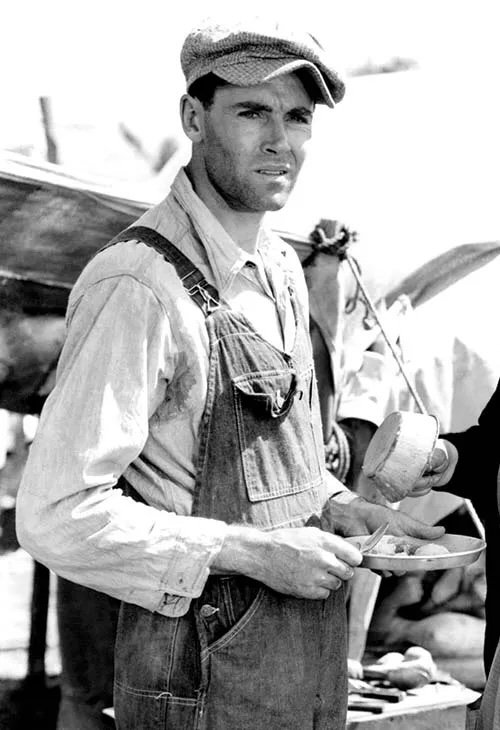
Henry Fonda as Tom Joad in The Grapes of Wrath (1940)
Favoring practicality over pretension, Tom Joad quickly re-adopts his family’s characteristic Okie style in sturdy denim overalls and low shoes, adapting the same chambray work-shirt and tweed newsboy cap he had sported with his dark prison-issued suit. (The blue-forward suggestions for his shirt and overalls are informed less by historical record and more by John Steinbeck’s narrative choices as well as the traditional colors for chambray shirts and denim workwear.)
- Light-blue chambray work-shirt with white contrast topstitching, point collar, front placket (with dark-blue plastic buttons), two button-through patch chest pockets, and single-button cuffs
- Dark indigo-blue mid-weight denim bib overalls
- Stronghold
- Mid-colored canvas CVO-style sneakers with white rubber outsoles
- Dark socks
- Light-gray checked twill tweed newsboy cap
Do Yourself a Favor and…
Check out the movie, and read John Steinbeck’s source novel.
The Quote
I’ll be all around in the dark, I’ll be everywhere. Wherever you can look—wherever there’s a fight so hungry people can eat, I’ll be there. Wherever there’s a cop beatin’ up a guy, I’ll be there. I’ll be in the way guys yell when they’re mad. I’ll be in the way kids laugh when they’re hungry and they know supper’s ready, and when the people are eatin’ the stuff they raise and livin’ in the houses they build… I’ll be there, too.
Discover more from BAMF Style
Subscribe to get the latest posts sent to your email.
You must be logged in to post a comment.