Tagged: Classic Hollywood
Written on the Wind: Rock Hudson’s Beige Tweed Jacket for a Fall Picnic
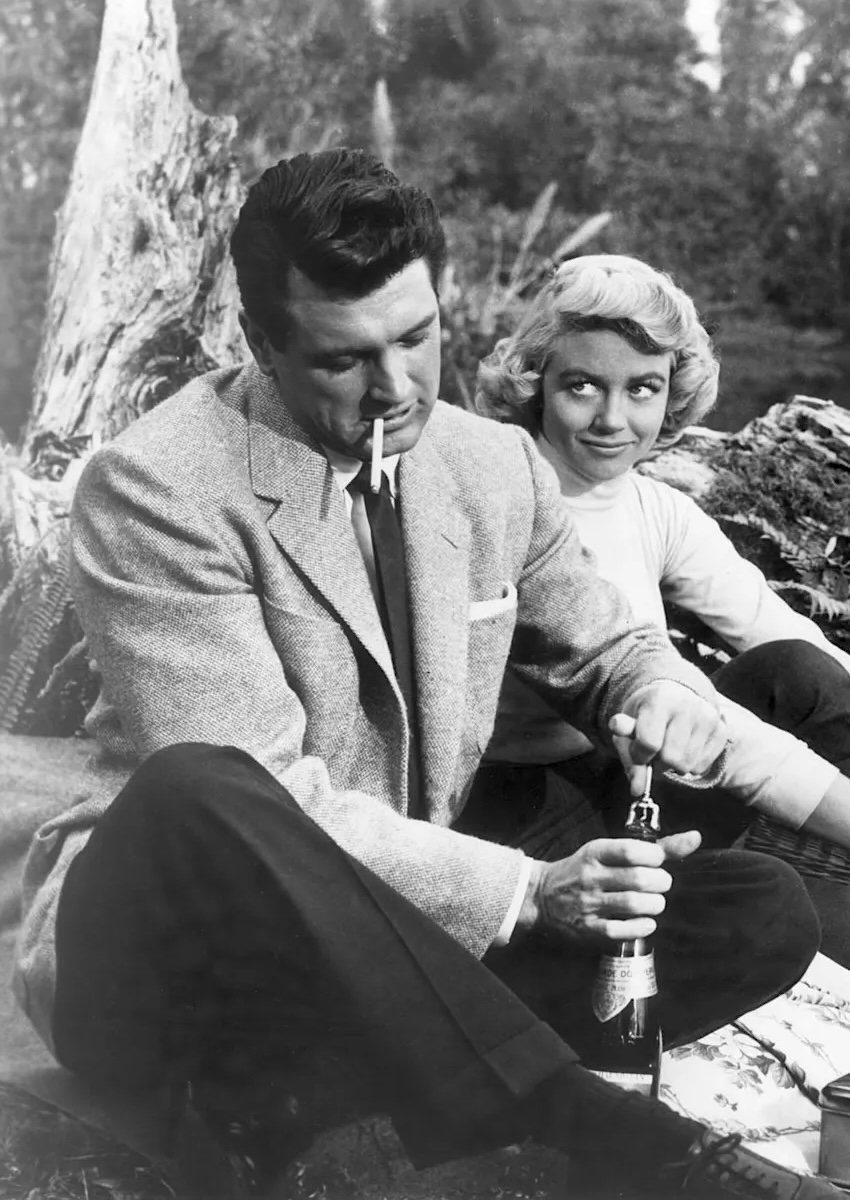
Rock Hudson and Dorothy Malone in Written on the Wind (1956)
Vitals
Rock Hudson as Mitch Wayne, oil company geologist
Texas, Fall 1956
Film: Written on the Wind
Release Date: October 5, 1956
Director: Douglas Sirk
Costume Designer: Bill Thomas (credited for gowns)
WARNING! Spoilers ahead!
Background
German-born director Douglas Sirk’s third in a trio of lushly photographed melodramas starring Rock Hudson, Written on the Wind, premiered in London seventy years ago this week on October 5, 1956.
This Southern Gothic melodrama follows a Texas oil dynasty, adapted from Robert Wilder’s 1946 novel of the same name—a roman à clef inspired by the scandal surrounding torch singer Libby Holman and the mysterious 1932 death of her tobacco-heir husband, Zachary Smith Reynolds, at his family’s estate. Threats from the Reynolds family kept a film adaptation out of production for a decade, until screenwriter George Zuckerman transplanted the drama from a North Carolina tobacco dynasty to a Texas oil family, evidently distancing it enough from its real-life inspiration for production to proceed.
Zuckerman and Sirk’s narrative centers on the family of oil baron Jasper Hadley (Robert Keith), including his irresponsible playboy son Kyle (Robert Stack) and self-destructive daughter Marylee (Dorothy Malone, who won the Academy Award for her performance). Both grew up alongside Mitch Wayne (Rock Hudson), an honest, hardworking geologist who remains employed by the family and earns Jasper’s admiration for his work ethic. While Marylee lusts after Mitch, Mitch longs for Lucy (Lauren Bacall), a company secretary whom Kyle impulsively marries after meeting her on a business trip.
Despite all the romantic turmoil, Mitch does find time for a covert lunch among the fall foliage with Marylee, who jokes, “There’s nothing like a picnic! I’ve brought everything but rain and ants.” Continue reading
Aldo Ray’s M-1943 Field Jacket in Nightfall

Aldo Ray in Nighfall (1956)
Vitals
Aldo Ray as Art Rayburn, aka Jim Vanning, commercial artist and war veteran
Jackson Hole, Wyoming, Winter 1956
Film: Nightfall
Release Date: December 5, 1956
Director: Jacques Tourneur
Costume Designer: Jean Louis (credited for gowns)
WARNING! Spoilers ahead!
Background
Today would have been the 100th birthday of Aldo Ray, born September 25, 1926. A tough and resilient U.S. Navy veteran of World War II, the raspy-voiced Ray often incorporated these traits into his characters—perhaps most skillfully in Jacques Tourneur’s 1956 thriller Nightfall, released 70 years ago this December. The film has been celebrated as a favorite by crime fiction experts James Ellroy and Quentin Tarantino, the latter citing it as inspiration for Bruce Willis’ character in Pulp Fiction.
Based on a 1948 novel by David Goodis, Nightfall both follows and subverts many film noir tropes; though often photographed against bright, snowy countryside rather than exclusively urban shadows, Ray’s protagonist Art Rayburn is cut from the noir mold, forced to reinvent himself (as commercial artist Jim Vanning) after running afoul of criminals. Continue reading
Summertime: Rossano Brazzi’s Gray Suit

Rossano Brazzi as Renato de Rossi in Summertime (1955)
Vitals
Rossano Brazzi as Renato de Rossi, antique store owner
Venice, Summer 1954
Film: Summertime
Release Date: June 21, 1955
Director: David Lean
Costume Designer: Rosi Gori (uncredited)
WARNING! Spoilers ahead!
Background
Prolific Italian actor and director Rossano Brazzi was born 110 years ago tomorrow on September 18, 1916. An on-screen fixture of Italian cinema since the late 1930s, Brazzi rose to global fame after three consecutive roles as a suave Italian romancing American women visiting his country in The Barefoot Contessa (1954), Three Coins in the Fountain (1954), and Summertime (1955).
The latter paired Brazzi opposite Katharine Hepburn, who portrayed American secretary Jane Hudson visiting Venice at the end of her lifelong dream vacation to Europe. Over evening drinks in Piazza San Marco, she spies the dashing antiques dealer Renato de Rossi (Brazzi), who romantically pursues her with goblets and gardenias until the two embark on a brief but passionate aestival affair.
With summertime officially ending after this weekend, let’s explore how Brazzi dressed for, well, the ending of Summertime. Continue reading
Sterling Hayden’s Four-Pocket Sport Jackets in The Killing

Sterling Hayden in The Killing (1956)
Vitals
Sterling Hayden as Johnny Clay, professional armed robber and ex-convict
Los Angeles, Fall 1955
Film: The Killing
Release Date: May 19, 1956
Director: Stanley Kubrick
Wardrobe Credit: Jack Masters
WARNING! Spoilers ahead!
Background
Stanley Kubrick’s third directorial feature The Killing arrived in select theaters 70 years ago today on May 19, 1956. The limited release hurt its box office, though it was well-received by critics and even received a BAFTA nomination for Best Film. In addition to establishing Kubrick as a more mainstream talent, it remains a quintessential example of heist film noir, influencing filmmakers like Quentin Tarantino who described his own debut Reservoir Dogs as his own take on The Killing.
Kubrick collaborated with pulp novelist Jim Thompson on the hard-boiled screenplay, adapted from Lionel White’s novel Clean Break. The action centers around recently paroled Johnny Clay (Sterling Hayden), who is already planning his next heist: the two-million-dollar robbery of a thoroughbred racetrack. Johnny’s scrappy gang includes two track employees, a crooked cop, a self-destructive former associate, and a sharpshooter whose job will be to shoot the favored horse and create chaos that distracts from the robbery. Continue reading
Glenn Ford’s Tanker Jacket in Human Desire

Glenn Ford in Human Desire (1954)
Vitals
Glenn Ford as Jeff Warren, railroad engineer and Army veteran
El Reno, Oklahoma, Fall 1953
Film: Human Desire
Release Date: August 6, 1954
Director: Fritz Lang
Costume Designer: Jean Louis (gowns)
WARNING! Spoilers ahead!
Background
Glenn Ford was born 110 years ago on May 1, 1916. The Quebec-born actor specialized as everymen with a tough side, making him the ideal star in classic film noir like Gilda (1946) and The Big Heat (1953) as well as westerns like 3:10 to Yuma (1957) and the school-set social drama Blackboard Jungle (1955) that featured both “Rock Around the Clock” and a young Sidney Poitier. In addition to being one of the most popular and bankable stars in the United States for a decade, Ford also enlisted in the Marine Corps during World War II and returned to service with a Navy Reserve commission in 1958.
While I always liked Ford’s screen presence which reminds me of my grandfather, the Golden Globe-winning actor’s complicated personal life as a serial womanizer included four marriages that all ended in divorce and—according to his son Peter’s biography—affairs with at least 140 Hollywood actresses, including an on-and-off romance with Gilda co-star Rita Hayworth that lasted four decades. He also recorded all of his home’s phone calls (resulting from a paranoid belief that his first wife Eleanor Powell would discover his frequent infidelity), supported candidates on both sides of the political arena, and was busted for illegally raising 140 white leghorn chickens.
Hardly the best-known from either its stars or director, the solid 1954 film noir Human Desire reteamed Ford with director Fritz Lang and co-star Gloria Grahame one year after their previous collaboration in The Big Heat. Continue reading
Cary Grant’s Tuxedo in Notorious

Cary Grant and Ingrid Bergman in Notorious (1946)
Vitals
Cary Grant as T.R. Devlin, American government agent
Rio de Janeiro, Spring 1946
Film: Notorious
Release Date: September 6, 1946
Director: Alfred Hitchcock
Costume Design: Edith Head (gowns only)
WARNING! Spoilers ahead!
Background
Released 80 years ago this September, Notorious marked the second of four screen collaborations between Alfred Hitchcock and Cary Grant—who was born 122 years ago today on January 18, 1904. Written by Ben Hecht, Notorious is vintage Hitch at full boil, blending noir-tinged espionage with a romance daring enough to taunt the censors, all delivered with the Master of Suspense’s unmistakable mix of wit, menace, and nerve-shredding tension.
Notorious reaches a boiling point during a party hosted by the urbane yet dangerous Alex Sebastian (Claude Rains) and his new wife Alicia (Ingrid Bergman)—in fact a honeyspot spy recruited by American agent T.R. Devlin (Grant) to seduce her way into Sebastian’s circle of German emigrés hiding in post-World War II Brazil. Continue reading
Killer’s Kiss: Jamie Smith’s Nailhead Jacket and Knitwear

Jamie Smith as Davey Gordon in Killer’s Kiss (1955)
Vitals
Jamie Smith as Davey Gordon, washed-up welterweight boxer
New York City, Fall 1954
Film: Killer’s Kiss
Release Date: October 1, 1955
Director: Stanley Kubrick
WARNING! Spoilers ahead!
Background
Stanley Kubrick’s independently produced sophomore film Killer’s Kiss was released 70 years ago this fall—premiering in New York City on September 21, 1955, followed by a wider release on October 1st.
Pittsburgh-born Jamie Smith stars as burned-out ex-boxer Davey Gordon, whose growing romantic involvement with his neighbor—the alluring blonde taxi dancer Gloria Price (Chris Chase, credited as Irene Kane)—sets him dangerously at odds with her shady employer, Vincent Rapallo (Frank Silvera). Inventively shot and economically packaged (if somewhat underwritten) on a $75,000 budget, this tight thriller clocks in just under 70 minutes, benefiting from on-location shooting across New York from Penn Station and Times Square to the Brooklyn waterfront and “Hell’s Hundred Acres” in SoHo.
As Davey and Gloria plot their escape from the neon-lit nights of 1950s New York, the storyline and atmosphere read like a blend of Detour (1945) and Sweet Smell of Success (1957), making this little-known landmark noir an ideal starting point for Noirvember! Continue reading
Dead End: Humphrey Bogart’s Dandy Gangster Suit

Humphrey Bogart in Dead End (1937)
Vitals
Humphrey Bogart as Hugh “Baby Face” Martin, gangster
New York City, Summer 1937
Film: Dead End
Release Date: August 27, 1937
Director: William Wyler
Costume Designer: Omar Kiam
WARNING! Spoilers ahead!
Background
After his breakthrough screen role as the menacing Duke Mantee in The Petrified Forest (1936), Humphrey Bogart followed it up the next year as another swaggering gangster in Dead End (1937), adapted from Sidney Kingsley’s hit play—which had premiered 90 years ago today, on October 2, 1935.
The play had run for 687 performances on Broadway, so bringing it to the screen became a passion project for producer Samuel Goldwyn and director William Wyler. Goldwyn spent a then-staggering $165,000 for the rights, bracing himself for battles with the Hays Office to keep the play’s thematic grit intact. He even hired the “Dead End Kids”, the scrappy young actors from the stage version, though their chaotic behavior on set soon had Goldwyn regretting it and he later sold their contract to Warner Brothers, where—under names like the East Side Kids and Bowery Boys—they made more than 60 films across the next two decades. Despite his dedication to replicating the realism that made the play a success, the famously fastidious Goldwyn also clashed with Wyler, who had the set decorated with actual garbage to recreate an actual slum atmosphere.
Goldwyn first hoped to cast James Cagney or George Raft as the central gangster “Baby Face” Martin, but the role ultimately went to Humphrey Bogart—already 37 years old at the time, though it still feels like watching a “young” Bogie. Continue reading
Richard Arlen’s White Suit in Island of Lost Souls

Richard Arlen in Island of Lost Souls (1932)
Vitals
Richard Arlen as Edward Parker, shipwrecked sailor
South Pacific, Summer 1932
Film: Island of Lost Souls
Release Date: December 23, 1932
Director: Erle C. Kenton
WARNING! Spoilers ahead!
Background
The old maxim that a gentleman shouldn’t wear white after Labor Day has long grown outdated, but those looking for one last hurrah in summer whites can find inspiration in Erle C. Kenton’s pre-Code sci-fi/horror adventure Island of Lost Souls.
Set on the titular island (but actually filmed on Catalina), this adaptation of H.G. Wells’ 1896 novel The Island of Doctor Moreau stars Charles Laughton as the eponymous Moreau and Richard Arlen as the shipwrecked Edward Parker, who finds himself at Moreau’s mercy on the island.
The sole survivor from the sunken S.S. Lady Vain, Parker is plucked from the sea aboard the Covina, where he’s treated by the enigmatic ex-doctor Montgomery (Arthur Hohl)—who seems more in command of the ship and its strange animal cargo than the drunken Captain Davies (Stanley Fields), who grumblingly describes their mysterious destination as “Dr. Moreau’s island, and it stinks all over the whole South Seas.”
Parker soon understands this criticism firsthand after discovering that Moreau has been dissecting men and beasts and combining their DNA into grotesque hybrid creatures, snarling in response: “Now I can understand why you and your island stink from one end of the South Seas to the other!” To keep Parker distracted and further his own experimentation, Moreau introduces him to the alluring Lota (Kathleen Burke) without explaining that she is part-panther.
Born 126 years ago today on September 1, 1899 (and shockingly only two months younger than Laughton), Arlen was cast after Randolph Scott was initially considered to play Parker. One of the most prominent actors of the 1920s and ’30s, Arlen brought his experience as a Canadian Royal Flying Corps pilot to his starring role in the first-ever winner of the Academy Award for Best Picture, Wings (1927). Though his stature waned in later decades, Arlen was one of the few major silent-era stars to successfully transition onto television, with guest appearances on dozens of shows until his death in March 1976. Continue reading
Robert Mitchum in The Night of the Hunter

Robert Mitchum in The Night of the Hunter (1955)
Vitals
Robert Mitchum as Harry Powell, self-described preacher and serial-killing swindler
West Virginia, Summer 1930
Film: The Night of the Hunter
Release Date: July 26, 1955
Director: Charles Laughton
Wardrobe Credit: Jerry Bos
WARNING! Spoilers ahead!
Background
Born 108 years ago today on August 6, 1917, Robert Mitchum delivered arguably the greatest performance of his prolific career in Charles Laughton’s 1955 gothic horror masterpiece The Night of the Hunter, which premiered 70 years ago last month in Des Moines, Iowa. Laughton’s first and only directorial effort was negatively received upon its release, though decades of reassessment have elevated its reputation and it’s now included on lists among the best movies ever made. Continue reading
You must be logged in to post a comment.