Richard Egan’s Cream Camp Shirt in The Revolt of Mamie Stover

Richard Egan in The Revolt of Mamie Stover (1956)
Vitals
Richard Egan as Jim Blair, writer
At sea from San Francisco to Hawaii, Summer to December 1941
Film: The Revolt of Mamie Stover
Release Date: May 11, 1956
Director: Raoul Walsh
Costume Designer: Travilla
WARNING! Spoilers ahead!
Background
Though it made waves for its controversial themes and Jane Russell’s eponymous performance at the time it was released 70 years ago in May 1956, The Revolt of Mamie Stover remains a barely remembered movie today aside from generally positive reappraisals from critics and reviewers. And while Russell remains an icon of Hollywood’s brassy bombshell era, her co-star Richard Egan—once a nearly ubiquitous leading man in the late 1950s—is also little-discussed today.
Egan was born 105 years ago this week on July 29, 1921. Like his character Jim Blair, the San Francisco-born Egan joined the U.S. Army during World War II and served in the Pacific. After Captain Egan’s discharge, he attended Stanford on the G.I. Bill and received his master’s degree in theater history. Eventually recruited into the Warner Bros. system, he rose from bit parts to leading roles across the mid-1950s, with his first top billing in the 1955 historical adventure Seven Cities of Gold.
In addition to his performance in The Revolt of Mamie Stover and a handful of Westerns and films noir, Egan starred in Elvis’ 1956 acting debut Love Me Tender, the 1959 drama A Summer Place (best remembered for Max Steiner’s dulcet instrumental theme song), and the 1962 historical epic The 300 Spartans before transitioning to television. After his NBC Western Empire was canceled following a single season, his roles became smaller and opportunities sparser, explaining in an interview that “they want anti-heroes now, and it’s just not for me.” Egan died of prostate cancer in 1987, just nine days before his 66th birthday.
Adapted by Sydney Boehm from William Bradford Huie’s novel of the same name, The Revolt of Mamie Stover stars Russell as the, uh, titular fille de joie Mamie, pressured by police to leave San Francisco in the summer of 1941. On a freighter bound for Hawaii, she meets the only other passenger, Jim Blair, an author who finds inspiration in Mamie’s life story. Their fledgling shipboard romance grinds to a halt upon docking in Honolulu, where Jim’s girlfriend Annalee (Joan Leslie) greets him.
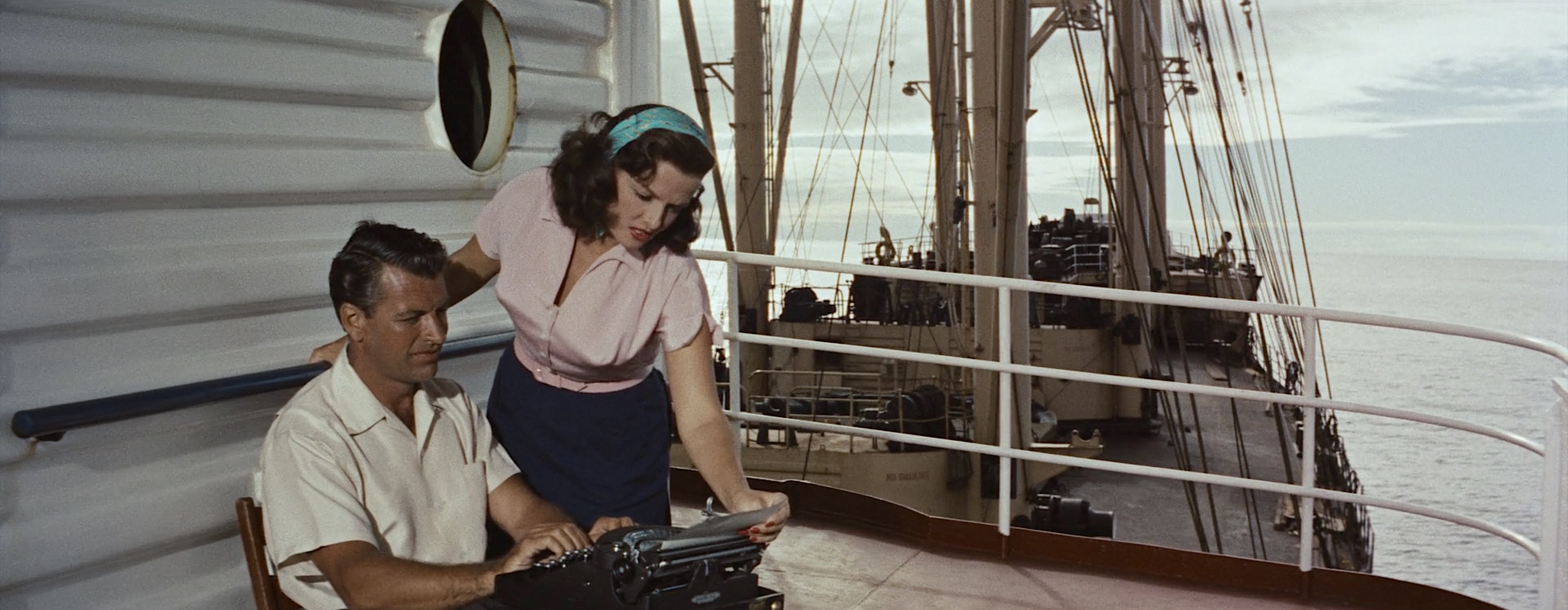
At Mamie’s request, Jim took his noisy typing topside, where she finds him at his typewriter already penning prose about their conversation the previous day.
Following his assurance that “the island’s a good place for wishing—for building a new life,” Mamie dyes her hair red and uses a hundred-dollar loan from Jim to build her new life as “Flaming Mamie”, a popular “hostess” at a local dance hall, despite Jim’s disapproval—and Annalee’s disapproval of their continued friendship. The attack on Pearl Harbor realigns Jim’s priorities as he leaves Annabel, desperately searching for Mamie and asking her to marry him once he returns from the war… having also decided to enlist.
What’d He Wear?
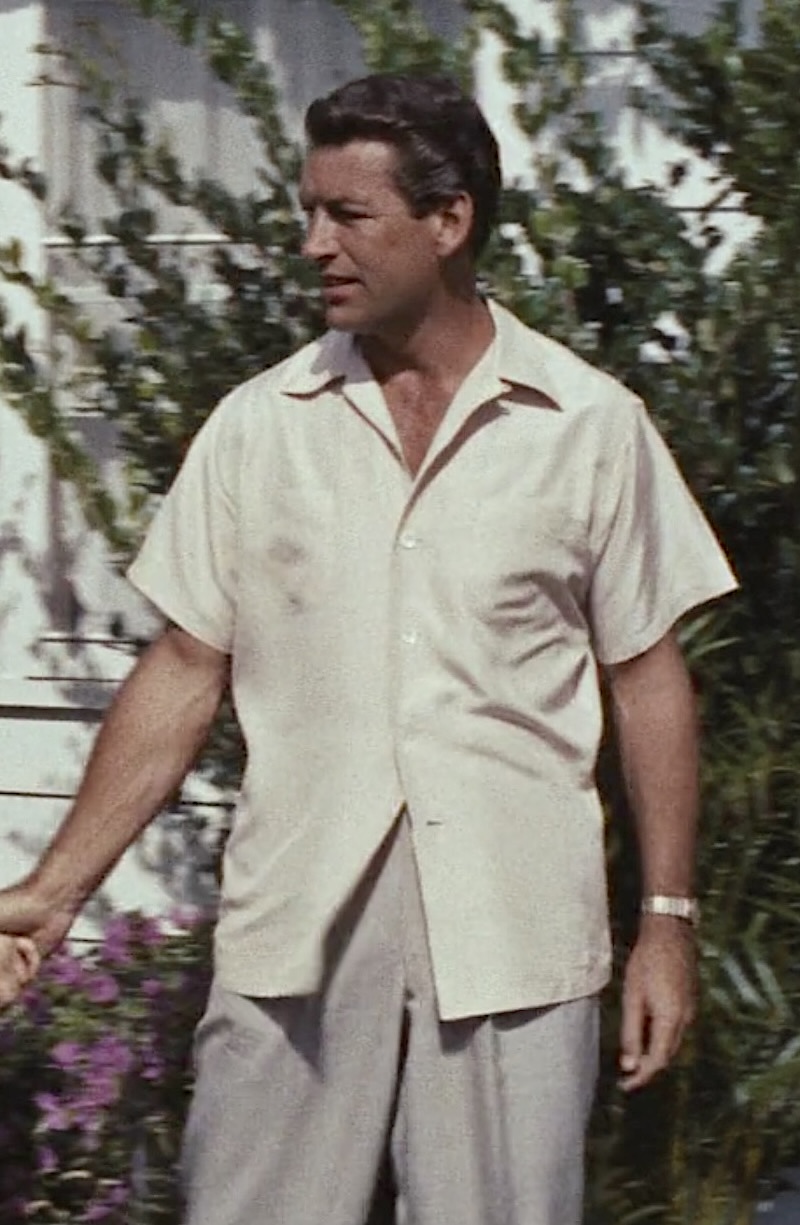
Jim rotates through a handsomely simple and relatively timeless mid-century casual wardrobe, evidently favoring a cream-colored camp shirt when writing—whether that’s at sea or on land. The warm cream-colored cloth has a subtle sheen suggesting silk in its construction, falling and folding more like genuine silk than rayon, which grew popular during this time as a less expensive synthetic substitute. The short-sleeved shirt has a long-pointed loop collar above a plain front with five faux-pearl flat plastic buttons through horizontal buttonholes, rear pleats that give a wider range of arm movement, and a straight hem that allows it to be worn fashionably untucked. There are also two chest pockets.

Don’t let anyone tell you camp shirts are out of style. If they once had Jane Russell’s stamp of approval, they’ll forever be good enough for me.
On the freighter, Jim pairs the shirt with light dove-gray gabardine reverse-pleated trousers styled with belt loops, side pockets, and turn-ups (cuffs). He holds them up with a dark leather belt—likely black to match his well-polished black leather loafers, worn with charcoal socks.

The shirt reappears in Hawaii several months later, when Annalee interrupts his typing as he awaits a visit from Mamie. These trousers are similarly styled with pleats, side pockets, and cuffed bottoms, though the cloth is a warmer pale ivory than his shipboard gray.

Both women in Jim’s wife wear green, with Annabel’s modest sage cardigan and Mamie’s sultry mint dress telling you everything you need to know about each of them.
Jim wears exclusively yellow-gold accessories. A square-faced ring shines from his left pinky while he wears a plain gold dress watch over his left wrist on a gold expanding band, detailed with a round beige dial with gold-finished non-numeric hour indices.
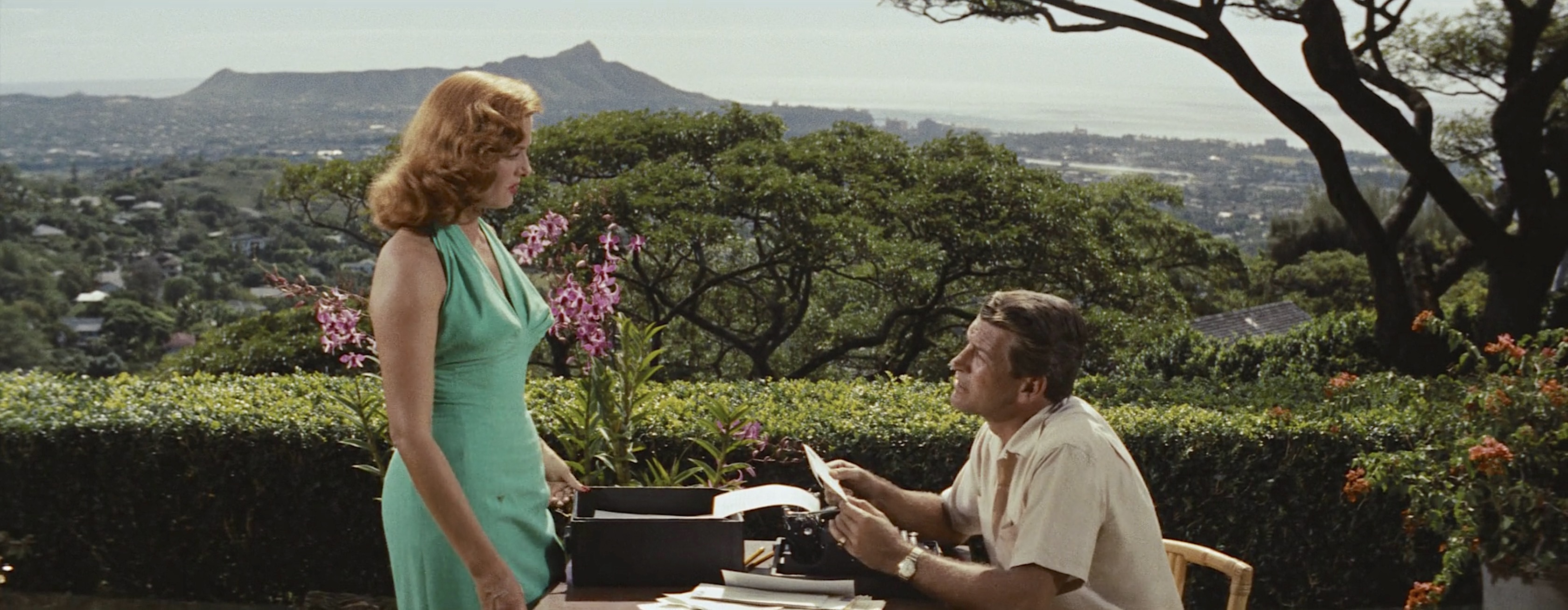
I imagine this is how Ian Fleming saw himself, dressed in cool-wearing open-neck camp shirts and working on his typewriter in an tropical exotic paradise while surrounded by beautiful women.
The Car
Jim’s car in Hawaii is a then-new 1941 Mercury Eight Club Convertible, the full-size V8 model that was Mercury’s exclusive offering for the first dozen years of the marque’s existence. Mercury debuted for the 1939 model year with the Eight available in five distinct two- and four-door body styles. It was slightly redesigned for the 1941 model year, maintaining Ford’s improved 239 cubic-inch (3.9 L) “flathead” V8 that produced 95 horsepower, mated exclusively to a three-speed manual transmission.
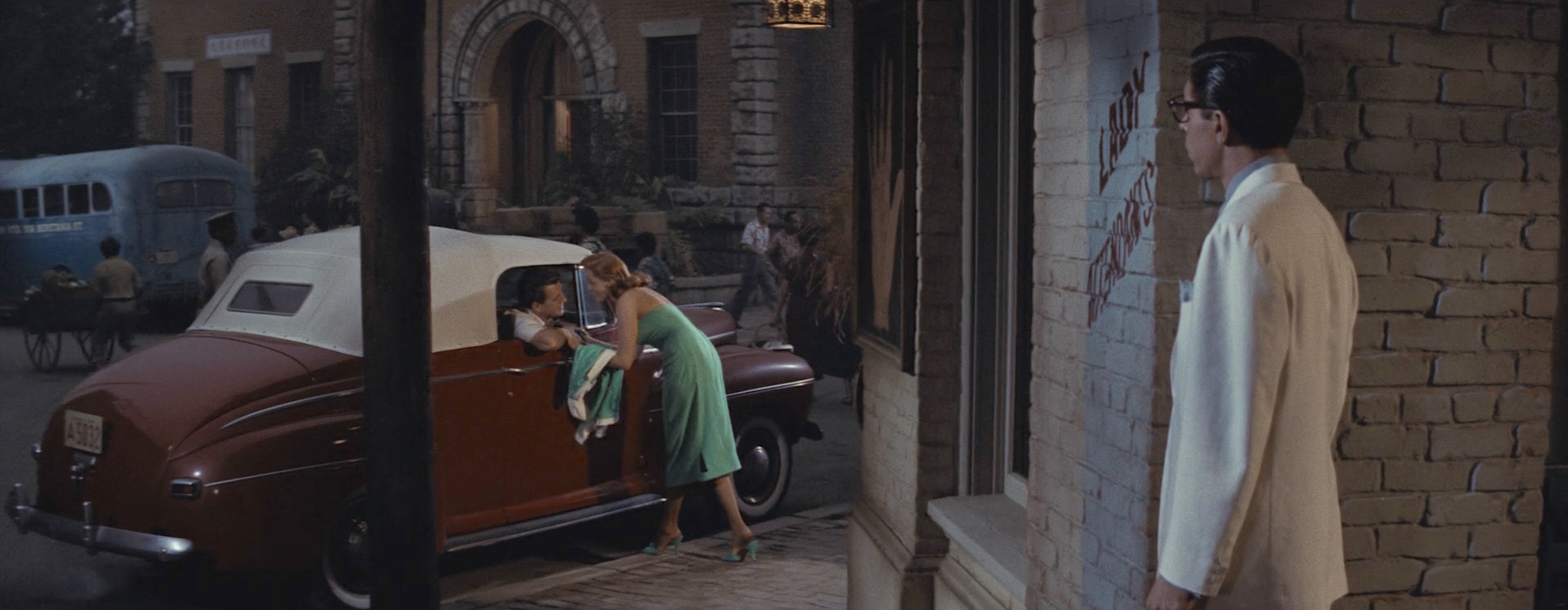
Jim’s Mercury appears to have “Mayfair Maroon” exterior paint (code M3927), paired with a beige vinyl retractable convertible roof.
Other than redesigned parking lights and concealed running boards, the primary adjustments for the 1942 Mercury were related to the drivetrain as the flathead V8’s output increased to 100 horsepower and Ford introduced the ill-fated “Liquamatic” semi-automatic transmission that paired the standard three-speed manual with a fluid coupling and a foot-operated clutch. When passenger vehicle production halted in February 1942 to focus American manufacutring on war materiel, the Liquamatic was relegated to the dustbin of automotive history, and no Mercury would be outfitted with an automatic transmission until the Merc-O-Matic appeared for the 1951 model year.
How to Get the Look
Richard Egan in The Revolt of Mamie Stover (1956)
The recent resurgence of camp-collar summer shirts and high-waisted pleated trousers has made Richard Egan’s elegantly simple and neutral-toned sportswear from The Revolt of Mamie Stover more accessible than it’s been in decades.
- Cream silk (or silk-blend) short-sleeved camp shirt with long-pointed loop collar, five-button plain front, two chest pockets, rear pleats, and straight hem
- Ivory or pale-gray gabardine reverse-pleated trousers with belt loops, side pockets, and turn-ups/cuffs
- Black leather belt
- Black leather loafers
- Charcoal socks
- Gold ring with square face
- Gold dress watch with round beige dial (with gold non-numeric hour indices) on gold-finished expanding band
Do Yourself a Favor and…
Check out the movie.
Discover more from BAMF Style
Subscribe to get the latest posts sent to your email.
You must be logged in to post a comment.