Manhunter: William Petersen’s Dark Sport Jackets as Will Graham

William Petersen as Will Graham in Manhunter (1986)
Vitals
William Petersen as Will Graham, tortured FBI criminal profiler
Across the United States, Fall 1986
Film: Manhunter
Release Date: August 15, 1986
Director: Michael Mann
Costume Designer: Colleen Atwood
WARNING! Spoilers ahead!
Background
While the Oscar-winning The Silence of the Lambs is a deservedly great movie that brought Thomas Harris’ fictional killer psychiatrist Hannibal Lecter to widespread public attention, the cannibalistic murderer had actually made his cinematic debut a half-decade earlier when Brian Cox portrayed the renamed Dr. Lecktor in Manhunter. Adapted by writer/director Michael Mann from Harris’ 1981 novel Red Dragon (with its title changed by producer Dino De Laurentiis), Manhunter was released 40 years ago this week on August 15, 1986.
Cox starred opposite William Petersen as FBI agent Will Graham, establishing the characters’ antagonistically layered screen dynamic that would be repeated in the 2002 remake Red Dragon and the NBC TV adaptation Hannibal. Petersen was a rising star in mid-’80s crime cinema, beginning with his leading debut in To Live and Die in L.A. (1985) before he was cast in Manhunter, returning to the MCU (Mann Cinematic Universe) following his earlier bit part as a bartender in Mann’s directorial debut Thief (1981). Echoing the real-life Violent Crimes Unit officers who advised him how difficult it was to compartmentalize their work, Petersen later recounted that playing Graham was so emotionally exhausting that he did everything he could to shed the character before moving on, ultimately also turning down roles in Platoon (1986) and Goodfellas (1990) before his career slowed through the ’90s. Ironically, it was a similar role that launched his comeback when he played Las Vegas forensic entimologist Gil Grissom on the long-running drama CSI: Crime Scene Investigation.
Manhunter begins with Graham’s semi-retirement with his wife and son in Florida, where his old FBI boss Jack Crawford (Dennis Farina) has tracked him down to request his help tracking a serial killer unofficially known as the “Tooth Fairy”. Returning to his vocation, Graham enlists the assistance of his erstwhile nemesis Dr. Lecktor, who had grievously attacked Graham during his capture three years prior.
Unlike Anthony Hopkins’ charismatically sinister characterizaton that won him an Academy Award, Cox portrays the cold-blooded Lecktor with a thuggish pretentiousness, having based his performance on the Scottish “Bedroom Killer” Peter Manuel… as well as his own fifteen-year-old son, following Mann’s suggestion to infuse his Lecktor with the insolence a British public schoolboy. Cox’s supporting performance is a standout of the film as Dr. Lecktor manipulates both sides of Graham’s investigation into the Tooth Fairy, revealed to be St. Louis film processor Francis Dolarhyde (played by an also-excellent Tom Noonan).
What’d He Wear?
Will Graham’s working wardrobe blends an offbeat presentability with the functionality that allows him to be flexible as needed to leap through glass windows in pursuit of his prey when he doesn’t have time to wait for SWAT teams. He travels the country from Atlanta and Birmingham to Chicago and Washington, D.C., and ultimately St. Louis in a rotation of non-white shirts and ties with dark sport jackets and jeans.
Costume designer Colleen Atwood took an interesting costume approach by contrasting Graham from his more traditional suit-and-tie superiors like Crawford as well as the flashier-dressed crime-stoppers on the contemporary Mann-produced series Miami Vice; Graham’s black suit jackets and jeans present a darker alternative to the white linens and pastels worn by Sonny Crockett and Rico Tubbs on the latter.
The All-Black Sports Coat
Back on the job, Graham arrives in Atlanta wearing a softly napped black sports coat that would be his primary jacket throughout Manhunter. The wide, padded shoulders end with roped sleeveheads, and each sleeve is detailed with two-button cuffs. The notch lapels plunge to a low two-button stance, consistent with mid-1980s fashions, while the jacket is otherwise conventionally styled with a welted breast pocket and straight hip pockets.

Graham’s offbeat manner is reflected in the nontraditional shirts he wears with jackets and ties, beginning with the textured black long-sleeved shirt he wears with a charcoal knit tie as he commences his investigation in Atlanta. This dark jacket, shirt, and tie ensemble could be considered a prototype for Michael Mann’s future maverick cop Vincent Hanna, played by Al Pacino in Heat (1995).
He frequently wears this shirt, which has a spread collar and button cuffs, both sans tie and with a skinny teal silk tie.

Green is one of the most frequent colors that gives Graham’s wardrobe some variety, almost certainly a meaningful choice given the way Mann and cinematographer Dante Spinotti—in their first of five collaborations to date—used color with stylistic intention throughout Manhunter. His first teal-green shirt has a darker tonal dotted graph-check, adding some pucker that dresses the shirt down and harmonizes with the texture of his black knitted silk tie. This shirt has a soft spread collar, plain front, breast pocket, and button cuffs.

Graham wears another teal shirt for his first visit to the imprisoned Dr. Lecktor, though it differs from the checked shirt with its narrower point collar and solid, non-patterned cloth that also reflects a slightly bluer cast—in this case, coordinating with his brighter blue knitted silk tie.

For his flight to Birmingham, Graham again comfortably dresses his sport jacket down in a soft long-sleeved sports shirt with a light-gray chest and sleeves, separated by the black lower portion of the torso by a bright red horizontal bar stripe. Styled with a flat camp collar, button cuffs, and a plain button-up front, this shirt reappears on its own when Graham is working late to mentally put together the pieces of the Tooth Fairy case.

Graham goes quasi-gangster with his style when luring the Tooth Fairy’s ire via an explosive interview with tabloid reporter Freddy Lounds (Stephen Lang), pairing a narrow cream silk tie with a mid-gray rayon shirt. The shirt has a narrow point collar, front placket, breast pocket, and single-button squared cuffs, and the tie has a square-ended blade and tail.

While Graham adheres to the Bureau’s professional image with jackets and ties, his non-white shirts and dark jeans indicate an outlaw’s reluctance to the dress code. He appears to cycle through black and dark-gray jeans, all styled with the conventional five-pocket layout but lacking clear branding marks like the Levi’s red tab, Lee “lazy S” stitch, or Wrangler patches. He holds these jeans up with a black leather belt through a gunmetal single-prong buckle.

Graham also rotates through a couple pairs of shoes, beginning with gray leather cap-toe oxfords with a low lacing system that recalls bowling shoes. By the end, he’s crashing into through the Tooth Fairy’s window wearing all-black shoes instead.

The Flecked Jacket
Perhaps the more interesting of Graham’s two jackets is the one he unfortunately wears less often: another black sports coat with white flecks woven into the fabric, recalling mid-century “atomic fleck” fashions. Though somewhat more structured than his more frequent all-black jacket, this is similarly detailed with notch lapels, low button stance, and the conventional welted breast pocket and hip pockets.
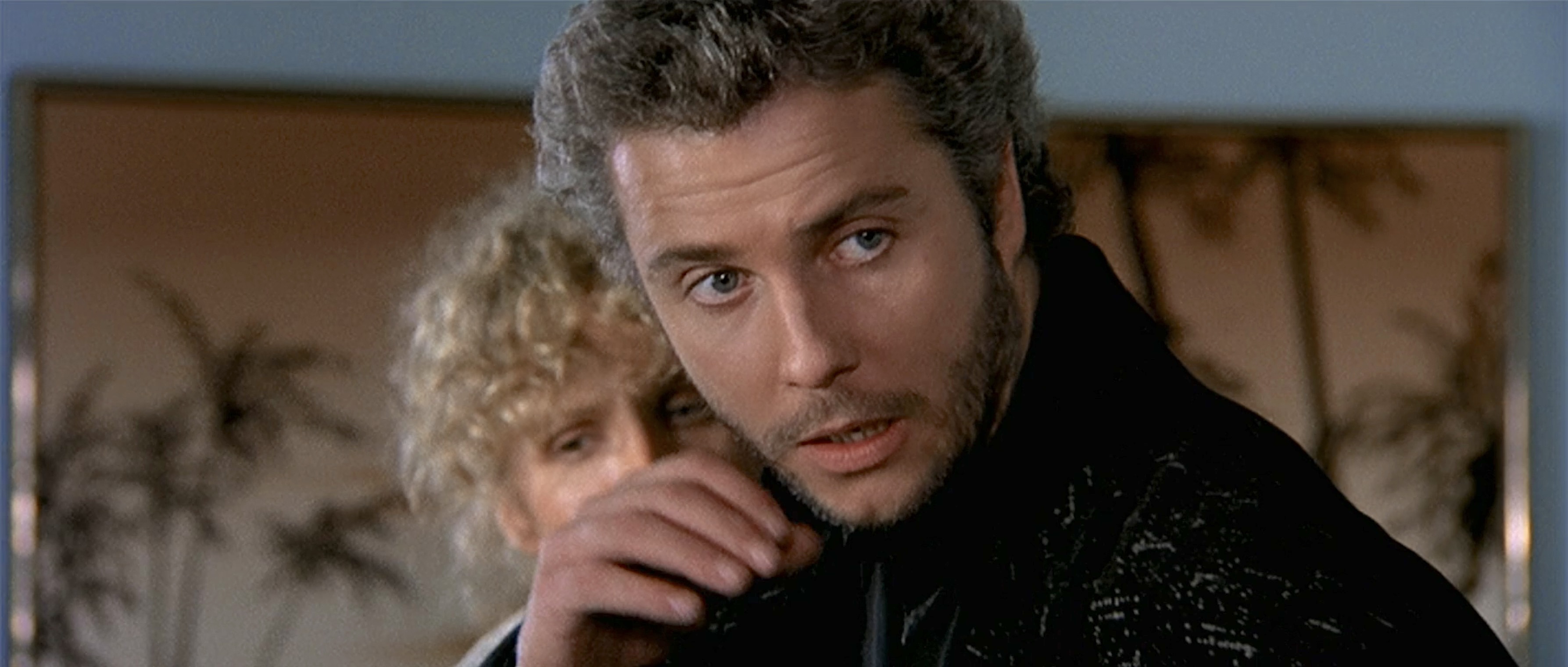
Graham eventually rotates through his aforementioned black textured shirt and light slate-colored shirt with this flecked jacket, though he debuts it with a brash burgundy silk shirt and the same skinny teal silk tie he had worn earlier while conferring with Crawford’s team in D.C. The shirt has a narrow point collar, plain button-up front, and single-button squared cuffs.

In addition to his gold wedding band on his left ring finger, Graham always wears a black PVD-coated stainless steel dive watch with a round, luminous off-white dial on a matching PVD-coated Jubilee-style bracelet. Based on the 36/37mm case shape and dial detailing—including black “dot” hour markers (except for the white-wheeled 3 o’clock date window, luminous 6 and 9 o’clock batons, and luminous 12 o’clock triangle), I believe he wears a 1980s-era Heuer 1000 Series ref. 980.031 known as the “Night Diver”. This same quartz-powered dive watch appeared the next year on Timothy Dalton’s wrist for his debut scene as James Bond in The Living Daylights (1987).

The Gun
Beginning midway through Manhunter, Will Graham begins packing a Charter Arms Bulldog snub-nosed revolver. I don’t believe any American federal law enforcement agency—or even many local police departments—ever formally issued inexpensive Charter Arms revolvers to their personnel, but the detail-oriented Michael Mann isn’t the type to allow an oversight regarding firearms.
In addition to dialogue with SWAT team member Spurgen (Jim Zubiena) explaining that Graham checked it out of inventory, which may be a stash maintained for undercover work or agents who don’t typically carry sidearms, this may be a nod to Graham feeling increasingly like he must embody a serial killer as the Charter Arms Bulldog was (and may still) be best known as the “Son of Sam” David Berkowitz’s handgun of choice during his deadly spree across the Bronx in the late 1970s, to the extent that he was known as “the .44-caliber Killer” before he was identified.

Graham draws his Charter Arms Bulldog in what would become one Mann’s trademark shot compositions, later echoed with Al Pacino during the climactic chase in Heat (1995).
Charter Arms launched the traditional double-action Bulldog five-shot revolver in 1973, nine years after the company was founded by Doug McClenahan. These inexpensive revolvers quickly gained popularity for its innovative design, relative reliability, and the ability to conceal large-bore calibers like .357 Magnum and .44 Special.
McClenahan named the Bulldog in reference to the small Webley revolvers from the late 19th century like Charles J. Guiteau had used to shoot President James Garfield, unaware that his own design would soon gain its own tragic association; indeed, Charter Arms’ infamy wasn’t limited to the Son of Sam’s .44 Bulldog; Undercover .38 Special models would later be used in the murders of Cherica Adams, Phil Hartman, and John Lennon, to name just a few. Despite this history and a sequence of bankruptcies and rebrandings, Charter Arms continues producing and improving its lineup, with more than 500,000 Bulldogs manufactured to this day.
Spurgen: Checked out a Charter Arms .44 Special Bulldog?
Graham: Yeah.
Spurgen: Load these in it. You ever fire ’em?
Graham: Glaser Safety Slugs—
Spurgen: Yeah, No. 12 shots, suspended in liquid Teflon and a copper casing. On impact, it all opens up in the target. Guaranteed one-shot stop.

Graham takes the Glaser Safety Slugs from Spurgen.
Recognized for their bright blue tips, these frangible bullets were developed by Jack Canon in 1975 and have since been produced in a range of handgun and rifle calibers. They were originally hand-made hollow-points filled with No. 12 birdshot (as Spurgen explains) until a polymer-tipped round ball was introduced in 1987, one year after Manhunter was released. They gained a positive reputation for law enforcement usage in tight indoor combat scenarios, including among air marshals, for their reduced likelihood of striking unintended targets.
How to Get the Look

William Petersen as Will Graham in Manhunter (1986)
Working for the FBI, Will Graham defies the traditional clean-cut image of “Hoover’s boys” in his ’80s-fashioned black jackets and jeans with non-white shirts and skinny ties.
- Black soft single-breasted sport jacket with notch lapels, low two-button front, welted breast pocket, straight hip pockets, and 2-button cuffs
- Non-white shirts with soft collars, breast pockets, and button cuffs
- Narrow silk ties
- Charcoal denim five-pocket jeans
- Black leather belt with gunmetal single-prong buckle
- Gray leather cap-toe oxford shoes
- Gold wedding ring
- Heuer 1000 Professional ref. 980.031 quartz “Night Diver” watch with 36/37mm black PVD-coated stainless steel case, luminous dial with 3:00 date window, and black PVD-coated Jubilee-style link bracelet
Do Yourself a Favor and…
Check out the movie, my man.
The Quote
Don’t talk to me about late, pal! I’ll tell you when it’s too fucking late! Until then, we go as late as I wanna take it!
Discover more from BAMF Style
Subscribe to get the latest posts sent to your email.
I was always fascinated with Graham’s fashion choices, and borrowed some for my own career in the Bureau. You should do an analysis of Peterson’s wardrobe in “To Live and Die in L.A.”