Twin Peaks: FBI Agent Dale Cooper’s Black Suit
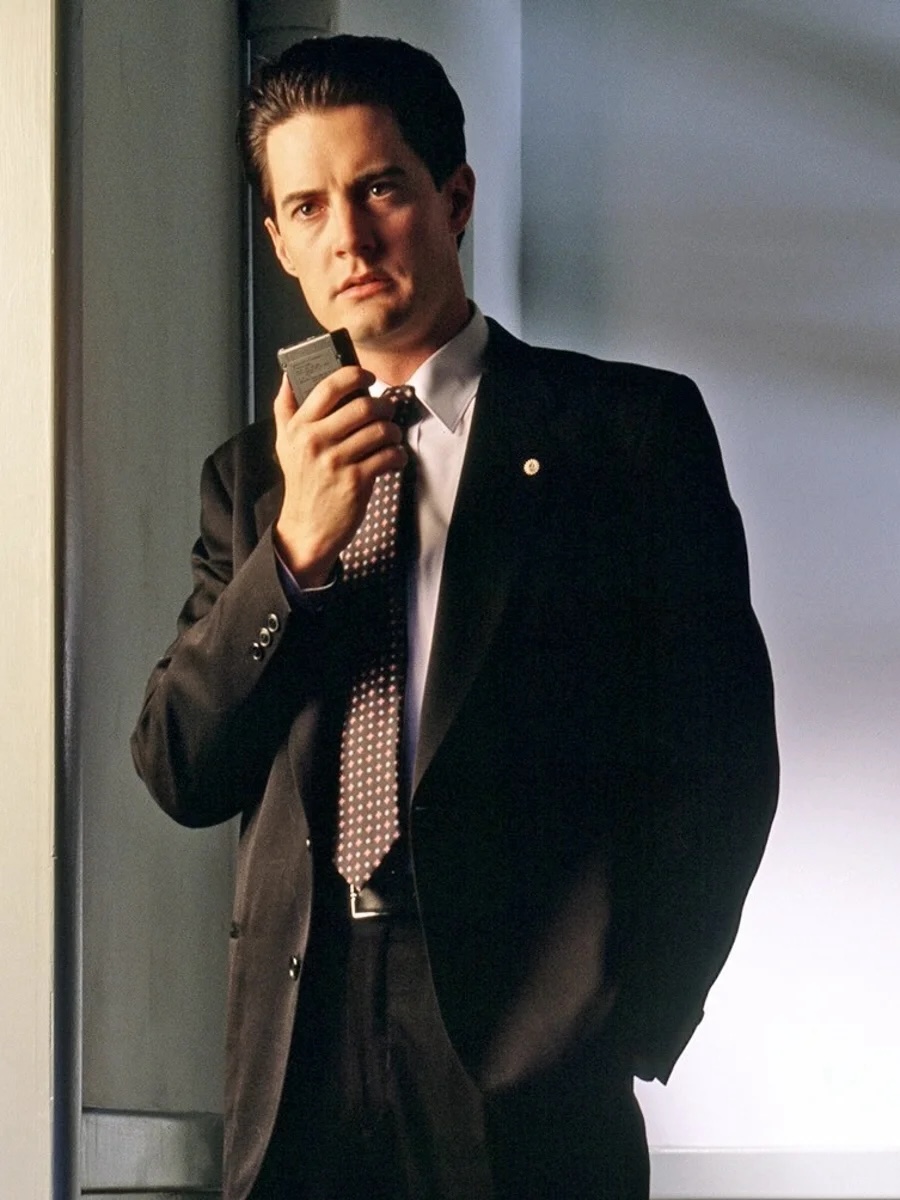
Kyle MacLachlan as FBI Special Agent Dale Cooper on Twin Peaks, in a promotional image for “The Man Behind the Glass” (Episode 2.03).
Vitals
Kyle MacLachlan as Dale Cooper, unusually perceptive FBI agent
Twin Peaks, Washington, February and March 1989
Series: Twin Peaks (Seasons 1-2)
Air Dates: April 8, 1990 to June 10, 1991
Created by: Mark Frost & David Lynch
Costume Design: Sara Markowitz (seasons 1-2) & Patricia Norris (pilot episode only)
WARNING! Spoilers ahead!
Background
Diane… 11:30 a.m., February 24th, entering the town of Twin Peaks. It’s five miles south of the Canadian border, twelve miles west of the state line.
Twin Peaks canon brought FBI Special Agent Dale Cooper (Kyle MacLachlan) into this small upstate Washington town exactly 37 years ago today in 1989, narrating the first of many unreturned missives into a tape recorder after the corpse of popular local teenager Laura Palmer (Sheryl Lee) was discovered washed ashore near the town’s lumber mill.

We meet Dale Cooper as he—and Diane—first drive into Twin Peaks late in the morning of February 24, 1989.
Envisioned as an extension of MacLachlan’s portrayal of college student-turned-amateur detective Jeffrey Beaumont in David Lynch’s previous project, Blue Velvet (1986), the quirky yet sapient Cooper is a walking contradiction—balancing his apparent naïveté with an almost supernatural sense of perception; he instantly ascertains the adulterous relationships underscoring the town while also completely unaware of the Douglas fir trees surrounding the town. His default temperament leans toward extreme affability, but Coop has no issue being extremely dismissive when the offending party deserves it.
Unlike the interagency rivalry that emerges on most crime shows, Coop’s partnership with local Sheriff Harry S. Truman (Michael Ontkean) quickly evolves from an easy collaboration to true friendship through the course of their joint murder investigation, though Harry himself is quick to admit by the second episode that Coop’s canniness often makes the laidback sheriff feel like Dr. Watson to the agent’s Sherlock Holmes.
“In the pursuit of Laura’s killer, I have employed Bureau guidelines, deductive technique, Tibetan method, instinct, and luck,” Cooper declares upon solving the case in “Arbitrary Law” (Episode 2.09). “But now I find myself in need of something new which, for lack of better word, we shall call: magic.”

Magic indeed.
Sure it’s a mystery series, but freshman viewers would be best advised to focus more on the blend of Lynchian absurdity with Rockwellian aesthetics—a picture-perfect Pacific Northwest town dressed in hardy plaid flannels and cozy sweaters, surrounded by Coop’s beloved Douglas firs, as gorgeous gals-next-door serve donuts, cherry pie, and coffee at the local diner.
“I’ve only been in Twin Peaks a short time, but in that time, I have seen decency, honor, and dignity,” Coop shares with fellow agent Albert Rosenfield (Miguel Ferrer) early in his extended visit:
Murder is not a faceless event here. It is not a statistic to be tallied up at the end of the day. Laura Palmer’s death has affected each and every man, woman, and child because life has meaning here—every life. That’s a way of living I thought had vanished from the earth, but it hasn’t, Albert, it’s right here. In Twin Peaks.
What’d He Wear?
Established by Patricia Norris in the first episode and maintained by series costume designer Sara Markowitz for all subsequent episodes, the de facto uniform for FBI agents in the Twin Peaks universe is single-breasted suits with conservative shirts and ties. Albert Rosenfield even comments during Coop’s suspension: “About the uniform… replacing the quiet elegance of a dark suit and tie with the casual indifference of these muted earth tones is a form of fashion suicide, but—call me crazy—on you it works.”
Several episodes later, when FBI Regional Bureau Chief Gordon Cole (David Lynch) reinstates Coop as an agent, he advises that “you better dust off your own black suit… we need you back on the team!”

Just a couple of FBI agents in their black suits: Regional Bureau Chief Gordon Cole and Special Agent Dale Cooper share a moment in the Double R Diner.
Coop’s Black Suit
Until shifting to their hardy, informal dress code during his aforementioned suspension, Agent Cooper stands out among Twin Peaks’ plaid-shirted locals in his pristine black worsted wool suit, always worn with light, solid-colored shirts and sharp ties, occasionally layered under his Korean War-era Army greatcoat. Black suits are unorthodox, even for an occupation as deadly serious as an FBI Special Agent, so this being Cooper’s suiting of choice emphasizes his occasionally unsettling presence… though it at least feels appropriate while attending funerals in the fourth and eighteenth episodes.
The black single-breasted jacket adheres to a conventional design, tailored in line with late 1980s and early ’90s menswear without chasing excess trendiness. The cut is full with straight, structured shoulders and a ventless back, while the notch lapels sit at a relatively low gorge, pushing the two-button stance lower but still consistent with the trousers’ medium rise. The welted breast pocket is supplemented by clean, straight jetted hip pockets, and the sleeves show subtle roping at the heads, finished with three-button cuffs.

Neither Truman nor Cooper wear traditional uniforms but both anchor their daily outfits: for Harry, that means khaki two-pocket shirts over black T-shirts with neutral slacks; for Coop, it’s his black suits with light-blue or off-white shirts and classic ties.
Rather than the American flag pins worn by fellow agents Cole and Rosenfield, Coop always dresses his left lapel with a small pin resembling membership badges of Soka Gakkai: a Japanese new religion founded in 1930, based on the teachings of 13th century Buddhist priest Nichiren. Measuring 18.5 centimeters in diameter, this circular pin has a scalloped border of sixteen connected mini-spheres, flanking a stylized gilt crane facing dexter with its wings fully spread and raised to form a circular frame around its body.
Though Cooper’s stated interest in Tibetan-influenced philosophy differs from the specific Nichiren Buddhist practice associated with Soka Gakkai, it is not outside the realm of possibility that he might wear this pin as a subdued nod to his broader engagement with Eastern spirituality.

Cooper’s Buddhist pin flashes from his lapel in the second-season premiere, “May the Giant Be with You” (Episode 2.01).
The suit’s matching single reverse-pleated trousers have belt loops, an extended single-button waistband tab, slightly slanted side pockets, jetted back pockets, and plain-hemmed bottoms with a full break. Coop holds them up with a smooth black leather belt that closes through a silver-toned squared single-prong buckle, also using the belt for his FBI badge and service revolver while on duty.

Coop off duty with Deputy Tommy “Hawk” Hill (Michael Horse), his shirt and tie loosened and belt freed of the badge and gun he had to turn in when suspended from duty at the top of the episode, “Masked Ball” (Episode 2.11).
Despite the costume’s prominence in the series, I haven’t found any confirmed documentation of who made Agent Cooper’s black suit. Rose-Marie Turk’s 1990 article “Backwoods Wear” for the Los Angeles Times (reprinted on Twin Peaks Blog) cites that Perry Ellis provided suits, though these could have also been given to Twin Peaks’ more fashion-minded characters like Ben Horne (Richard Beymer) or Leland Palmer (Ray Wise).
Although Leo Johnson may need a new pair of shoes, Dale Cooper is perfectly satisfied with the polished black calf leather cap-toe derby shoes that he regularly wears with his suit, always with plain black socks and presumably the burgundy-and-mustard striped garters seen as he suspends from his hotel room’s ceiling in “Traces to Nowhere” (Episode 1.02).

Shirts and Ties
Cooper typically prefers light-blue poplin shirts, ranging from a pale ice-toned shirt with a spread collar that he first wears in the pilot episode to a deeper cornflower-blue shirt with a point collar appearing only in “Masked Ball” (Episode 2.11). He also rotates a plain white poplin shirt with a spread collar, a cream shirt that reappears through the first and second seasons, and a pale-pink shirt with a more dramatic spread collar that shows up twice in the second season.
Though the collar shape differs in its spread distance and tie space, Coop’s shirts are invariably a light, solid-colored poplin with a front placket, breast pocket, and adjustable barrel cuffs that close through one of two buttons—typically rounded, though one of his light-blue shirts has mitred cuffs instead. They fit generally well but strongly suggest American off-the-rack styles.

The rare sighting of Cooper sans his suit jacket and tie, about to be pleasantly interrupted in his room at the Great Northern by the future “Miss Twin Peaks” (Episode 2.21).
Coop may have only brought one suit to Twin Peaks, but he ensures a variety of looks by cycling through at least eighteen different ties over the course of his monthlong visit during the thirty original episodes. The widths and patterns differ, beginning with the pilot episode “Northwest Passage” (Episode 1.01) where he exclusively wears a narrow black tie textured with tonal rectangles angled up the blade.

Coop’s black suit and tie through the pilot episode would set the stage for MacLachlan’s look in the 2017 revival series, Twin Peaks: The Return.
The rest of his ties are generally split between two pattern categories: stripes and dot/medallion prints. Unlike his supervisor Gordon Cole who invariably wears the same plain black ties, Cooper rarely repeats his neckwear though a few ties do make return appearances. His ties are often patterned against a dark ground in plain black or dark navy (or the occasional scarlet), with the stripe or dot prints ranging along the red, white, and blue spectrum, only occasionally approaching earth-tone territory. I haven’t confirmed any of the ties’ makers, but the designs recall contemporary patterns from designers like Brooks Brothers, Christian Dior, Oscar De La Renta, Pierre Cardin, Ralph Lauren, and Yves St. Laurent.
With his reinstatement into the FBI late in the second season, Coop also begins regularly wearing a dual-pronged sliding tie bar with a large faceted gemstone mounted on it.

Coop only repeats these four of his eighteen screen-worn ties, all representing his preference for classic repp stripes and small repeating medallion prints. From left to right:
➢ An alternating pattern of blue dots and red medallions against a black ground, seen here in “Traces to Nowhere” (Episode 1.02) and again repeated in “The Man Behind the Glass” (Episode 2.03).
➢ A dark-navy tie with alternating sets of pink-and-navy then pink-and-white downhill stripes, seen here in “Arbitrary Law” (Episode 2.09) but also worn in the final two episodes of the series as Coop enters the black lodge. Based on the logo over the blade, this may be Christian Dior.
➢ A black tie with gray downhill bar stripes bordered with narrower white stripes along the top; seen here with Harry’s gifted fishing bait next to his Buddhist pin in “Dispute Between Brothers” (Episode 2.10) but also worn in “The One-Armed Man” (Episode 1.05) and “On the Wings of Love” (Episode 2.18).
➢ A black tie with blue-bordered white dots seen here with a tie clip in “Variations on Relations” (Episode 2.19) but also worn in “Rest in Pain” (Episode 1.04) and “The Path to the Black Lodge” (Episode 2.20).
Outerwear and Underwear
Unlike the fashion-forward fed Albert Rosenfield in his slimmer suits, “Pepsi bezel” Rolex GMT Master, and shorter Burberry trench coat, Agent Cooper follows the subdued template evidently set by his FBI superior, Regional Bureau Chief Gordon Cole—right down to an identical Korean War-era Regulation Army overcoat in the light-brown shade of 100% wool gabardine twill described as “Taupe, Shade No. 79”.
These full-fitting, knee-length topcoats are styled like a military-informed cross between a greatcoat and a trench coat, authorized in July 1952 as “Overcoat, Wool, Taupe, Shade No. 79 with Removable Liner” for U.S. Army officers and produced to spec MIL-o-3219A by contractors like The Barrister Corp. and Sigmund Eisner Co. The trench-informed details include an ulster collar, shoulder epaulets, a storm flap over the upper right chest, and a full waist-belt which closes through a tall metal buckle over a widely spaced 6×3-button double-breasted front. The set-in sleeves are finished with square-ended two-button straps, and there are two slanted side pockets.

Four types of character-defining outerwear: the flashy Albert’s short Burberry trench coat, by-the-book Coop’s classic Army greatcoat, Harry’s trusty and distinctive flecked car coat, and Deputy “Hawk” in his department-issued nylon bomber jacket.
Cooper always wears white ribbed cotton sleeveless undershirts. In “Miss Twin Peaks (Episode 2.21), the shirt’s tag is visibly from the J.C. Penney house brand Stafford. He also exclusively wears tartan plaid cotton boxer shorts, as illustrated by his red, black, green, and yellow checked shorts during his in-room calisthenics in “Traces to Nowhere” (Episode 1.02) but reinforced as he packs a stack of nearly identical undershorts when preparing for his fishing trip in “Dispute Between Brothers” (Episode 2.10).

Coop’s Accessories
A gold banded pinky ring on Cooper’s left hand is one of the agent’s few affectations until the second season premiere, when the mysterious giant (Carel Struycken) demands: “Give me you ring. I will return it to you when you find these things to be true.” In the following episode, Coop explains to Rosenfield that “Albert, my ring is gone. One day here, the next day gone.”
Twin Peaks lore passed the ring down Cooper’s family from his maternal grandfather to his own mother, who passed it down to Dale in a dream after her death. The one-armed MIKE (Al Strobel) assures Coop that this “golden circle” will lead him to BOB and, as promised, the Giant returns Cooper’s ring to him in “Arbitrary Law” (Episode 2.09) before Cooper announces the identity of Laura’s killer to the assembled men of Twin Peaks.

In the pilot episode only, Cooper wears a stainless steel wristwatch with a hefty case on a swelled brown leather band. The round cream-colored dial has baton-style hour indices and a moon-phase complication at 6 o’clock, similar to the Omega Cosmic line introduced in 1947.

Coop’s moon-phase watch appears only in the feature-length first episode, “Northwest Passage”.
From the second episode through the end of the series, Coop nearly almost wears a yellow-gold dress watch with a rounded rectangular ellipse-shaped case filled out by a minimalist black dial with gold baton-style hands and hour indices, fastened to a black textured leather strap. The style echoes popular quartz-powered dress watches from the late 1970s into the ’80s.
There’s been considerable online discussion (such as The RPF and WatchUSeek) attempting to identify Coop’s canonical gold watch, with informed guesses ranging in price range from Hamilton Boulton and Omega De Ville to Bulova and Timex. Unlike the identity of Laura’s killer, this mystery may never be truly solved.

Coop’s canonical gold watch flashes from his wrist during an intimate interlude with Annie Blackburn (Heather Graham) in “Miss Twin Peaks” (Episode 2.21).
Cooper’s third screen-worn watch appears to be a Timex Lextra, distinguished by the dual black cross-bars prongs extended from the blackened case over the top and bottom of the round white dial, attached to a black resin strap. He never wears this inexpensive quartz watch with his suit, instead reserving it for his flannel-shirted off-duty looks while suspended from the FBI late in Twin Peaks‘s second season.
The Guns
Smith & Wesson Model 66 Revolver
Agent Cooper carries his FBI-issued snub-nosed Smith & Wesson Model 66 service revolver in a black leather holster (with a retention strap over the top), attached to the right side of his belt for a strong-side draw. Coop and Sheriff Truman’s deputies first prominently draw their sidearms in the fifth episode, “The One-Armed Man” (Episode 1.05), and—after the sweet-natured Deputy Andy Brennan (Harry Goaz) accidentally discharges his revolver upon dropping it—the agent insists that he, Harry, Andy, and Hawk all hit the firing range.
Coop: After Andy’s mishap at the motel, I want to make absolutely certain each of us is comfortable and confident with our firearms.
Hawk: Nice piece.
Coop: Actually, it’s standard issue. I made a few modifications.
Coop’s “modification” may have been the adoption of the flashier stainless steel Model 66 itself, as I believe the Bureau had most commonly issued the blued Smith & Wesson Model 10, Model 13, and Model 19 revolvers during this time frame. Stainless variants like the Model 66 were authorized in select cases, and field agents could also carry personally purchased revolvers that met Bureau spec.

At the Twin Peaks firing range in “The One-Armed Man” (Episode 1.05), Coop explains how he placed his six rounds through a paper target: “I put four through the eyes and one through each nostril.”
Smith & Wesson introduced the Model 66 in the early 1970s as a stainless-framed variant of the blued or nickel-finish Model 19, both marketed as “Combat Magnum” revolvers built on Smith & Wesson’s medium-size K-frame. These have a traditional double-/single-action (DA/SA) operation with adjustable rear sights and six-round cylinders chambered for .357 Magnum ammunition, though agents often loaded theirs with .38 Special+P for reduced recoil, improved control, and less wear.
Barrel lengths included the standard 4″ barrel for service revolvers, a longer 6″ barrel, and the snub-nosed 2.5″ barrel as carried by Coop, which weighs approximately 30.5 ounces. Although not specifically authorized by the FBI, this configuration of a 2.5″-barreled Smith & Wesson Model 66 did have some federal credentials as it was carried by agents of the U.S. Immigration and Naturalization Service (INS) through the mid-1990s.

Alongside his Bureau badge, Cooper gets one last look at his holstered Smith & Wesson Model 66 during his suspension in “Masked Ball” (Episode 2.11).
Smith & Wesson “1076” Service Pistol
After Coop is suspended without pay from the FBI in “Dispute Between Brothers” (Episode 2.10), he surrenders the Model 66 revolver alongside his FBI badge. When Gordon Cole himself returns to Twin Peaks in “On the Wings of Love” (Episode 2.18) to reinstate Coop into the Bureau, he also personally issues him an updated sidearm: the Smith & Wesson 1076 in 10mm Auto, reflecting the agency’s actual shift at this this time from revolvers to semi-automatic pistols.
“Brand new issue, more accurate and efficient,” Gordon exclaims to Coop, identifying it as a “Smith & Wesson 10mm, model 1076. All stainless steel! It’s a beautiful weapon, Coop, and it’s all yours.”
The FBI had indeed reevaluated their use of .38 Special and .357 Magnum service revolvers following an April 1986 gunfight in Miami that resulted in the deaths of two agents. The Bureau then adopted a reduced-velocity variant of the then-new 10mm Auto round, collaborating with Smith & Wesson on developing the semi-automatic model 1076—colloquially known as “the FBI pistol” during its brief term of adoption. Designed consistent with Smith & Wesson’s third generation of all-steel semi-automatic pistols, the model 1076—in fact, all of the company’s 10mm third-gen pistols—fed from nine-round single-stack magazines.
Despite Gordon’s dialogue identifying it as the model 1076, an IMFDB user cited the screen-used pistol’s five-inch barrel and slide-mounted decocking/safety lever as evidence that Cole actually issues Coop the cosmetically similar model 4506 (chambered in .45 ACP) as opposed to the 4.25″-barreled model 1076 with its frame-mounted decocker.

Only one episode after he receives it, Coop already has to draw his new Smith & Wesson service pistol in “Variations on Relations” (Episode 2.19). Note the weapon’s reflection in Harry’s Bronco, showing the longer slide nose of a five-inch barrel, a stepped frame, and a slide-mounted safety/decocker—all details consistent with the more common model 4506 than the Bureau’s briefly issued model 1076 referred to in dialogue.
The FBI ultimately canceled its model 1076 contract after receiving less than 2,500 of the initial 10,000 pistols ordered, prompting Smith & Wesson to spin the concept into the shorter .40 S&W round which would ultimately be adopted by the Bureau as well as many federal, state, and local law-enforcement agencies.
Twin Peaks maintained its accurate reflection of federal-issued firearms for The Return revival series in 2017, with Cooper’s updated Bureau sidearm now a Glock 17 pistol in 9x19mm Parabellum, as the FBI had started arming its agents with full-sized Glocks from 1997 onward.
What to Imbibe
“You know, this is—excuse me—a damn fine cup of coffee,” Dale Cooper proclaims to a waitress at the Great Northern Inn in the second episode, “Traces to Nowhere” (Episode 1.02), cementing the longstanding association between the agent and his endless cups of joe, often accompanied by donuts at the office or cherry pie at the Double R Diner—where patrons can score their first cup of coffee for a mere 25 cents. (To be comprehensive, Coop’s enthusiasm for breakfast also extends to declaring that “nothing beats the taste sensation when maple syrup collides with ham,” in the fourth episode.)
Coop had initially been an advocate of the Lamplighter Inn, as we all know “they’ve got a cherry pie there that’ll kill ya” until he’s pleasantly surprised by the Double R’s pie that Shelly Johnson (Mädchen Amick) promises is “the best in the tri-counties.” After an impressed Cooper orders “two more pieces of this incredible pie,” Sheriff Truman observes that he “must have the metabolism of a bumblebee!”

Seated at the Double R next to Big Ed Hurley (Everett McGill), Coop enjoys some of the diner’s famous coffee, cherry pie, and ice cream in “Rest in Pain” (Episode 1.04).
Later in the second episode, local logger Pete Martell (Jack Nance) welcomes Agent Cooper and Sheriff Truman with his own pot of coffee.
Pete: Mr. Cooper, how do you take it?
Coop: Black as midnight on a moonless night.
But Coop must abandon his caffeine fix at the Martell abode after Pete realizes there was a fish in the percolator. Luckily, Cooper needn’t wait much longer as he’s treated to some more “damn good coffee! and hot!” during an outdoor briefing in the following episode.
All told, I believe I’ve counted at least forty cups of coffee enjoyed by Cooper over the course of all thirty episodes, right up until that mysterious cup he’s served in the Black Lodge in the series finale, “Beyond Life and Death” (Episode 2.22).

eeffoc fo puc enif nmad!
Harry, I’m gonna let you in on a little secret: every day, once a day, give yourself a present. Don’t plan it, don’t wait for it, just let it happen. It could be a new shirt at the men’s store, a cat nap in your office chair, or two cups of good hot black coffee like this.
—Dale Cooper, “Realization Time” (Episode 1.07)
It makes sense that Coop would eventually find his love match with a woman who makes him coffee! In “Wounds and Scars” (Episode 2.17), Norma Jennings’ sister Annie Blackburn (Heather Graham) begins working at the Double R and crafts his requested cup of “deep black joe” just right, despite her own worry that it was “a little strong.”

Annie follows the overly caffeinated path to Cooper’s heart in “The Path to the Black Lodge” (Episode 2.20).
How to Get the Look

“Zen, or the Skill to Catch a Killer” (Episode 1.03) would be the only Twin Peaks episode until the 2017 revival where Dale Cooper recalls his solid black suit/black tie aesthetic from the pilot episode.
Like his FBI colleagues, Dale Cooper wears light shirts and classic ties with a somber two-piece suit as black as his favorite cup of damn fine coffee, but he adds subtle touches of character with his pinky ring, gold wristwatch, and a Buddhist badge pinned to his lapel.
- Black worsted wool suit:
- Single-breasted 2-button jacket with low-gorge notch lapels, welted breast pocket, straight jetted hip pockets, 3-button cuffs, and ventless back
- Single reverse-pleated trousers with belt loops, slightly slanted side pockets, jetted back pockets, and plain-hemmed bottoms
- Pale-blue poplin shirt with spread collar, front placket, breast pocket, and adjustable barrel cuffs
- Dark silk ties with classic downhill-striped or repeating-medallion prints
- Black smooth leather belt with silver-toned squared single-prong buckle
- Black leather belt holster with snap-fastened retention strap
- Black calf leather cap-toe derby shoes
- Black socks
- Burgundy-and-mustard striped sock garters
- White ribbed cotton sleeveless undershirt
- Red tartan plaid cotton boxer shorts
- Light taupe-brown wool gabardine twill knee-length Regulation Army officer’s greatcoat with wide ulster collar, shoulder epaulets, upper right storm flap, 6×3-button double-breasted front, full waist-belt, slanted side pockets, and two-button square-ended cuff straps
- Gold banded pinky ring
- Gold ellipse-cased quartz dress watch with black dial and gold baton indices on black textured leather strap
Do Yourself a Favor and…
Every day, once a day, give yourself a present. Don’t plan it, don’t wait for it, just let it happen. And fire walk with the series.
The Quote
👍
Discover more from BAMF Style
Subscribe to get the latest posts sent to your email.
I’ve seen people suggest Coop’s suit to be Brooks Brothers but I don’t think the cut really looks like any BB suit I’ve seen from that era. It’s been a moment since I watched Fire Walk With Me but to my memory he wears a different black suit that has a looser fit, wider shoulders, and an even lower gorge and in The Return he wears a slim fitting suit.
Hey Im doing some research on the “MIL-O-3219A” overcoat you mentioned and this webpage is the only place on the internet that mentions it even a little. Could you share your source on the coat with me? I would really appreciate it! Thank you for your time.
Definitely! If you look at the tags of Coop/Cole-style Korean War-era Army overcoats (often posted on eBay or Etsy, among other places), you’ll see things like “Overcoat, Wool, Taupe, Shade No. 79 with Removable Liner” as well as the military specification “MIL-0-3219A” to which contractors like Barrister and Eisner built these coats so they’d be generally identical.
Does anyone know who might have made the tie Coop wears when he first dreams of the Red Room?
https://ibb.co/tp0C541G