One Way Passage: William Powell’s Shipboard Flannel Suit

William Powell in One Way Passage (1932)
Vitals
William Powell as Dan Hardesty, recaptured death row fugitive
Hong Kong to San Francisco, via Honolulu, Fall 1932
Film: One Way Passage
Release Date: October 22, 1932
Director: Tay Garnett
Costume Designer: Orry-Kelly (gowns)
WARNING! Spoilers ahead!
Background
On the anniversary of William Powell’s July 29, 1892, birthday, let’s look at how the dashing actor brought his marvelous sense of style to the screen in the last of his six major films opposite Kay Francis, the pre-Code drama One Way Passage.
Crafted from a story by Robert Lord, who won the Academy Award for Best Story, One Way Passage stars Powell and Francis as Dan Hardesty and Joan Ames, star-crossed lovers who meet over Paradise cocktails at the International Bar in Hong Kong. Shortly after, they reconnect aboard the S.S. Maloa steaming across the Pacific to San Francisco. (Much of the movie was actually filmed aboard the Calawaii, a former freighter and troopship that was retired and scrapped the following year.)
Unbeknownst to her, he’s a recently recaptured fugitive facing the death penalty; unbeknownst to him, she has a terminal illness and not long to live. Despite their intense shipboard romance, Dan knows he needs to escape from his SFPD captor Sgt. Steve Burke (Warren Hymer) at the first opportunity to save his life, enlisting his onboard allies “Barrelhouse Betty” (Aline MacMahon) and “Skippy” (Frank McHugh) to help him without betraying the secret of his identity to Joan.
On their 17th day at sea, Dan pens a farewell letter to Joan to the strains of “Aloha O’e” as he plans to make his break when the ship docks in Honolulu. He then encounters Joan while scrambling off the ship, and the two take their planned tour of Honolulu—including an assignation in the sand and a stop at a beachside tavern, where Dan arranges to be smuggled away by a shady freighter captain. When Joan’s sickness causes her to pass out just before Dan is about to reveal that he can’t rejoin her aboard the ship, he makes the snap decision to sacrifice his chance at freedom by bringing her back aboard the S.S. Maloa.
What’d He Wear?
By the early 1930s, Americans had yet to fully embrace the floral-printed aloha shirts that would later define Hawaiian style, so Dan Hardesty sticks to William Powell’s signature smart tailoring during the Maloa’s brief stopover in the islands—albeit with seasonally appropriate headwear. Following the custom of the time, particularly among well-dressed stars like Powell, Dan’s wardrobe was likely sourced from the actor’s own closet.
In Hawaii, he wears a three-piece suit made from lightweight flannel, depicted as a muted blue in contemporary lobby artwork—though such illustrations often took creative liberties and may not reflect the suit’s true color.

A contemporary lobby card depicts both Dan and Steve in blue suits, though Dan’s flannel suit is considerably lighter than Steve’s navy worsted.
While flannel may have served Dan comfortably aboard ship, it’s harder to imagine it feeling anything but sweltering once ashore in Hawaii, where—even in December, when the scene takes place—the average daily temperature rarely dips below 70°F.
The single-breasted jacket follows a typical silhouette for the time, with wide peak lapels that end high over the three-button front—its sharp peaks directing eyes to the concave shoulder lines and roped sleeve-heads that build a strong-chested silhouette, emphasized by a gently suppressed waist and a ventless skirt. The sporty patch pockets over the hips and left breast dress the suit down just enough for what’s meant to be a leisurely stopover, and Dan dresses the breast pocket with a white linen pocket square. The sleeves are finished with four-button cuffs.
The matching waistcoat has a five-button front—which Dan wears fully fastened—and four welted pockets, with his pocket watch on a chain strung across the center and tucked into one of the pockets. The pleated trousers have an appropriately long rise that conceals the waistband underneath the waistcoat, and the bottoms are finished with turn-ups (cuffs). As Dan never removes his jacket or waistcoat on screen, we can only assume that they’re either tailored with a self-suspended waist and/or worn with suspenders (braces).

Dan’s white cotton shirt may not sound remarkable when described, but it features many hallmarks that quietly distinguished style during this oft-described “golden age” of menswear. Perfectly sized for Powell’s neck, the collar follows the long “spearpoint” shape that almost completely fills the space above the opening of his waistcoat that isn’t covered by his garza fina grenadine-woven silk tie—fastened in a neat four-in-hand. The shirt’s barrel cuffs are fastened with two stacked buttons, aligned in a parallel column over each wrist.

Never bring a glass to a gunfight.
Cap-toe oxfords are typically on the dressier end of the footwear spectrum, but Dan’s shoes have suede uppers—likely brown—that mirror the sportier details of his suit. His somewhat dark cotton lisle socks were likely chosen to match his suit trousers and continue the leg line into his shoes.

On the third day of the sea voyage, Dan presented himself on deck wearing this suit with a summery white herringbone-woven cotton flat cap.

For the 17th day when he joins Joan ashore in Hawaii, he wears a natty white straw Panama hat with a fully turned-down brim and a distinctively high, flat-top crown detailed with an “optimo”-style front dimple and a narrow black grosgrain band.

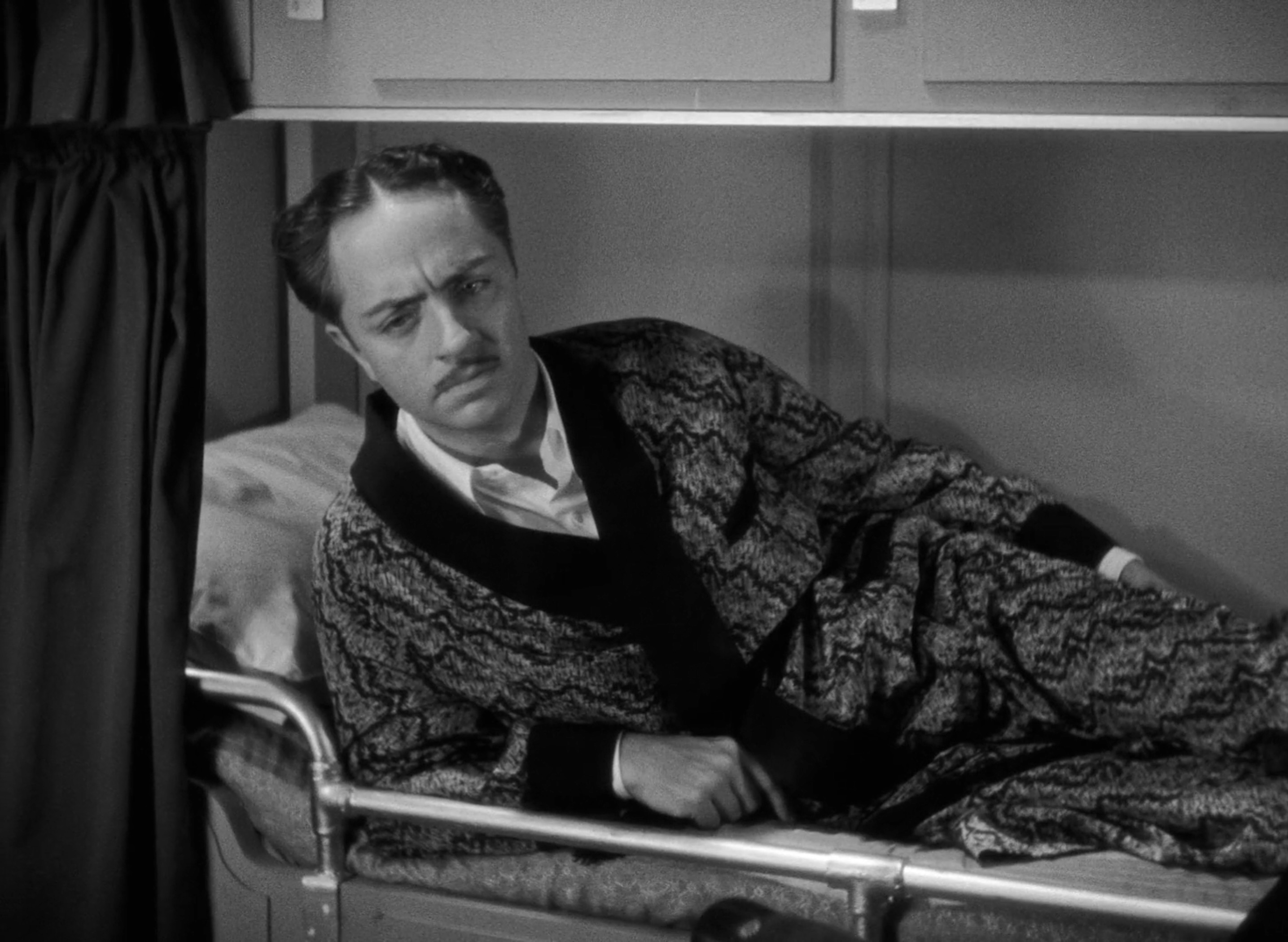
After returning a sickly Joan to the Maloa, Dan sheds his jacket, waistcoat, and tie in lieu of a long dressing gown to keep vigil. We can safely assume that this was also one of Powell’s actual robes as it later appears in the closing scenes of The Thin Man, recognizable for that same “zigzag” jacquard silk body with its contrasting dark shawl collar, cuffs, sash, and pocket piping.
The Car
Though much of the action is set at sea, Dan does take the opportunity to rent a 1932 Chrysler Eight Series CP Convertible Coupe for his and Joan’s island adventure. Positioned just below the luxurious Imperial model, the high-end Chrysler Eight was introduced in 1931, the same year that the marque introduced eight-cylinder engines.
Chrysler touted the Eight’s “Floating Power”, designed to reduce vibration, mated to a four-speed manual transmission with silent gear selection and Chrysler’s innovative automatic clutch. The ’32 model received a slightly larger L-head straight-eight engine with a 298.65 cubic-inch (4.9 L) displacement that generated approximately 100 horsepower, as opposed to the 82-hp six-cylinder engine or the 125-hp Imperial Eight. Five body styles ranged between two and four doors and open or closed tops, with Dan’s rented Convertible Coupe positioned in the upper-middle tier at a base price just over $1,500.

How to Get the Look

Kay Francis and William Powell in One Way Passage (1932)
William Powell epitomizes the “smooth criminal” as the impeccably dressed—but ultimately doomed—Dan Hardesty in One Way Passage, layering on a period-perfect flannel three-piece suit with his long-collared white shirt, woven tie, suede oxfords, and Panama hat for a Hawaiian stopover with his new paramour.
- Light blue woolen flannel three-piece suit:
- Single-breasted 3-button jacket with short, wide peak lapels, patch breast pocket, patch hip pockets, 4-button cuffs, and ventless back
- Single-breasted 5-button waistcoat with four welted pockets
- Pleated trousers with long rise, self-suspended waistband, side pockets, and turn-ups/cuffs
- White cotton shirt with spearpoint collar and two-button barrel cuffs
- Mid-colored grenadine woven silk tie
- Brown suede cap-toe oxford shoes
- Mid-dark cotton lisle socks
- White straw Panama hat with tall, flat “optimo”-dimple crown, black grsograin band, and turned-down brim
- Pocket watch on chain
- White linen pocket square
Do Yourself a Favor and…
Check out the movie.
Discover more from BAMF Style
Subscribe to get the latest posts sent to your email.
One comment