Rudolf Nureyev’s Dancing Tailcoat as Valentino

Rudolf Nureyev as Rudolph Valentino in Valentino (1977)
Vitals
Rudolf Nureyev as Rudolph Valentino, Italian-American dancer and future silent film star
Los Angeles, Fall 1919
Film: Valentino
Release Date: October 4, 1977
Director: Ken Russell
Costume Designer: Shirley Russell
Tailor: Anderson & Sheppard
WARNING! Spoilers ahead!
Background
The sudden death of screen icon Rudolph Valentino 100 years ago today on August 23, 1926 prompted mass public mourning including approximately 100,000 mourners lining the streets of Manhattan to pay their respects. Among these was his lover—and fellow silent-era sex symbol—Pola Negri, who theatrically collapsed over his $10,000 coffin, which she had previously adorned with an eleven-foot-long bank of lilies spelling out her own name. In contrast to more tasteful tributes offered by contemporaries like Charlie Chaplin and Buster Keaton, fans launched a day-long riot by smashing the Frank E. Campbell Funeral Chapel’s windows in attempts to get in, while there were also reported suicides from despondent devotees.
Valentino’s death at age 31 at the height of his stardom contributed to his lasting mystique and old Hollywood legends. His star had shown hard and fast during the silent film era of the roaring ’20s, following his global breakthrough in the 1921 anti-war epic The Four Horsemen of the Apocalypse. Nicknamed the “Latin Lover” but alternately known simply as “Valentino”, the actor’s intense and exotic presence in romantic roles earned him wide devotion among female fans… and a jealous ire among men who questioned his masculinity.
The latter backlash to his persona dogged Valentino throughout his career, culminating in the actor challenging a Chicago Tribune reporter to a boxing or wrestling match. Following the writer’s failure to respond, New York Evening Journal boxing writer Frank “Buck” O’Neil took the challenge and publicly faced off against Valentino on the roof of the Ambassador Hotel in New York, refereed by heavyweight champion Jack Dempsey, who would later describe Valentino as “the most virile and masculine of men.” O’Neil only landed one punch before the Latin Lover swiftly knocked him down and won the bout. Ever the gentleman, the victorious Valentino apologized to O’Neil when helping him to his feet.

The real Rudolph Valentino (1895-1926) dances with Alice Terry in The Four Horsemen of the Apocalypse (1921), which would transform Valentino from a supporting player into a superstar.
Valentino’s life and legend has made him a popular subject for film and TV representation, from the 1951 biopic Valentino to Finn Wittrock portraying a vampiric Valentino in the fifth season of American Horror Story. But perhaps the most notorious retelling was Ken Russell’s 1977 drama Valentino, based on Chaw Mank and Brad Steiger’s biography subttitled “an Intimate Exposé of the Sheik” and starring Russian-born dancer Rudolf Nureyev as the titular actor. Many difficulties during production have been linked to Nureyev’s tense working relationships with Russell and with co-star Michelle Phillips, whose debut performance in Dillinger (1973) had impressed Russell enough to land her the role of Valentino’s second wife, Natacha Rambova.
Despite a troubled production, harsh reception upon its release, and Russell himself distancing himself from the film, Valentino received a trio of BAFTA nominations: Best Cinematography, Best Production Design, and—most relevant to this blog—Best Costume Design. This was the second of six BAFTA nominations for costume designer Shirley Russell (Ken’s wife until their 1978 divorce), who would later win for Yanks (1979).
What’d He Wear?
The opening credits attribute “Mr. Nureyev’s suits by Anderson and Sheppard of Savile Row”, the London tailor founded in 1906 that remains celebrated for its house style: the English drape cut. This is particularly suitable for dancers like Rudolph Valentino and his portrayer Nureyev, as Anderson & Sheppard’s blog recalls that “Fred Astaire… would dance around the fitting room with one eye on the surrounding mirrors, monitoring how his suit was responding to his movement and checking that the coat remained flush against his neck.”
We see these fluid movements through the scene set in 1919 when a pre-stardom Valentino is working as a dancer in a New York nightclub, where he seduces actress Jean Acker (Carol Kane) from her date with a blustering Fatty Arbuckle (William Hootkins). Valentino loses the job but gains a wife, as Rudy and Jean would be married less than two months later. (However, the temptestuous marriage all but ended on the wedding night when Acker locked Valentino out of their hotel room. By the time their case went to divorce court in 1921, his star was shining and the judge ruled for Valentino—citing Acker’s relatively obvious financial motives.)
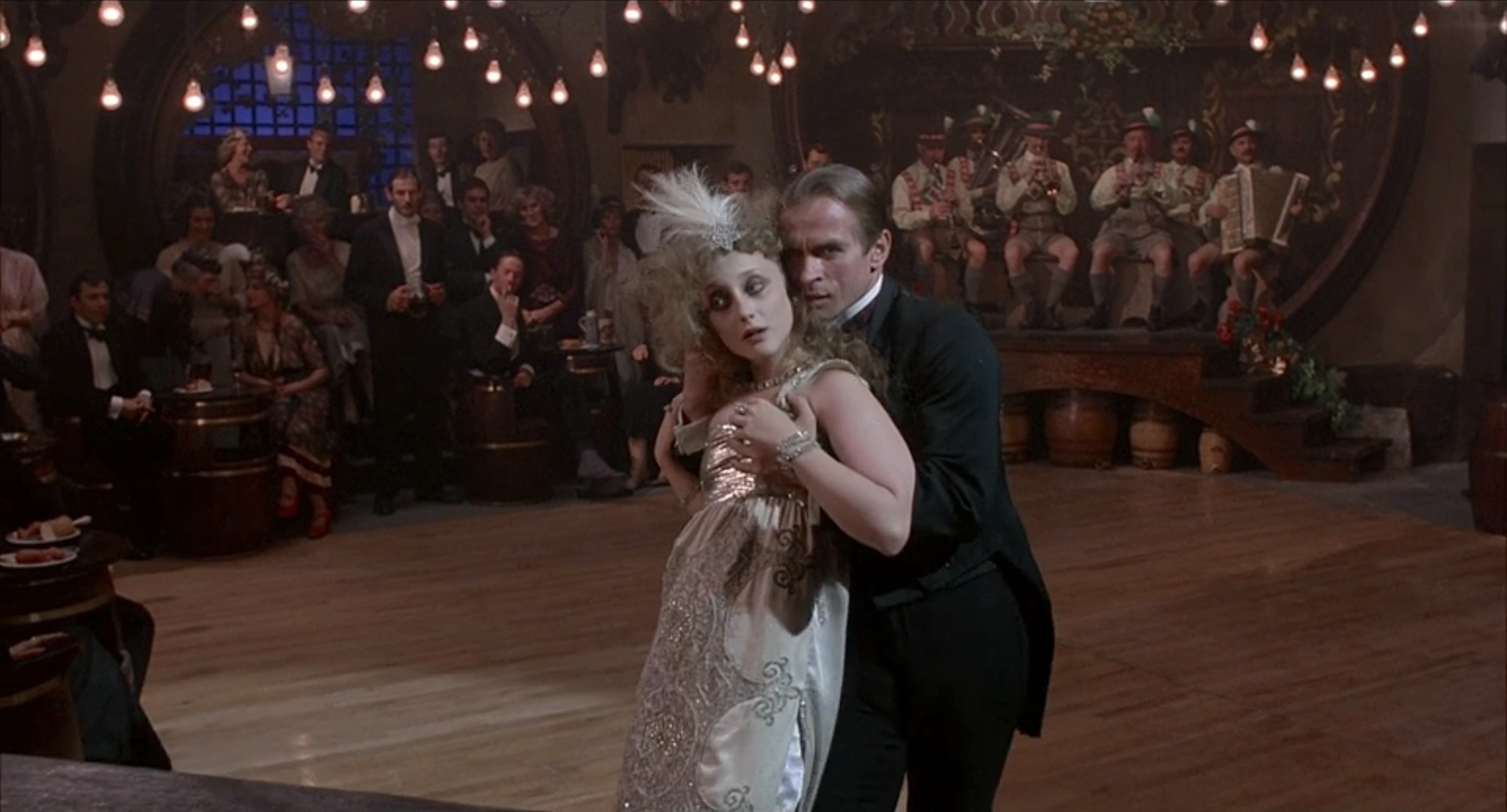
Valentino pulls Jean Acker onto the dance floor. Note the unique cut of his tailcoat.
Costume designer Shirley Russell dresses Valentino for post-Edwardian elegance in a unique blend of formal evening dress and burgeoning black tie-coded fashions. The shape and details of his black wool jacket follow some evening dress conventions, with a vestigial double-breasted front—with three non-functioning buttons on each side—that sharply cuts away to the back, though these rear tails are only slightly longer than a lounge jacket without approaching the knees as far as a full dress tailcoat.
The coat has a broad shawl collar, which had cyclical periods of popularity on tailcoats before it became more steadfastly associated with more informal black-tie dinner jackets. The sleeve-ends are finished with wide cuffs edged in black silk, rather than traditional buttons.
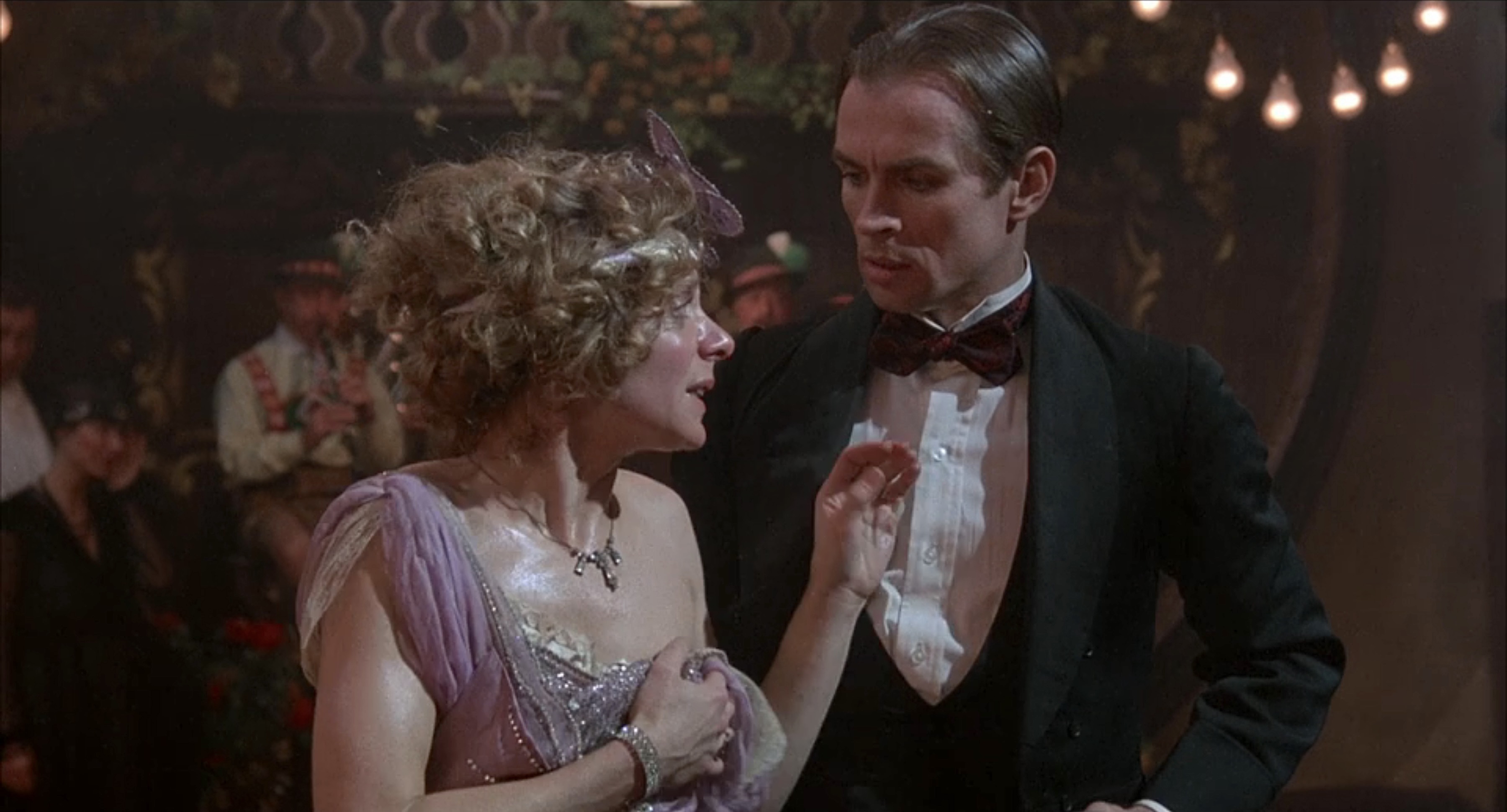
Valentino’s bow tie is neither white nor black but a dramatic swath of burgundy-on-black paisley jacquard silk, tastefully self-tying and in a substantial butterfly (thistle) shape. He wears it with a white cotton shirt that would be more black-tie than white-tie coded, styled with a front placket and square double (French) cuffs that he fastens with gold links, securing a stiff white wing collar around the neck to frame his tie.

The black wool waistcoat echoes the elevated formality of his modified tailcoat with its low-fastening opening that tapers to a V-shape above the single-breasted front with four buttons clustered above a shallow notched bottom. The narrow self-faced shawl collar mirrors his coat collar. Two pockets with jetted openings are positioned over the hips—presumably for a pocket watch, though Valentino foregoes one. The waistcoat achieves its purpose of competely masking the top of his trouser waistband.

The dancing suit’s matching black wool trousers rise appropriately high to Nureyev’s natural waist with narrow, tapered legs down to plain-hemmed bottoms, creating elegant lines that emphasize the 5’8″ actor’s lean frame and adds the effect of height while gliding across the dance floor. The trousers maintain their elegance with a lack of side pockets, which could create unsightly gaps while moving—nor would they serve much purpose here, given that there’s little that Valentino would need to carry while dancing.
Valentino holds up his trousers with light stone-colored cloth suspenders (brace) detailed with white bar stripes following the borders. They are rigged with silver-toned sliding adjusters and beige cloth double-eared straps that attach to buttons along the outside of his trouser waistband.

Valentino dances in spat boots, a period-specific hybrid footwear that incorporates the fussy-looking functionality of detachable spats (or “spatterdashes”) by integrating these cloth gaiters directly onto leather uppers. Valentino’s spat boots follow a traditional arrangement of gray suede button-up gaiters onto black polished leather cap-toe uppers, worn with black socks only faintly glimpsed above the suede.

Not prominently seen in this sequence but worthy of mention is that Nureyev eventually wears a yellow-gold Cartier Tank watch as Valentino had favored in real life, most prominently spied on his wrist in his final completed film: the 1926 silent romantic drama The Son of the Sheik.
Inspired by the new Renault tanks that Louis Cartier observed on the Western Front during World War I, the Tank emerged as one of the earliest successful wristwatch models following its production debut in 1919. Though Cartier continues to refine the Tank, the tasteful square Roman numeral-detailed dial tucked inside the rectangular case with its sapphire cabochon-surmounted crown remain hallmarks of the original design—now marketed as the “Tank Normale”.

What to Imbibe
As opposed to the boorish Fatty Arbuckle insisting on beer for everyone, Valentineo charms Jean Acker by pouring them rounds of her preferred Ramos Gin Fizz cocktails, assuring her that they are “nice and creamy”. As they should be, given the recipe that calls for 1½ oz. London dry gin, ½ oz. lemon juice, ½ oz. lime juice, two tablespoons of cream (there it is!), egg white, a tablespoon of superfine sugar (or simple syrup), and a few dashes of orange-flower water. These are to be shaken with ice for upwards of ten minutes until foamy, poured into a chilled wine glass, topped with club soda, and stirred to completion.
Some drinkers—including Louisiana’s bombastic governor Huey Long—advocate for the addition of vanilla extract, resulting in a minor but entertaining controversy in the latter months of the Kingfish’s life before his September 1935 assassination.
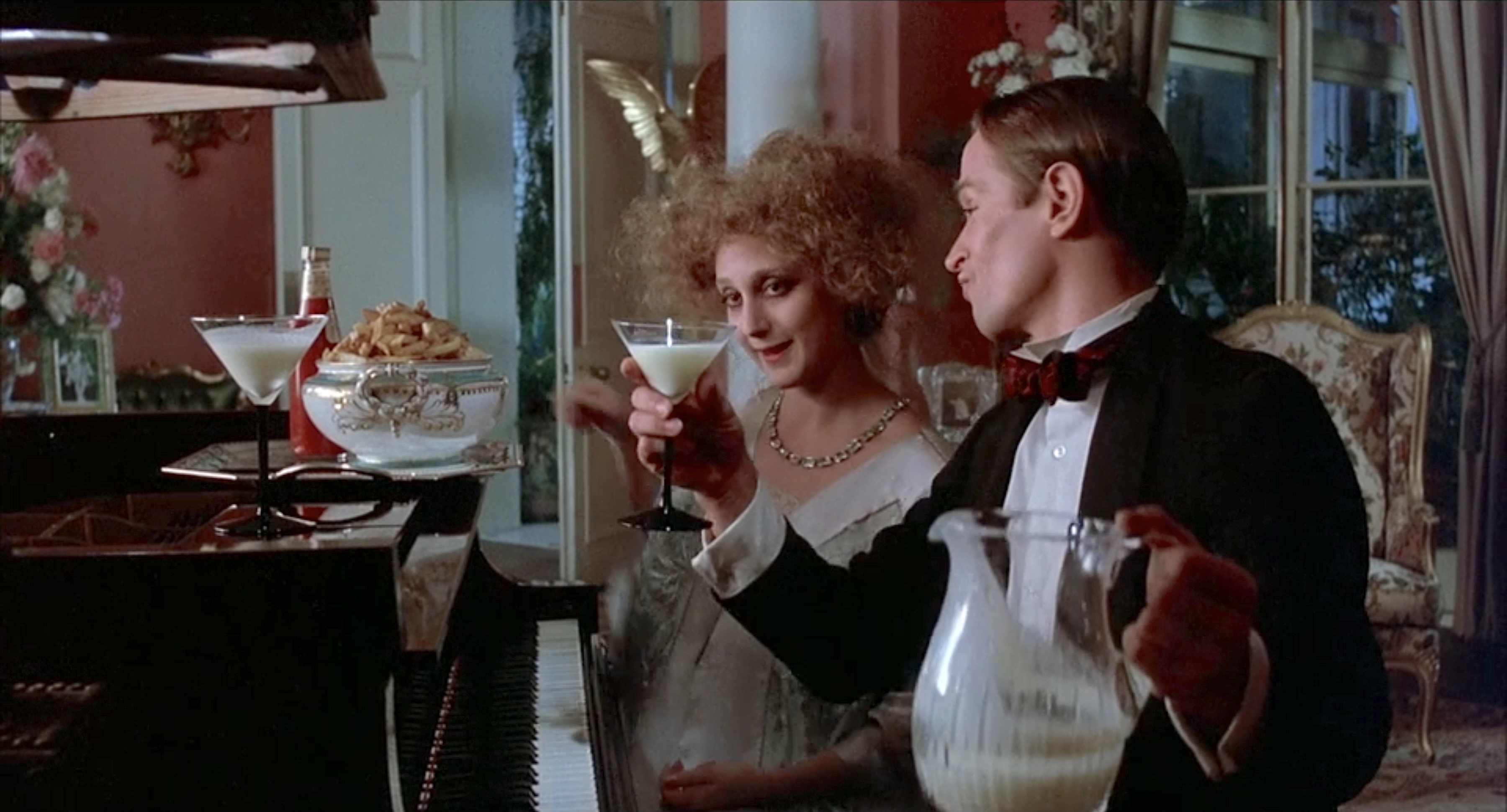
Jean complains that Fatty didn’t like her to order these “on account of he has to lose weight,” so the lean Valentino accompanies their late-night cocktails with a bowl of French fries and Heinz ketchup.
Unlike the conflicting origins of other famous cocktails, the Ramos Gin Fizz was indisputably invented in 1888 by New Orleans bartender Henry C. Ramos at the Imperial Cabinet Saloon… presumably without vanilla extract included. The drink’s popularity eventually resulted in Ramos needing to hire nearly three dozen “shaker boys” exclusively dedicated to spending the 12 minutes required to shake the concoction for thirsty Mardi Gras patrons. Valentino saves himself some time by preparing an entire pitcher for his night with Jean.
How to Get the Look

Rudolf Nureyev as Rudolph Valentino in Valentino (1977)
As a professional dancer trading on his exotic looks as much as his talent, Rudolph Valentino blends white- and black-tie conventions for a specific dance kit built on both form and function. This specific outfit may translate to a mere costume beyond the dance floor of a post-World War I nightclub (especially if one doesn’t quite have Nureyev’s build to replicate it), but it maintains the sartorial lesson of making educated modifications to an outfit to serve your purpose… which means knowing the “rules” in order to tactfully break them.
- Black wool English-tailored dancing suit:
- Modified tailcoat with self-faced shawl collar, vestigial 6×3-button double-breasted front, cuffed sleeve-ends, and short-tailed back
- Single-breasted 4-button waistcoat with narrow shawl collar, jetted hip pockets, and shallow notched bottom
- Flat-front high-rise trousers with outer waistband suspender buttons and plain-hemmed bottoms
- White cotton shirt with detachable stiff wing collar, front placket, and double/French cuffs
- Gold cuff links
- Burgundy-on-black paisley jacquard silk butterfly-shaped self-tying bow tie
- Stone and white edge-striped cloth suspenders with silver-toned adjusters and beige double-ear button hooks
- Black leather cap-toe spat boots with gray suede gaiters
- Black dress socks
Do Yourself a Favor and…
Check out the movie.
The Quote
I’m unattached, unemployed—no strings!
Discover more from BAMF Style
Subscribe to get the latest posts sent to your email.
You must be logged in to post a comment.