Charles Bronson’s Brown Suit in Farewell, Friend

Charles Bronson in Farewell, Friend (1968)
Vitals
Charles Bronson as Franz Propp, opportunistic thief, pimp, and former French Foreign Legion sergeant
Paris, December 1963
Film: Farewell, Friend
(French title: Adieu l’ami)
Release Date: August 14, 1968
Director: Jean Herman
Costume Designer: Tanine Autré
WARNING! Spoilers ahead!
Background
Charles Bronson was a steady supporting tough-guy presence in films like The Magnificent Seven (1960), The Great Escape (1963), and The Dirty Dozen (1967), though the western Pennsylvania-born actor found his first major breakthrough fame in Europe after starring opposite French superstar Alain Delon in the Franco-Italian heist caper Adieu l’ami (Farewell, Friend), released this month in 1968.
Bronson stars as Franz Propp, an American crook who served in the French Foreign Legion during the Algerian War, where he met regular Army doctor Dino Barran (Delon). Circumstances reunite Propp and Barran just before Christmas 1963, when the alluring Isabelle Moreau (Olga Georges-Perot) lures Barran into Propp’s plot to rob a company safe while the staff is out for the holidays, merely believing he will be helping Isabelle return stolen documents.
When Barran refuses to join Propp in the heist, Propp locks him in an antechamber and—spotting that Barran is out of cigarettes—taunts him with one of his own Marlboros. In desperation, Barran responds with the safe’s combination… proving that you can ask nearly anything from a Frenchman who is out of cigarettes.
It would be five years until Farewell, Friend was released in the United States (initially under the title Honor Among Thieves), capitalizing on Bronson’s growing American fame in films like The Mechanic (1972), The Valachi Papers (1972), and Death Wish (1974). After retiring from a career that leaned heavily toward action roles, Bronson died 23 years ago today on August 30, 2003.
What’d He Wear?
Once he’s out of uniform, Franz Propp exclusively wears a brown double-breasted suit that occasionally reflects a cooler, puce-like shade in certain light. The close tailoring is contemporary to late 1960s European fashion, with a slightly shorter jacket rigged with peak lapels that roll to high above the narrow 4×2-button wrap, affecting the look of a single-breasted jacket with a waist-slimming effect that makes Charles Bronson look taller than his 5’8½” stature.
The natural shoulders, simple straight jetted hip pockets, and the 4×2-button layout’s lack of vestigial buttons reflect the streamlined late ’60s Euro-minimalism. The jacket also has double side vents, three-button cuffs, and a welted breast pocket.

The minimalist details continue to Propp’s trousers, tailored with a beltless waistband (without side adjusters or anything!) and narrow leg that tapers down to the plain-hemmed bottoms. Unlike some contemporary tailoring solutions that maintained clean lines with full-top front pockets, Propp’s trousers appear to completely lack any pockets on the front, back, or sides, forcing Bronson to frequently stuff his hands into his jacket pockets.

Propp adds a mod touch with his brown suede plain-toe ankle boots, styled with high two-eyelet derby-style lacing and hard black leather soles. He wears them with plain black cotton lisle socks.

Propp’s style captures the transitionary period between trim, clean 1960s fashions and the coming ’70s excess with his white voile shirt’s large point collar, which neatly frames his tie knot and follows the lines of his jacket. Sheer voile shirt fabric is typically plain-woven from cotton or silk; Bronson’s screen-worn shirt suggests the latter, given its sheen.
With his tie removed, we see the wide, sharp neckband actually features two buttonholes that allow the wearer to adjust the height and tightness of how he fastens it through the single button on the opposing side. The rest of the shirt is relatively conventional, styled with a front placket, shirred barrel cuffs with single-button closure, and a breast pocket widely reinforced across the top with a mitred-corner yoke.

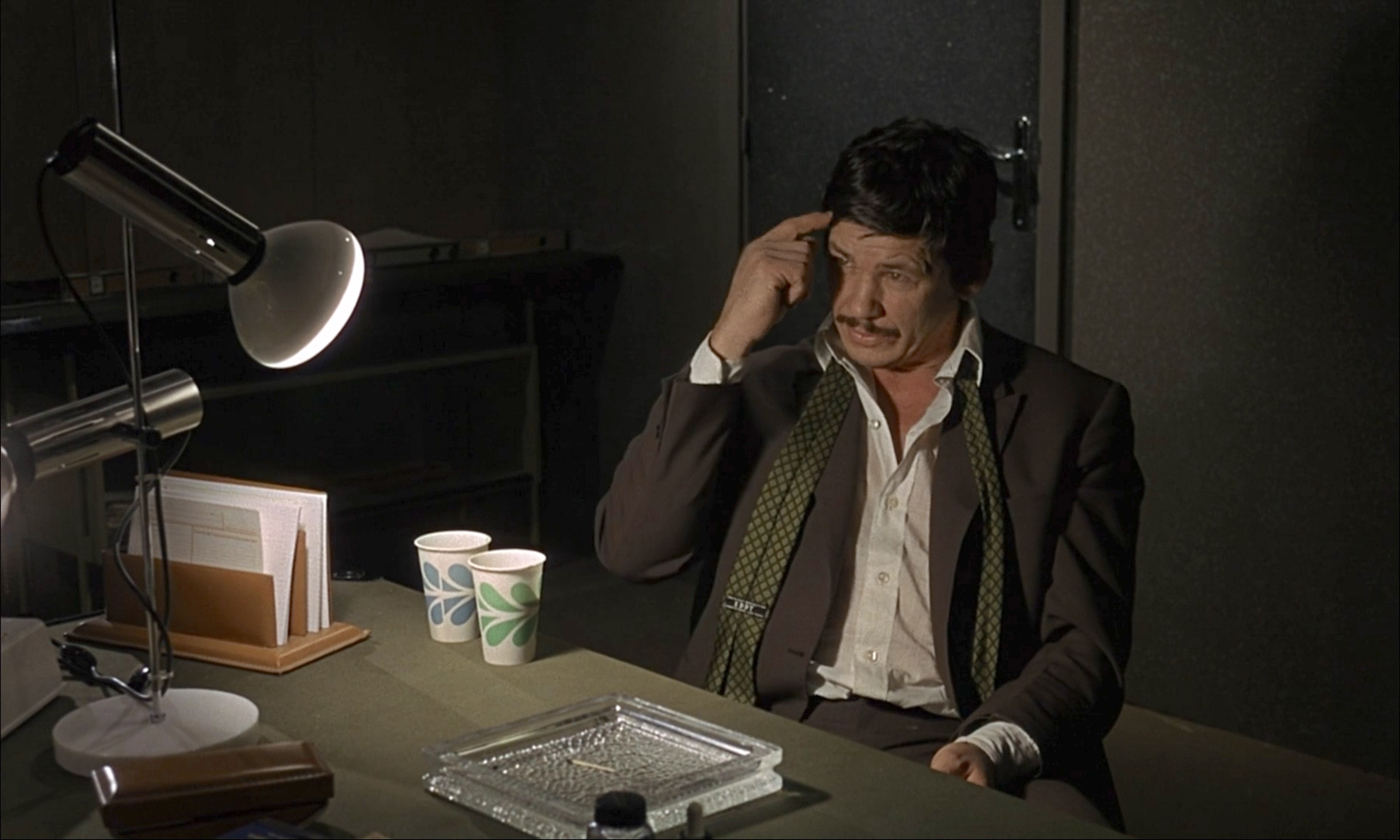
Propp’s tie is neatly arranged in a geometric grid of light-olive diamond-shaped squares against a darker green background. Each square is bordered in a lighter olive and smudged with five dots in a quincux like a die.
When Propp has his tie completely undone during his police interrogation, we see the tie’s label: black with white lines across the top and bottom flanking four white letters, the last almost certainly a “T”… unfortunately, this is all I can discern without being expert enough in 1960s European neckwear manufacturers to know who actually made it.

Farewell, Friend blesses its viewers with great shots of both men’s wristwatches. As opposed to the hefty functionality of Barran’s Enicar Sherpa Ultradive Super Compressor, Propp wears an elegant Longines Jamboree dress watch. (It’s well-documented that the Enicar was one of Alain Delon’s personal watches, but I’m not sure if Bronson owned his Longines.)
Longines produced the Jamboree through the 1950s and ’60s in both stainless steel and gold twist-back cases that house the 17-jewel, manually wound Longines caliber 280 movement. Dials ranged from fully non-numeric to many marked with Arabic 12, 3, 6, and 9 o’clock hour indices. Propp’s ref. 6884-5 Jamboree has a stainless steel 34.5mm case, its scratched crystal covering a plain white dial detailed with lume-filled, silver-toned dauphine hands and applied silver arrows non-numerically marking each hour. He wears it on a simple black leather 18mm strap.

Like any respectable crook worth his salt, Propp pulls on black leather gloves during the heist.
The Gun
Quipping that he needs money, Propp sells Barran’s “Smith & Wesson .45” war souvenir back to him. This accurately describes the Smith & Wesson M1917, at this point a half-century-old design that was developed as a quick response to the United States government’s demand for handguns to supplement the M1911 service pistol during World War I.
Requiring the new handgun to fire .45 ACP prompted both Colt and Smith & Wesson to modify existing revolver designs to fit half-moon clips designed by Joseph Wesson expressly for this purpose. Both companies produced just over 150,000 M1917 revolvers each to be issued to the American Expeditionary Force, though experts like Elmer Keith preferred the Smith & Wesson design—adapted from their existing .44 Hand Ejector.

What to Imbibe
Propp and Barran drink admittedly more than I would during the heist, beginning with bottles pulled from the company vending machine. Once they’re out of the trapped room and air shaft, Barran finds a bottle of Black & White whisky that both he and Propp take pulls from.
This blended Scotch originated in 1879 when founder James Buchanan (not to be confused with the United States’ fifteenth president, who preferred his home state’s Pennsylvania rye) developed a whisky he first called “Buchanan’s Blend”, then “House of Commons”, before its branding-informed nickname “Black & White” became its official name. During the 1890s, Buchanan introduced the whisky’s signature label illustration with a black Scottish terrier and a white West Highland White Terrier.

Following their escape, Propp and Barran drink red Beaujolais wine at a nearby bar.
How to Get the Look

Charles Bronson in Farewell, Friend (1968)
Franz Propp looks hip and fashionable in late 1960s France with his contemporary-tailored brown double-breasted suit, white voile shirt, geometric tie, manually wound Longines, and brown suede ankle boots.
- Puce-brown suit:
- Double-breasted narrow-wrap 4×2-button jacket with peak lapels, welted breast pocket, straight jetted hip pockets, 3-button cuffs, and double side vents
- Flat-front trousers with beltless waistband, tapered legs, and plain-hemmed bottoms
- White silk voile shirt with long point collar, adjustable 2-button neckband, front placket, yoke-reinforced breast pocket, and button cuffs
- Olive diamond-shaped square medallion grid-printed tie
- Brown suede derby-laced 2-eyelet plain-toe ankle boots
- Black cotton lisle socks
- Longines Jamboree stainless steel 34.5mm-cased manual-winding dress watch with round white dial (with silver non-numeric hour batons) on black leather strap
Do Yourself a Favor and…
Check out the movie.
The Quote
Farewell, friend.
Discover more from BAMF Style
Subscribe to get the latest posts sent to your email.
You must be logged in to post a comment.