Wild at Heart: Nicolas Cage’s Snakeskin Jacket as Sailor Ripley

Nicolas Cage as Sailor Ripley in Wild at Heart (1990)
Vitals
Nicolas Cage as Sailor Ripley, an A #1-certified manslaughterer who just broke parole
Cape Fear to Texas via New Orleans, Fall 1989
Film: Wild at Heart
Release Date: August 17, 1990
Director: David Lynch
Costume Designer: Amy Stofsky
WARNING! Spoilers ahead!
Background
This week continues to explore unconventional style from David Lynch movies with a long-overdue look at Nic Cage’s snakeskin jacket as the swaggering Sailor Ripley in Wild at Heart, Lynch’s darkly comic adaptation of Barry Gifford’s 1989 novel of the same name. The film premiered at the 1990 Cannes Film Festival where it garnered some controversy for winning the Palme d’Or, three months prior to its wider North American release in August 1990.
Specifically considered for the role after Lynch read Gifford’s novel, Cage described Sailor as “a kind of romantic Southern outlaw,” reunited with his girlfriend Lula Fortune (Laura Dern) after spending 22 months and 18 days in the Pee Dee Correctional Institution for fatally defending himself—and Lula’s honor—against an attacker hired by Lula’s domineering mama Marietta (Dern’s real-life mother Diane Ladd) after Sailor spurned her drunken advances. Two years has done little to dampen Marietta’s dislike for Sailor, who again sends paid killers on Sailor’s trail as he and Lula flee Cape Fear on their way west to sunny California. Their dwindling funds get them no farther than a dusty detour to Big Tuna, Texas, where their path intersects with the sadistic career crook Bobby Peru (Willem Dafoe), who violates Lula and recruits Sailor into a feed store robbery.
With a cast full of the director’s frequent future collaborators like Harry Dean Stanton, Sherilyn Fenn, Sheryl Lee, Jack Nance, Isabella Rossellini, and Grace Zabriskie, Wild at Heart maintains Lynch’s unique lens of American nostalgia, specifically The Wizard of Oz and Elvis Presley. Lula mentions her favorite song by the latter is “Love Me Tender”, which was released 70 years ago today on September 14, 1956, just three weeks after the King recorded this Ken Darby-penned update of George R. Poulton’s Civil War ballad “Aura Lee”. When Lula asks why Sailor didn’t sing it to her (after he instead led speed metal band Powermad singing Presley’s similarly titled “Love Me”), he responds that he would only ever sing it to his future wife.
Other than Cage’s renditions of them, no actual Elvis songs appear on the soundtrack which ranges from ’50s classics like Gene Vincent’s “Be-Bop-A-Lula” (played as Sailor repeatedly be-bops Lula) to modern rock like Powermad’s “Slaughterhouse” (the film’s de facto theme) and Chris Isaak’s “Wicked Game”, which resulted in Lynch casting Isaak as FBI agent Chet Desmond in Twin Peaks: Fire Walk with Me.
What’d He Wear?
“My snakeskin jacket! Thanks, baby!” Sailor earnestly exclaims as Lula surprises him with his python-scaled sports coat upon his release from prison. “Did I ever tell you that this here jacket represents a symbol of my individuality and my belief in personal freedom?” He later repeats the maxim when a punk tells him he looks “like a clown in that stupid jacket.”

The screen-worn snakeskin jacket belonged to Nicolas Cage, who found it in the Melrose Avenue secondhand store Aaardvark’s Odd Ark about a year before he even met with David Lynch for Wild at Heart. “It reminded me of the jacket Brando wears in The Fugitive Kind,” he recounted to The Guardian in 2025, adding “I knew at some point I was gonna put it in a movie.”
Like Marlon Brando’s celebrated jacket from The Fugitive Kind, Cage’s snakeskin jacket is likely crafted from the skin of a python—characterized by its irregular black blotches outlined against the golden tan ground and surrounded by much smaller retriculated scales.
Unlike Brando’s jacket, it follows a more conventional sports coat design with notch lapels tapering to a three-button front, with each button covered in matching snakeskin. In case its snakeskin shell didn’t already signal that the wearer was something of a cowboy, the jacket is detailed with a single western-style pointed yoke across the back and on each front panel, in lieu of the traditional breast pocket. The set-in hip pockets echo these yokes with pointed flaps that each close with a single snakeskin-covered button.

The sleeves are left plain at each cuff, and the back is split with a single vent. Bi-swing pleats behind each shoulder allow Cage a greater range of arm movement, which is particularly suitable when dramatically punching the air after getting ready for a night out with Lula.
After production wrapped, Cage eventually gifted the jacket to his co-star Laura Dern. Presumably, Dern also eventually parted with the jacket as it was auctioned alongside one of Cage’s screen-worn T-shirts, jeans, and boots in 2017. The auction describes the jacket with an “internal Evon Matheau maker’s label,” referring to a now-defunct Beverly Hills brand. While this may be true of the auctioned jacket (why wouldn’t it be?), the brief glimpses we get of the jacket’s label on screen appear to show the familiar logo for Texas-based bootmaker Justin, consisting of a red “J” followed by its white-lettered name against a black oval.
Early in the film, Sailor dons a royal-blue shirt with a spread collar, button cuffs, and a pair of button-through pockets. By the time he and Lula get to the nightclub, his shirt looks much darker and appears to lack pockets. However, the shirt is clearly blue again when they’re in New Orleans.

Sailor dresses for a night out in Cape Fear, flashing the Justin label of his snakeskin jacket as he pulls it on over his blue shirt.
Sailor otherwise rotates through a half-dozen shirts under his snakeskin jacket, most frequently a plain black cotton crew-neck short-sleeved T-shirt with a pocket.

Sailor later breifly wears a brick-red cotton crew-neck short-sleeved T-shirt when asking Perdita Durango (Rossellini) if there’s a contract out on him.

The last and least frequently seen of Sailor’s T-shirts is a light heather gray cotton tee, following the same short-sleeved, crew-neck design as the others.

Blink and you’ll miss Sailor’s light heather gray T-shirt, worn only for this vignette at the wheel of his T-bird but prominently featured in set photography (as you’ll see at the bottom of this post.)
During the awkward night in the Big Tuna trailer camp, Sailor nods to his jacket in a black long-sleeved button-up shirt with double snakeskin strips down each side of the front.

Later in Big Tuna, Sailor wears a white tank top—perhaps a crew-neck tee with the sleeves cut off—when Bobby Peru interrupts his putting fresh oil in the T-bird to invite him out for a beer.

Sailor always wears black Levi’s 501® jeans, possibly a reference to the myth that Elvis Presley himself publicly debuted the first pair of black Levi’s jeans while promoting Jailhouse Rock in 1957. Levi Strauss & Co. historian Tracey Panek corrected this rumor in a 2021 blog post, sharing that black Levi’s jeans date back to at least 1903 with the “Spring Bottom” pants offered in a black 9-oz. denim twill. However, it may not have been until the 1980s when Levi’s introduced a black wash to their flagship 501® Original Fit jeans.
As modeled by Cage throughout Wild at Heart, these are styled with the 501®’s trademark button-fly and classic five-pocket configuration—two patch-style back pockets, two front pockets, and a smaller watch/coin pocket inset on the right side. According to the aforementioned auction listing, Cage’s screen-worn jeans had a size 32 waist and 34 inseam. He holds them up with a worn black leather belt, detailed with subtle gray whip-stitching intermittently laced across the center. The belt closes through a polished silver-toned single-prong buckle in a slightly bloated western shape.

If you’re truly invested in going full Sailor style, you gotta balance the cool snakeskin jacket with more questionable underwear. Sail’s black cotton briefs are indeed quite brief, styled with a jock strap’s front pouch but a fully covered seat. His pale-gray ribbed cotton boot socks extend high on each calf, ringed at the top with a more tightly elasticized dark-brown band.

Some Caged heat for Nic’s super-fans out there.
Sailor appropriately grounds his western-inspired snakeskin jacket and jeans with cowboy boots that he frequently shines to a glossy finish. His boots maintain Sailor’s chromatic scheme with their black leather uppers, heavily scaled like a reptile skin that thematically unites them with his snakeskin jacket. Built on dark-brown hard leather soles, these boots have a pointed toe and decoratively stitched shafts.
The auction listing describes cowboy boots made by El Paso bootmaker Tony Lama; while Cage may have indeed worn Tony Lama boots in Wild at Heart, the listing shows smoother uppers with the traditional bug-and-wrinkle stitching not present on Cage’s screen-worn boots.

Sailor’s distinctive sunglasses have large black acetate trapezoidal lens frames and a narrow gold bar running straight across the browline, gently dipping forward over the bridge and continued onto the arms. In keeping with his retro fashion sensibilities, these were especially popular during the 1970s when both Persol and Ray-Ban sold nearly identical designs; however, the Persol Ratti PP 508 maintained a connecting acetate bridge behind the gold bar while the Ray-Ban Olympian II acetate pieces were separate, connected only by the continuous gold bar.
Due to the latter detail as well as their straighter temple arms, Cage appears to be wearing the Ray-Ban Olympian II (in black-and-gold color code L1004), despite Persol claiming credit for Cage wearing their PO2458S model in both Wild at Heart and Leaving Las Vegas.
Ray-Ban introduced the Olympian I and II models in 1965, differentiated by the Olympian I’s smaller, rounder lenses and all-metal frame. Sailor’s sunglasses clearly predate when Ray-Ban began etching their logo into the corner of the right lens in the ’80s. Though Ray-Ban has reconfigured the Olympian II model, vintage examples like Sailor’s shades can still be purchased from secondhand sellers on sites like eBay and Etsy.

In the post-quartz revolution age as digital watches and flashy status watches dominated the ’80s, Sailor’s classic dress watch may also symbolize his individuality and belief in personal freedom. The watch itself consists of an approximately 36mm gold-plated or solid gold case, dominated by a mirrored silver dial with non-numeric gilt dots indexing each hour around the edge. A gold chain-link bracelet attached to the fixed lugs reflect a retro rockabilly-informed elegance.

The epilogue advances us nearly six years, after Sailor has completed his sentence. He emerges from prison wearing his same snakeskin jacket but with a different black shirt and pants. The long-sleeved shirt has seven white buttons up the front, with the two chest-pocket flaps each closed through a matching white button. He tucks the shirt into roomy black silk pleated trousers, styled with belt loops, side pockets, and narrow turn-ups (cuffs), maintaining the aesthetic but updating the sophistication from his earlier appearance.

POV: You see someone who, if he is truly wild at heart, will fight for his dreams.
The Car
What symbolizes personal freedom more clearly than hitting the open road in a classic convertible? Sailor and Lula embark on their road trip in a black 1965 Ford Thunderbird, the second year of this luxury sports car’s fourth-generation redesign.

Though the 1964-66 T-bird generation maintained much of the Space Age-informed body of Bill Boyer’s bullet-like 1961 redesign (and the unibody construction dating back to Joe Oros’ 1958 “Square Bird”), the ’64 styling squared off some of its edges while initially keeping the straight grille design with its quad headlights.
Ford offered the two-door Thunderbird as a hardtop coupe, convertible, or carriage-informed landau, though the only powertrain for 1964 and ’65 was a Ford’s FE-series 390 cubic-inch V8 generating 300 horsepower and exclusively mated to a three-speed Cruise-O-Matic automatic transmission. (The 390 V8 remained standard for ’66, albeit with a 15-horsepower increase, and an optional 428 cubic-inch V8 pushing 345 horsepower was added.)
What to Imbibe
Sailor and Lula’s road trip through the South includes a parade of regionally informed spirits at every stop, including:
- Dixie beer in New Orleans
- Jack Daniel’s Tennessee whiskey at the Big Tuna motor camp, where one of their fellow strandees offers some to Bobby Peru (“have yourself another glass of Jack”)
- Lone Star beers with Bobby in Texas

The Gun
In the trunk of Bobby’s burgundy 1976 Cadillac Eldorado, he reveals to Sailor: “a double-barreled, sawed-off Ithaca shotgun… next to it, you got a cold Smith & Wesson .38 handgun with a four-inch barrel.” Though it appears as a Smith & Wesson Model 15 in this establishing shot, the revolver that Sailor carries for the feed store robbery is an older Smith & Wesson Model 10 design, also chambered in .38 Special with a four-inch barrel but differentiated by simpler fixed sights rather than the adjustable rear and ramped front sights of the Model 15 “Combat Masterpiece”.
The quintessential six-shot American service revolver, the Model 10 dates to Smith & Wesson’s .38 Hand Ejector revolver, introduced in 1899 when it was swiftly rebranded as the “.38 Military & Police” after orders from the U.S. Army and Navy. Now a standard in revolver design, its traditional double-action trigger and swing-out cylinder were still relatively recent developments at the turn of the 20th century, and—combined with the power of its then-new .38 Special cartridge—this Smith & Wesson revolver became quickly adopted by American law enforcement agencies. In the late 1950s, Smith & Wesson standardized its revolver nomenclature so the Military & Police became the Model 10. More than six million of these revolvers have been produced in varying barrel lengths since its introduction.

Sailor’s Model 10 turns out to be filled with blank ammunition (“Those are dummies, dummy,” Bobby giggles) as Bobby had set Sailor up on behalf of gangster Marcellus Santos (J.E. Freeman).
How to Get the Look
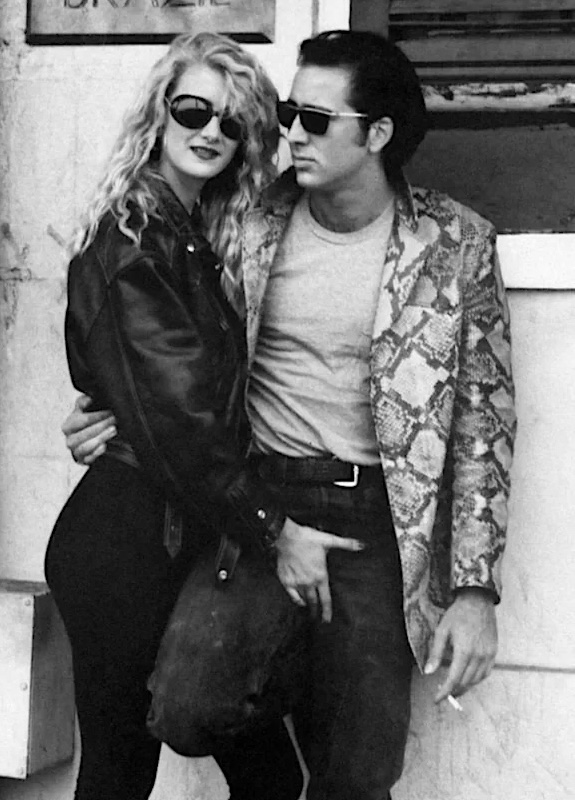
Nicolas Cage and Laura Dern in Wild at Heart (1990)
What do you wear to represent your individuality and belief in personal freedom?
- Tan-and-black python/snakeskin single-breasted 3-button jacket with western-pointed yokes, pointed-flap hip pockets, plain cuffs, bi-swing rear shoulder pleats, and single vent
- Justin
- Black, brick-red, or light heather-gray cotton crew-neck short-sleeve T-shirt with breast pocket
- Black cotton denim straight-leg jeans with belt loops, button-fly, and five-pocket layout
- Levi’s 501® Original Fit
- Black leather belt with decorative gray whip-stitched lacing detail and silver-toned single-prong buckle
- Black reptile-skin scaled leather pointed-toe cowboy boots with decorative shafts and dark-brown hard leather soles
- Pale-gray ribbed cotton boot socks with dark-brown ringed tops
- Black jock briefs
- Black acetate trapezoidal-framed sunglasses with continuous gold brow bar and temples
- Ray-Ban Olympian II (L1004)
- Gold vintage dress watch with mirrored silver dial on gold chain-link bracelet
Do Yourself a Favor and…
Check out the movie.
The Quote
If ever somethin’ don’t feel right to you, remember what Pancho said to the Cisco Kid: “Let’s went, before we’re dancing at the end of a rope without music.”
Discover more from BAMF Style
Subscribe to get the latest posts sent to your email.
This is a great movie I especially enjoy the scenes with Willem Dafoe. Great soundtrack too I like the haunting melody by Chris Isaak. Five stars for the wardrobe too the snakeskin jacket definitely lives on with a life of its own. I wonder why Laura Dern sold it?