Tagged: 1980s
Eddie Murphy’s Glen Plaid Suit in 48 Hrs.

Eddie Murphy in 48 Hrs. (1982)
Vitals
Eddie Murphy as Reggie Hammond, smooth criminal
San Francisco, Summer 1982
Film: 48 Hrs.
Release Date: December 8, 1982
Director: Walter Hill
Costume Designer: Marilyn Vance
WARNING! Spoilers ahead!
Background
Happy 65th birthday to Eddie Murphy, born April 3, 1961! Following his success as a stand-up comic and on Saturday Night Live, Murphy made his screen debut opposite Nick Nolte in 48 Hrs. Though often considered seminal in the “buddy cop” subgenre, half the duo isn’t even a cop as Murphy plays smooth-talking ex-con Reggie Hammond, reluctantly paired with Nolte’s brusque SFPD Inspector Jack Cates.
With six months left on his three-year sentence for armed robbery, Reggie convinces Jack that his assistance is essential to capture his former associate, the vicious killer Albert Ganz (James Remar). Once Jack secures a temporary 48-hour release for his new partner, it becomes clear that Reggie’s primary goal is a “trim hunt” as he’s constantly on the make. But he eventually relishes working on the other side of the law, taking the lead in rousting a sawdust joint where one of Ganz’s accomplices used to work:
And I want the rest of you cowboys to know something! There’s a new sheriff in town, and his name is Reggie Hammond. Y’all be cool. Right on.
What’d He Wear?
Jack: This prison give out $400 suits?
Reggie: $957, and I wore this shit in.
Jack: We’re after a killer, not a bunch of hookers.
Reggie: Yeah, well I got a reputation for lookin’ real nice with the ladies, man.
Two years after the designer’s threads turned heads in American Gigolo, Giorgio Armani was again commanding cinematic attention as costume designer Marilyn Vance outfitted Eddie Murphy in an Armani-made Prince of Wales check suit described in the original screenplay as “a beautifully tailored plaid suit.”
Maintaining his rep for style, Reggie’s wool suiting has a black-and-cream glen plaid foundation and a muted red windowpane overcheck. One of Murphy’s screen-matched suits was auctioned by Prop Store, though the original screen-worn gray buttons appear to have been replaced with light-brown buttons at some point during the four decades between the film’s release and the November 2022 auction.

While some use “glen plaid” and “Prince of Wales check” interchangeably, a true Prince of Wales check consists of a glen plaid base with a colored overcheck as seen on Reggie Hammond’s suit.
The suit demonstrates many hallmarks of 1980s tailoring, including its double-breasted jacket rigged with low-gorge notch lapels—an uncommon combination that was most popular during the decade. The shoulders are padded, framing a full fit that continues through the ventless skirt. The four buttons are configured in a 4×1 arrangement known as “Kent” style as this was popularized by Prince George, the Duke of Kent. The straight jetted hip pockets are supplemented by a welted breast pocket that Reggie dresses with a pale slate-gray silk pocket square.

The flat-front suit trousers have side pockets, button-through back pockets, and plain-hemmed bottoms. Rising to just below Murphy’s waist, the trousers are held up with a brown leather belt that closes through a small silver-toned square single-prong buckle.

Reggie’s pale-pink cotton shirt nicely coordinates to the muted red overcheck in his suiting. It has a breast pocket, button cuffs, and a narrow collar held neatly in place with a gold clip. This pushes forward the four-in-hand knot of Reggie’s skinny dark indigo tie with its printed pinkish oval medallions against a tonal cross-hatched ground.

Reggie counters the businesslike suiting and fussy shirt collar with flashy all-white loafers—styled with an apron-toe, fixed instep straps, and dark brown leather soles. He wears them with thin mid-gray dress socks which effectively continue his trouser leg-lines into the shoes.

Both Murphy and Nolte wear their watches on their right wrist; while Nolte’s Jack Cates wears an affordable “Blue Thunder” Casio digital piece, Reggie opts for a more luxurious yellow-gold watch on a matching bracelet. Detailed simply with gold baton-style indices, the large white dial fills out the gold-finished TV-shaped case. Often powered by quartz movements, these TV-case watches resembled a hybrid of tonneau- and cushion-cased styles and were popular through the 1970s and ’80s from watchmakers like Bulova, Citizen, Omega, and Seiko. (When Murphy famously played a policeman two years later in Beverly Hills Cop, Axel Foley followed Inspector Cates’ example by wearing a more affordable Casio.)
Two gold rings shine from the last two fingers of Reggie’s right hand: a ridged band on his pinky and a chunkier ring with a row of diamonds on his ring finger.

Murphy would later reprise the role—and the suit—in the 1990 sequel, Another 48 Hrs.
The Guns
Jack refuses to arm Reggie, but Reggie takes care of that himself—first by knocking out the fleeing Luther Kelly (David Patrick Kelly) and disarming him of his heavy Colt revolver. Luther’s piece follows the aesthetic of most early 20th century Colt revolvers with its free-hanging ejector rod and wooden grips, with the larger frame, wide bore, and front sight’s shape specifically suggesting the Colt New Service revolver.
This heavy-duty double-action revolver was introduced in 1898 and produced in a variety of calibers over nearly a half-century, including .357 Magnum, .44 Special, .44-40 Winchester Center Fire (WCF), .45 Long Colt, and even .45 ACP, with the latter two calibers adopted for U.S. military service as the Model 1909 and M1917, respectively.

Reggie is a little cavalier with trigger discipline when handling Luther’s Colt New Service.
After Jack forces him to surrender the New Service, the wily Reggie secures himself another sidearm by slipping a Jennings J-25 from a redneck in a cowboy bar. Made from a zinc alloy, these budget subcompact pistols were a common “Saturday night special” during the 1970s and ’80s.
Jennings Firearms was founded in 1978 by Bruce Jennings, son of Raven Arms founder George Jennings, establishing its lineage among what the ATF described as the “Ring of Fire” of inexpensive firearms manufacturers that would be re-established as Bryco Arms, Jiminez Arms, and ultimately JA Industries over the course of several bankruptcies and legal issues over the following four decades. (For reference, the 14th edition of The Official Gun Digest Book of Guns & Prices suggests that a Model 25—even in “Excellent” condition—would be worth no more than $90. Compare this to $300 for a late model Colt New Service in “Poor” condition!)
That should tell you all you need to know about the type of gun Reggie lifts—and the type of person he nabbed it from. The blowback-operated J-25 was one of the first pistols produced after Jennings Firearms was founded, fed from a six-round magazine of anemic .25 ACP ammunition and ripe with Jennings/Bryco/Jiminez’s characteristic reliability issues. But J-25 buyers typically weren’t serious shooters, instead just needing something concealable that—occasionally—could go bang.
In the era before trusty 9mm subcompacts, the J-25’s strongest asset was its size, measuring less than five inches overall with a 12-ounce weight. Unfortunately for Reggie, the Jennings wasn’t small enough to go unobserved by Jack. Reggie makes the case to keep it but doesn’t appreciate Jack keeping the magazine, so he tosses it down the street in protest.

Reggie lifts a bar patron’s Jennings J-25.
Third time’s the charm. “I’ll let you in on a little secret, Jack,” Reggie confides before showing Jack the snub-nosed Smith & Wesson Model 19 revolver in his trouser waistband. “Keep it, I’m too tired to argue about that,” Jack responds with resignation.
Twenty years after they pioneered the .357 Magnum cartridge, Smith & Wesson introduced the double-action “.357 Combat Magnum” in 1955 with its heavy, four-inch barrel in response to shooting expert Bill Jordan’s vision for a “peace officer’s dream” handgun. Two years later, this was re-designated the Model 19 when Smith & Wesson changed to a numbered nomenclature. The Model 19 was initially only produced with a four-inch barrel, with six-inch and 2.5-inch barrel options added in the 1960s.

According to IMDB, Eddie Murphy shared on Inside the Actors Studio that he didn’t know how to “act” when drawing a gun, so he started mimicking the face Bruce Lee made when preparing for battle.
What to Imbibe
At the country-and-western bar Torchy’s, Reggie requests “preferably some vodka,” which prompts the bartender (Peter Jason) to sternly suggest a Black Russian. Reggie laughs it off, but insists on just “plain old vodka… that’d be nice,” so the bartender pours him a shot of Smirnoff.

He clearly likes vodka, ordering “vodka with a twist” when beginning his tab at Norman’s.
The Car
We only see him drive it at the very end, but much of the plot revolves around the money stashed in the trunk of Reggie’s dust-covered Intermeccanica 356 A Speedster—a replica of the famous 1950s Porsche model. Frank Reisner founded Intermeccanica in 1959 in Turin, where it initially manufactured automotive tuning kits.
After developing its own designs, Intermeccanica relocated to North America in 1975, when it refocused on replica cars like the Porsche 356 Speedster facsimile first offered the following year. Approximately 600 Speedster replicas were built in California during Reisner’s initial partnership with Tony Baumgartner prior to operations moving to Vancouver, where it continues building Speedster (“S”) and Roadster (“D”) replicas today.

Though Jack had Reggie’s Speedster impounded and cleaned before giving it back to him, he still has to drive as Reggie’s license likely expired during his time served.
Reggie’s Speedster makes its first appearance when he and Jack surveil Luther retrieving it from three years stored in a parking garage. “I didn’t know you darker people went in for foreign jobs,” Jack comments of the car’s European-informed design.
“Yeah, well, I had no choice, some white asshole bought the last piece-of-shit sky-blue Cadillac,” Reggie retorts in reference to Jack’s dilapidated ’64 Coupe de Ville convertible that they’re following in.

How to Get the Look

Eddie Murphy in 48 Hrs. (1982)
“Look at you, you got a $500 suit on and you’re still a lowlife,” Jack comments. “Yeah, but I look good,” Reggie responds.
- Black-and-cream glen plaid with muted red windowpane overcheck Prince of Wales check suit by Giorgio Armani:
- Double-breasted jacket with low-gorge notch lapels, 4×1-button front, welted breast pocket, straight jetted hip pockets, 2-button cuffs, and ventless back
- Flat-front trousers with belt loops, side pockets, button-through back pockets, and plain-hemmed bottoms
- Pale-pink cotton shirt with narrow collar, breast pocket, and button cuffs
- Gold collar clip
- Dark-indigo tonal cross-hatched tie with pinkish medallion print
- Brown leather belt with silver-toned squared single-prong buckle
- White leather apron-toe fixed-strap loafers
- Mid-gray dress socks
- Gold diamond-studded ring
- Gold ridged pinky ring
- Gold TV-shaped dress watch with white dial and gold bracelet
Do Yourself a Favor and…
Check out the movie.
The Quote
I’ve been in prison for three years. My dick gets hard if the wind blows.
Val Kilmer’s Leather Jacket in Top Secret!

Val Kilmer and Lucy Gutteridge in Top Secret! (1984)
Vitals
Val Kilmer as Nick Rivers, American rock star who is not Mel Tormé
East Germany, Fall 1983
Film: Top Secret!
Release Date: June 22, 1984
Directed by: Jim Abrahams, David Zucker, and Jerry Zucker
Costume Designer: Emma Porteous
WARNING! Spoilers ahead!
Background
Val Kilmer died one year ago today on April 1, 2025 at age 65, following a prolific career demonstrating his versatile talent for action, comedy, and drama across a range of genres. He made his screen debut in 1984 starring in Top Secret!, the Zucker-Abrahams-Zucker team’s follow-up to Airplane! and Police Squad. Filled with ZAZ’s trademark sight gags and wordplay, the movie was conceptualized as a modern spy spoof that blended elements of World War II espionage thrillers with Elvis Presley’s musicals of the 1950s and ’60s.
Even with a nonexistent screen resume before he was cast, Kilmer proved he was ready for the task with his signature dedication: dressed as Elvis for his audition and performing every song for the soundtrack, including the Beach Boys-inspired “Skeet Surfin'” over the opening credits.
Kilmer stars as Nick Rivers, a ’50s-like rockabilly singer whose global stardom seems to even eclipse Stevie Wonder, Linda Ronstadt, and Frank Sinatra on billings. After Leonard Bernstein is unable to attend, Nick is hired by the East German government to perform at the cultural festival that they’re hosting as a diversion from their plan to reunite Germany under totalitarian rule. Already something of a rebel, Nick’s trip grows more complicated as he falls for the mysterious Hillary Flammond (Lucy Gutteridge), a member of the local resistance group. Continue reading
The Living Daylights: Timothy Dalton’s Casual Tan Suit as 007

Timothy Dalton as James Bond in The Living Daylights (1987)
Vitals
Timothy Dalton as James Bond, British government agent
Tangier, Morocco, Fall 1986
Film: The Living Daylights
Release Date: June 27, 1987
Director: John Glen
Costume Designer: Emma Porteous
Costume Supervisor: Tiny Nicholls
Tailor: Benjamin Simon
WARNING! Spoilers ahead!
Background
Happy 80th birthday to Timothy Dalton! Born March 21, 1946 in Wales, Dalton became the fourth actor to portray James Bond when he starred in The Living Daylights in 1987. He had actually been approached several times for the role over the previous decades but initially felt too young—and too intimidated—to replace Sean Connery. Still, the part may have been in his blood: his father, Peter Dalton Leggett, served in the Special Operations Executive (SOE), the real-life British World War II unit that inspired Ian Fleming to write several of Bond’s literary adventures.
Though he only officially starred as 007 twice on screen, Dalton’s portrayal has enjoyed renewed appreciation for its fidelity to the harder-edged tone of Fleming’s source material and how this may have inspired Daniel Craig’s later characterization.
One of my favorite suits and scenes from The Living Daylights takes Bond to Tangier, where the agent confronts KGB director Leonid Pushkin (John Rhys-Davies)—using the general’s girlfriend (Virginia Hey) as a decoy when a bodyguard storms in the hotel room. Commanding the situation with his silenced Walther PPK, Bond settles the tension with the Soviet general as they mutually agree to stage a public assassination.
Scripted by stalwart Bond screenwriters Richard Maibaum and Michael G. Wilson, the scene plays like a lost Fleming chapter—firmly rooted in late Cold War-era espionage while also showcasing a sharp suit that feels like perfect inspiration for spring style and warmer days ahead. Continue reading
Body Double: Craig Wasson’s Tan Corduroy Sport Jacket

Craig Wasson and Deborah Shelton in Body Double (1984)
Vitals
Craig Wasson as Jake Scully, sensitive struggling actor
Los Angeles, January 1984
Film: Body Double
Release Date: October 26, 1984
Director: Brian De Palma
Costume Designer: Gloria Gresham
WARNING! Spoilers ahead!
Background
After a long, cold winter, the promise of a milder spring invites us to trade heavy wool coats and thick sweaters for lighter, transitional layers—think the corduroy-anchored wardrobe of Jake Scully in Brian De Palma’s Hitchcock-inspired Body Double. This 1984 erotic thriller stars Craig Wasson (born 72 years ago today on March 15, 1954) as Jake, a claustrophobic struggling actor who loses his most promising gig, his girlfriend, and his apartment in one swift collapse.
The cuckolded Jake ultimately stumbles into a promising new arrangement, house-sitting a swingin’ Hollywood Hills pad for the enigmatic Sam (Gregg Henry), who explains it’s “one struggling actor helpin’ out another, that’s what it’s all about, right?” Filmed at the John Lautner-designed modernist Chemosphere off Mulholland Drive, the joint comes with a telescope conveniently pointed into the neighboring home of striking brunette Gloria Revelle (Deborah Shelton).
Jake’s voyeurism grows over the next few days of watching Gloria’s onanistic dancing until he believes she has a more dangerous stalker and takes matters into his own hands, drawing him into a horny Rear Window-meets-Vertigo intrigue that includes an adult film star named Holly Body (Melanie Griffith) and a murder-by-power-drill incident. Continue reading
Twin Peaks: FBI Agent Dale Cooper’s Black Suit
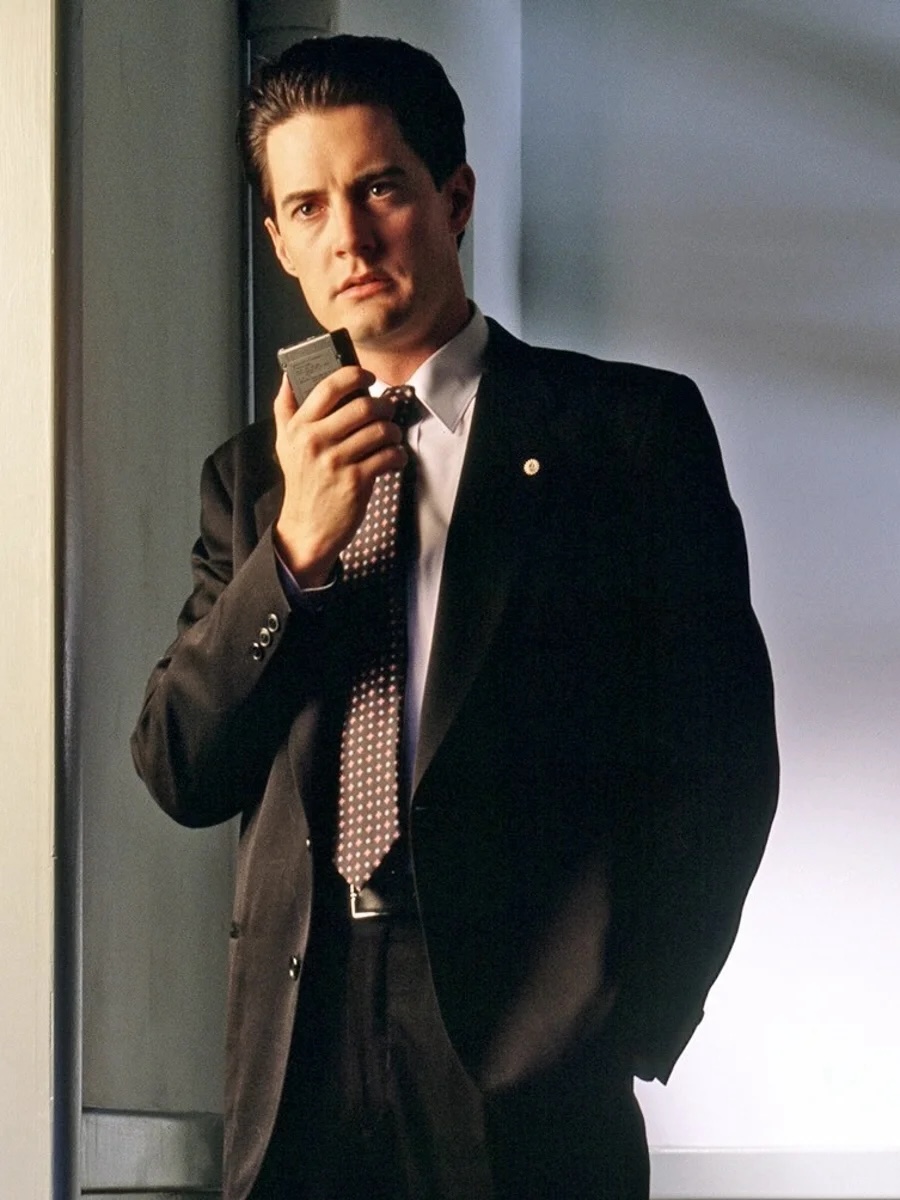
Kyle MacLachlan as FBI Special Agent Dale Cooper on Twin Peaks, in a promotional image for “The Man Behind the Glass” (Episode 2.03).
Vitals
Kyle MacLachlan as Dale Cooper, unusually perceptive FBI agent
Twin Peaks, Washington, February and March 1989
Series: Twin Peaks (Seasons 1-2)
Air Dates: April 8, 1990 to June 10, 1991
Created by: Mark Frost & David Lynch
Costume Design: Sara Markowitz (seasons 1-2) & Patricia Norris (pilot episode only)
WARNING! Spoilers ahead!
Background
Diane… 11:30 a.m., February 24th, entering the town of Twin Peaks. It’s five miles south of the Canadian border, twelve miles west of the state line.
Twin Peaks canon brought FBI Special Agent Dale Cooper (Kyle MacLachlan) into this small upstate Washington town exactly 37 years ago today in 1989, narrating the first of many unreturned missives into a tape recorder after the corpse of popular local teenager Laura Palmer (Sheryl Lee) was discovered washed ashore near the town’s lumber mill. Continue reading
Chuck Norris’ Safari Jacket in The Delta Force

Chuck Norris in The Delta Force (1986)
Vitals
Chuck Norris as Scott McCoy, U.S. Army Delta Force commando
Beirut, Summer 1985
Film: The Delta Force
Release Date: February 14, 1986
Director: Menahem Golan
Costume Designer: Tami Mor
WARNING! Spoilers ahead!
Background
Following my latest post about air travel calamities, I’m now turning my focus to Menahem Golem’s action flick The Delta Force—released 40 years ago tomorrow on Valentine’s Day 1986. Inspired by the real-life hijacking of TWA Flight 847 the previous year, The Delta Force capitalized on Chuck Norris’ rising fame by featuring the actor as Scott McCoy, deputy commander of a U.S. Army Delta Force commando unit. Continue reading
The Four Seasons: Alan Alda’s Après-ski Sweater in Winter

Alan Alda in The Four Seasons (1981)
Vitals
Alan Alda as Jack Burroughs, married lawyer
Stowe, Vermont, Winter 1980
Film: The Four Seasons
Release Date: May 22, 1981
Director: Alan Alda
Costume Designer: Jane Greenwood
WARNING! Spoilers ahead!
Background
Happy 90th birthday to Alan Alda, the movie and TV icon born January 28, 1936. Alda rose to prominence through the 1970s playing Army surgeon “Hawkeye” Pierce in the TV adaptation of M*A*S*H—an early style inspiration for yours truly, as I was particularly obsessed with Hawkeye’s rakish pairing of aloha shirts with his G.I.-issue OG-107 fatigue trousers.
In addition to being the only cast member to appear in all 256 episodes, Alda also ignited his talents behind the camera, ultimately writing 17 and directing 32 episodes during the series’ eleven-season run. Even before M*A*S*H ended, Alda penned his screenwriting debut, The Seduction of Joe Tynan (1979), starring as the eponymous fictional senator. As Alda’s own grandson Jake would summarize in his Letterboxd review: “My grandpa has an affair with a young Meryl Streep… what more can I ask for?”
Two years later, Alda released his directorial debut, The Four Seasons (1981), which he also wrote and—of course—starred in. Alda portrays New York lawyer Jack Burroughs who, along with his wife Kate (Carol Burnett), join two other middle-aged couples for quarterly getaways: one for each of the titular four seasons, and thus framed by Vivaldi’s violin concerti of the same name. Continue reading
Twin Peaks: Michael Ontkean in Khakis and Fleck Jacket as Sheriff Harry Truman

Michael Ontkean as Sheriff Harry S. Truman in Twin Peaks (Episode 1.03: “Episode 2″, aka “Zen, or the Skill to Catch a Killer”)
Vitals
Michael Ontkean as Harry S. Truman, small-town sheriff
Twin Peaks, Washington, February and March 1989
Series: Twin Peaks (Seasons 1-2)
Air Dates: April 8, 1990 to June 10, 1991
Created by: Mark Frost & David Lynch
Costume Design: Sara Markowitz (seasons 1-2) & Patricia Norris (pilot episode only)
WARNING! Spoilers ahead!
Background
For Canadian actor Michael Ontkean’s 80th birthday, today’s post continues the Twin Peaks theme started this week with series co-creator David Lynch’s appearance as FBI Deputy Director Gordon Cole. Born just four days after Lynch on January 24, 1946, Ontkean rose to fame through the 1970s on the TV series The Rookies and the 1977 sports comedy Slap Shot before he took on the role of the even-tempered Sheriff Harry S. Truman—no known relation to the president of the same name, though the sheriff does hang the 33rd president’s portrait in his office. Continue reading
Twin Peaks: Dale Cooper’s FBI Raid Jacket

Kyle MacLachlan as FBI Special Agent Dale Cooper in Twin Peaks (Episode 1.06: “Episode 5”, aka “Cooper’s Dreams”)
Vitals
Kyle MacLachlan as Dale Cooper, FBI agent
Twin Peaks, Washington, March 1989
Series: Twin Peaks
Episodes:
– “Cooper’s Dreams” (Episode 1.06, dir. Lesli Linka Glatter, aired 5/10/1990)
– “Realization Time” (Episode 1.07, dir. Caleb Deschanel, aired 5/17/1990)
– “Variations on Relations” (Episode 2.19, dir. Jonathan Sanger, aired 4/11/1991)
Created by: Mark Frost & David Lynch
Costume Design: Sara Markowitz
WARNING! Spoilers ahead!
Background
Following what would have been series co-creator David Lynch’s 80th birthday on Tuesday, I decided to make this Twin Peaks week on BAMF Style to give Lynch and Mark Frost’s surreal mystery series some long overdue attention. If you don’t like that, fix your hearts or die.
Twin Peaks centered around the arrival of FBI Special Agent Dale Cooper (Kyle MacLachlan) to the fictional titular small town in upper Washington state, where he joins Sheriff Harry S. Truman (Michael Ontkean) to investigate the murder of local teen Laura Palmer (Sheryl Lee). Even after the murder is ostensibly solved, Coop hangs around in Twin Peaks, lured by its colorful townsfolk and growing lore around the mysterious Black Lodge. Continue reading
Twin Peaks: David Lynch’s Black FBI Suit as Gordon Cole

David Lynch as FBI Regional Bureau Chief Gordon Cole on Twin Peaks (Episode 13: “Demons”)
Vitals
David Lynch as Gordon Cole, hearing-impaired FBI regional bureau chief
Twin Peaks, Washington, March 1989
Series: Twin Peaks
Episodes:
– “Demons”, aka “Episode 13” (Episode 2.06, dir. Lesli Linka Glatter, aired 11/3/1990)
– “Lonely Souls”, aka “Episode 14” (Episode 2.07, dir. David Lynch, aired 11/10/1990)
– “On the Wings of Love, aka “Episode 25” (Episode 2.18, dir. Duwayne Dunham, aired 4/4/1991)
– “Variations on Relations”, aka “Episode 26” (Episode 2.19, dir. Jonathan Sanger, aired 4/11/1991)
Created by: Mark Frost & David Lynch
Costume Designer: Sara Markowitz
WARNING! Spoilers ahead!
Background
Today would have been the 80th birthday of David Lynch, the celebrated filmmaker whose surrealist productions often blended elements of humor and horror. Born January 20, 1946 in Missoula, Montana, Lynch died just four days before his 79th birthday last year when his emphysema was exacerbated from his Hollywood Hills home during the destructive wildfires that ravaged southern California.
In addition to the ten feature films he directed, Lynch co-created the TV series Twin Peaks with Mark Frost. On its surface, this mystery series centered around FBI Special Agent Dale Cooper (Kyle MacLachlan) investigating the death of homecoming queen Laura Palmer (Sheryl Lee) in a small Washington town, while more surreal elements focused on the supernatural realm presented through Coop’s bizarre dreams and the interactions among the quirky Twin Peaks townsfolk that lean into the characteristically Lynchian references to mid-century Americana.

Lynch himself would finally appear on screen during the second season as Coop’s hearing-impaired supervisor: “Federal Bureau of Investigation Regional Bureau Chief Gordon Cole,” as he introduces himself to local sheriff Harry S. Truman (Michael Ontkean), adding, “that’s a real mouthful, but I can’t hear myself anyway.” Continue reading
You must be logged in to post a comment.