Category: Two-Piece Suit
Twin Peaks: FBI Agent Dale Cooper’s Black Suit
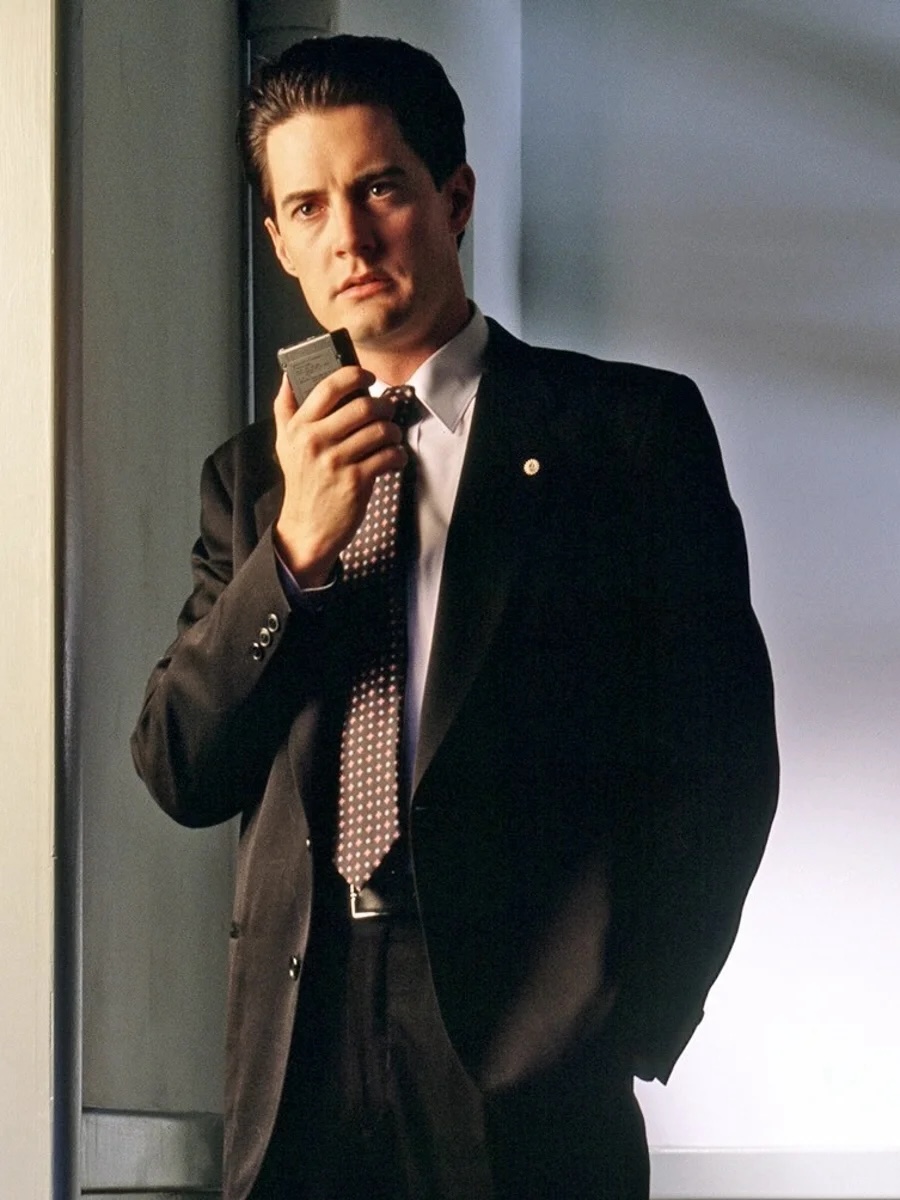
Kyle MacLachlan as FBI Special Agent Dale Cooper on Twin Peaks, in a promotional image for “The Man Behind the Glass” (Episode 2.03).
Vitals
Kyle MacLachlan as Dale Cooper, unusually perceptive FBI agent
Twin Peaks, Washington, February and March 1989
Series: Twin Peaks (Seasons 1-2)
Air Dates: April 8, 1990 to June 10, 1991
Created by: Mark Frost & David Lynch
Costume Design: Sara Markowitz (seasons 1-2) & Patricia Norris (pilot episode only)
WARNING! Spoilers ahead!
Background
Diane… 11:30 a.m., February 24th, entering the town of Twin Peaks. It’s five miles south of the Canadian border, twelve miles west of the state line.
Twin Peaks canon brought FBI Special Agent Dale Cooper (Kyle MacLachlan) into this small upstate Washington town exactly 37 years ago today in 1989, narrating the first of many unreturned missives into a tape recorder after the corpse of popular local teenager Laura Palmer (Sheryl Lee) was discovered washed ashore near the town’s lumber mill. Continue reading
Ben Gazzara’s Navy Suit for The Killing of a Chinese Bookie

Ben Gazzara in The Killing of a Chinese Bookie (1976)
Vitals
Ben Gazzara as Cosmo Vitelli, strip club owner and emcee
Los Angeles, Fall 1975
Film: The Killing of a Chinese Bookie
Release Date: February 15, 1976
Director: John Cassavetes
Wardrobe Credit: Mary Herne
WARNING! Spoilers ahead!
Background
John Cassavetes re-teamed with his friend and frequent collaborator Ben Gazzara for The Killing of a Chinese Bookie, a gritty neo-noir originally released 50 years ago today on February 15, 1976. The original cut ran over two hours, but feedback from audience—and Gazzara himself—resulted in Cassavetes recutting it down to a tighter 108-minute version that was re-released in 1978, maintaining its tone and ambiguously bleak ending.
“My name, if you don’t know it by now, is Cosmo Vitelli, and I own this joint,” Gazzara’s scrappy cabaret owner announces to his audience. “You know, they say everything is sex; sex is everything. Here at the Crazy Horse West, we give you a lot more than that.” Continue reading
Twin Peaks: David Lynch’s Black FBI Suit as Gordon Cole

David Lynch as FBI Regional Bureau Chief Gordon Cole on Twin Peaks (Episode 13: “Demons”)
Vitals
David Lynch as Gordon Cole, hearing-impaired FBI regional bureau chief
Twin Peaks, Washington, March 1989
Series: Twin Peaks
Episodes:
– “Demons”, aka “Episode 13” (Episode 2.06, dir. Lesli Linka Glatter, aired 11/3/1990)
– “Lonely Souls”, aka “Episode 14” (Episode 2.07, dir. David Lynch, aired 11/10/1990)
– “On the Wings of Love, aka “Episode 25” (Episode 2.18, dir. Duwayne Dunham, aired 4/4/1991)
– “Variations on Relations”, aka “Episode 26” (Episode 2.19, dir. Jonathan Sanger, aired 4/11/1991)
Created by: Mark Frost & David Lynch
Costume Designer: Sara Markowitz
WARNING! Spoilers ahead!
Background
Today would have been the 80th birthday of David Lynch, the celebrated filmmaker whose surrealist productions often blended elements of humor and horror. Born January 20, 1946 in Missoula, Montana, Lynch died just four days before his 79th birthday last year when his emphysema was exacerbated from his Hollywood Hills home during the destructive wildfires that ravaged southern California.
In addition to the ten feature films he directed, Lynch co-created the TV series Twin Peaks with Mark Frost. On its surface, this mystery series centered around FBI Special Agent Dale Cooper (Kyle MacLachlan) investigating the death of homecoming queen Laura Palmer (Sheryl Lee) in a small Washington town, while more surreal elements focused on the supernatural realm presented through Coop’s bizarre dreams and the interactions among the quirky Twin Peaks townsfolk that lean into the characteristically Lynchian references to mid-century Americana.

Lynch himself would finally appear on screen during the second season as Coop’s hearing-impaired supervisor: “Federal Bureau of Investigation Regional Bureau Chief Gordon Cole,” as he introduces himself to local sheriff Harry S. Truman (Michael Ontkean), adding, “that’s a real mouthful, but I can’t hear myself anyway.” Continue reading
Sean Connery’s Sheepskin Coat and Plaid Suit in The Offence

Sean Connery in The Offence (1973)
Vitals
Sean Connery as Detective Sergeant “Johnny” Johnson, jaded police detective
Berkshire, England, Spring 1972
Film: The Offence
Release Date: January 11, 1973
Director: Sidney Lumet
Costume Designer: Evangeline Harrison
WARNING! Spoilers ahead!
Background
Sean Connery and director Sidney Lumet’s third of five cinematic collaborations, The Offence, was released on this day in 1973. Adapted by John Hopkins from his own stage play This Story of Yours, the film was the first of two projects that United Artists agreed to finance through Connery’s production company Tantallon Films in exchange for the star returning to play James Bond in Diamonds are Forever.
As his first post-Bond film, Big Tam specifically chose The Offence to demonstrate his range and expand his screen image beyond the 007 persona, resulting in perhaps one of his greatest performances. Continue reading
Dillinger (1973): Ben Johnson’s Indigo Chalkstripe Suit as Melvin Purvis

Ben Johnson as Melvin Purvis in Dillinger (1973)
Vitals
Ben Johnson as Melvin Purvis, experienced federal agent
Northern Illinois, Winter 1933
Film: Dillinger
Release Date: July 20, 1973
Director: John Milius
Costume Designer: James M. George
WARNING! Spoilers ahead!
Background
The Depression-era desperado roundup of 1934 which eventually took down the likes of John Dillinger, Bonnie and Clyde, “Pretty Boy” Floyd, and “Baby Face” Nelson began in the last days of 1933 when a 24-man strike force of federal agents and local police surrounded the rented cottage where “Tri-State Terror” Wilbur Underhill was spending his honeymoon with his new bride Hazel Jarrett Hudson… as well as his partner-in-crime Ralph Roe and his girlfriend Eva May Nichols. The subsequent gunfight resulted in one of the women’s deaths and Underhill mortally wounded.
Despite the title character’s removal from these events, John Milius’ 1973 directorial debut Dillinger gets these general circumstances correct, though it relocates the action from outside Shawnee, Oklahoma to “northern Illinois” and places rising FBI star Melvin Purvis (Ben Johnson) onsite to single-handedly lead the counterattack against Underhill, silently portrayed by Dillinger‘s cinematographer Jules Brenner. Continue reading
Three Days of the Condor: Wicks’ Leather Car Coat and Navy Suit

Michael Kane in Three Days of the Condor (1975)
Vitals
Michael Kane as S.W. Wicks, shady CIA section chief
Langley, Virginia to New York City, Winter 1975
Film: Three Days of the Condor
Release Date: September 24, 1975
Director: Sydney Pollack
Costume Designer: Joseph G. Aulisi
WARNING! Spoilers ahead!
Background
Released in September 1975, the Christmas-adjacent spy thriller Three Days of the Condor celebrated its 50th anniversary earlier this year. Robert Redford stars as the titular “Condor”, the CIA’s codename for its low-level researcher Joe Turner who is the only survivor of a coordinated attack on its deep-cover office in Manhattan.
The massacre is revealed to have been part of an internal conspiracy, involving Turner’s own section chief S.W. Wicks. Though not a prominent character with just a few minutes of screen time across four scenes, Wicks is certainly a significant one and very effectively played by Michael Kane—no, not that Michael Caine—an acclaimed Canadian actor and World War II veteran who died 18 years ago last week on December 14, 2007. Continue reading
The Menswear of Clue
Film: Clue
Release Date: December 13, 1985
Director: Jonathan Lynn
Costume Designer: Michael Kaplan
WARNING! Spoilers ahead!
Background
Today marks the 40th anniversary since the release of Clue, which overcame an underwhelming initial release to become perhaps the most successful cinematic adaptation of a board game. The Parker Brothers classic formed the foundation for John Landis and Jonathan Lynn’s zany murder mystery, framed against the backdrop of the post-World War II “Red Scare” though, ultimately, communism was just a red herring.
Clue was released with three separate endings (a fourth was dropped during production), intended to be varied at each showing. In addition to reflecting the spirit of the original game, Landis had hoped that multiple endings would bring audiences back for multiple showings, but the gimmick unfortunately backfired as the public. It wasn’t until Clue was released to home video with all three endings presented sequentially that it gained a cult following.

The movie is set over a rainy New England night in June 1954, as the game’s six colorfully named suspects—Mr. Green (Michael McKean), Colonel Mustard (Martin Mull), Mrs. Peacock (Eileen Brennan), Professor Plum (Christopher Lloyd), Miss Scarlet (Lesley Ann Warren), and Mrs. White (Madeline Kahn)—are summoned to dinner at the foreboding Hill House mansion, where each are greeted by the butler Wadsworth (Tim Curry). Continue reading
White Heat: James Cagney’s Chalkstripe Suits and 1949 Mercury

James Cagney with Margaret Wycherly in White Heat (1949)
Vitals
James Cagney as Arthur “Cody” Jarrett, ruthless gang leader and devoted son
Los Angeles, California and Springfield, Illinois, Fall 1949 to Spring 1950
Film: White Heat
Release Date: September 2, 1949
Director: Raoul Walsh
Wardrobe Credit: Leah Rhodes
WARNING! Spoilers ahead!
Background
Closing out Noirvmber but speeding into this winter’s Car Week, Raoul Walsh’s hard-boiled 1949 masterpiece White Heat erupts at the intersection of film noir and the classic Warner Brothers gangster film, which its star James Cagney had a hand in pioneering through his roles in The Public Enemy (1931), Angeles with Dirty Faces (1938), and The Roaring Twenties (1939). The latter had been his final criminal role for nearly a decade, as he evolved toward romantic and comedic roles including his Academy Award-winning performance as George M. Cohan in Yankee Doodle Dandy (1942).
But as his subsequent movies were unsuccessful with audiences, Cagney reluctantly returned to both the cinematic underworld and Jack L. Warner’s kingdom when he signed on to play the volatile gang leader Cody Jarrett in White Heat. Virginia Kellogg’s story was loosely inspired by the myth surrounding the ill-fated “Ma” Barker and her sons during the Depression-era crime wave, purchased for $2,000 by Warner Bros., where Ivan Goff and Ben Roberts spent six months adapting into a fictional screenplay where—much to Jack Warner’s frustration—they only envisioned Cagney to play Cody.
Following a $300,000 mail train robbery in the Sierra Nevada mountains that left four crewmen dead, Cody leads his gang’s retreat from their mountain hideout, splitting off with his sultry wife Verna (Virginia Mayo) and domineering mother (Margaret Wycherly) to hole up in a motel on the outskirts of Los Angeles. We’ve already seen Ma’s powerful influence over her son, both supporting him when he has his mind-splitting migraines and gently suggesting that he execute a wounded gang member rather than take the chance he’ll talk.
When Ma risks a trip into town to buy Cody’s favorite strawberries for him, she picks up a police tail that has Cody again at the wheel of their Mercury to make their getaway. After a night-time police chase through the streets of L.A., Cody ducks the Mercury into a drive-in theater and develops his plan to take the fall for a hotel heist in Illinois that was the same day as their deadly train robbery, giving himself a 2,000-mile alibi:
While those hoodlums were killing those innocent people on the train, I was pushing in a hotel in Springfield! Couldn’t be in both places at once, could I?
Mads Mikkelsen’s Dark Dance Suit in Another Round (Druk)

Mads Mikkelsen in Druk (Another Round) (2020)
Vitals
Mads Mikkelsen as Martin, inebriated history teacher
Copenhagen, Spring 2020
Film: Another Round
(Danish title: Druk)
Release Date: September 24, 2020
Director: Thomas Vinterberg
Costume Design: Ellen Lens & Manon Rasmussen
WARNING! Spoilers ahead!
Background
Happy 60th birthday to Mads Mikkelsen! Born November 22, 1965, the Danish actor rose to global prominence for his performance as the villainous Le Chiffre in the 2006 James Bond film Casino Royale and as the title character on NBC’s Hannibal, though his most celebrated performance may be as the depressed schoolteacher Martin in Thomas Vinterberg’s 2020 comedy-drama Another Round—originally released in Denmark as Druk and honored in the United States with the Academy Award for Best International Feature Film. Continue reading
Casino: Robert De Niro’s Lookbook as Ace Rothstein

Robert De Niro as Sam “Ace” Rothstein in Casino (1995)
Vitals
Robert De Niro as Sam “Ace” Rothstein, Vegas casino executive and mob associate
Las Vegas, 1973 to 1983
Film: Casino
Release Date: November 22, 1995
Director: Martin Scorsese
Costume Design: Rita Ryack & John A. Dunn
Tailors: Carlos Velasco, Tommy Velasco, and Vincent Zullo
WARNING! Spoilers ahead!
Martin Scorsese’s Las Vegas-centric crime epic Casino premiered in New York City thirty years ago tonight on November 14, 1995, eight days before its wider release.
Chronicling the rise and fall of the midwest mob’s influence in Sin City during the 1970s and ’80s, Casino stars Robert De Niro as Sam “Ace” Rothstein, a fictionalization of real-life bookie Frank “Lefty” Rosenthal (1929-2008). De Niro was re-teamed with Joe Pesci as yet another volatile gangster—this time the hotheaded Chicago hitman Nicky Santoro, based on Lefty’s actual pal Tony “the Ant” Spilotro, and Sharon Stone received an Academy Award nomination as Ace’s hustler wife Ginger.
Part of Casino‘s legacy is due to the lavish costume design by Rita Ryack and John A. Dunn, who researched and worked with the real Lefty’s tailors and shirt-makers to recreate the gambler’s eye-catching style for the screen. Continue reading
You must be logged in to post a comment.