Tagged: Criminal
Michael Caine in Get Carter
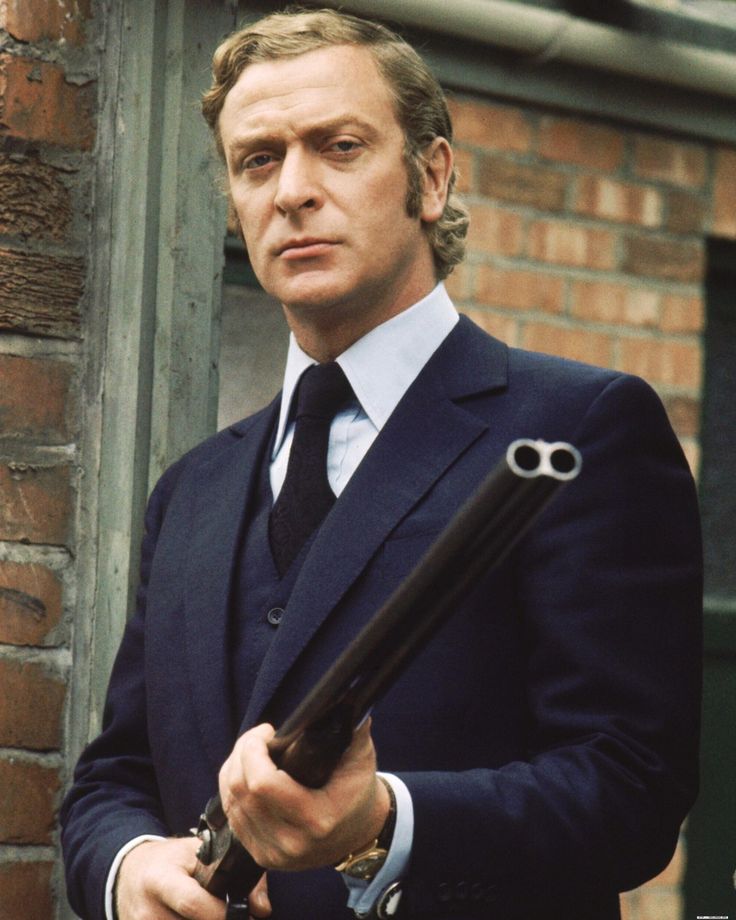
Michael Caine as Jack Carter in Get Carter (1971).
Vitals
Michael Caine as Jack Carter, ruthless London gangster
Newcastle, England, Spring 1971
Film: Get Carter
Release Date: March 10, 1971
Director: Mike Hodges
Costume Designer: Evangeline Harrison
Tailor: Douglas Hayward
Background
Get Carter is arguably one of the greatest crime films of all time, making it – by my default – one of the greatest films of all time. Bleak, gritty, and violent, and, the film was the love child of director Mike Hodges and superstar Michael Caine with a screenplay written by Hodges from Ted Lewis’ 1970 novel Jack’s Return Home. Although Hodges had originally drafted the screenplay with Ian Hendry (who would play Eric Paice in the film) in mind for the lead role, Caine eventually took the role that cemented his place as a cinema icon. Hodges was surprised that a major star like Caine would take on the role of Jack Carter; although Caine had previously played a gangster in The Italian Job, Charlie Croker was more of a charming ne’er-do-well while Carter was a restrained but brutal and ultimately unlikable killer. Continue reading
The Sundance Kid’s Gray Wool Traveling Suit

Paul Newman, Katharine Ross, and Robert Redford in Butch Cassidy and the Sundance Kid (1969).
Vitals
Robert Redford as Harry Longbaugh, aka “The Sundance Kid”, American outlaw and sharpshooter
Colorado to Bolivia (via New York City), Spring 1901
Film: Butch Cassidy and the Sundance Kid
Release Date: October 24, 1969
Director: George Roy Hill
Costume Designer: Edith Head
Background
For Throwback Tuesday (that’s a thing, right?), BAMF Style is focusing on another BAMF hero – Robert Redford, who celebrated his 78th birthday yesterday – in the role that arguably shot his career into megastardom.
As Harry Longbaugh, alias “The Sundance Kid”, Redford played a level-headed – if pessimisitc – ying to the optimistic dreamer Butch Cassidy played by Paul Newman. Butch and the Kid were outlaws, killers, and thieves, but William Goldman’s script, George Roy Hill’s direction, and Newman and Redford’s bickering chemistry reinvented the two bandits’ image. Continue reading
Cary Grant’s Gray Suit in To Catch a Thief

Cary Grant as John Robie in To Catch a Thief (1955).
Vitals
Cary Grant as John Robie, retired cat burglar and jewel thief
Cannes, French Riviera, Summer 1954
Film: To Catch a Thief
Release Date: August 5, 1955
Director: Alfred Hitchcock
Costume Designer: Edith Head
Background
To Catch a Thief is a classic Hitchcock production featuring two of his favorite stars – Cary Grant and Grace Kelly – in a romantic crime comedy-thriller set against the exotic backdrop of the French Riviera. It was one of Grace’s last films in her too-brief five-year acting career before becoming Princess of Monaco.
Grant and Kelly’s undeniable chemistry is still remarkable sixty years later. While legendary Hollywood costumer Edith Head dressed Princess Grace for the film, it’s believed that Grant provided most of his own attire as he was, after all, Cary fucking Grant. Continue reading
The Death of John Dillinger – 2009 Style

Johnny Depp as John Dillinger in Public Enemies (2009).
Vitals
Johnny Depp as John Dillinger, doomed Depression-era bank robber
Chicago, July 1934
Film: Public Enemies
Release Date: July 1, 2009
Director: Michael Mann
Costume Designer: Colleen Atwood
Background
While 1973’s Dillinger took a “just the facts” approach to retelling the life of bank robber John Dillinger (albeit with very exaggerated facts), Michael Mann’s Public Enemies painted the farmboy-turned-criminal as a more mythical figure. This seems to be the trend in recent years.
Forty-some years ago, the cinematic John Dillinger and Clyde Barrow were depicted as Robin Hood-type folk heroes who were cornered by relentless authorities and shot without warning. Continue reading
The Death of John Dillinger – 1973 Style

Warren Oates and Michelle Phillips as John Dillinger and Billie Frechette, respectively, in Dillinger (1973). The film inaccurately portrays Polly Hamilton as an alias for Billie Frechette; in reality, Polly was an entirely different person.
Vitals
Warren Oates as John Dillinger, doomed Depression-era bank robber
Chicago, July 1934
Film: Dillinger
Release Date: July 20, 1973
Director: John Milius
Costume Designer: James M. George
Background
Although it had been founded in 1908, the FBI had existed for more than a quarter of a century without grabbing major national attention. There were many major successes, but the recent crime wave of bank-robbing desperadoes tarnished the agency’s image and, in turn, turned outlaws into folk heroes.
One of these criminal “folk heroes” was John Dillinger, a 31-year-old Indiana native who had recently embarrassed national law enforcement by reportedly breaking out of jail with a wooden gun. Although they had Dillinger in their sights for the better part of a year, the FBI—then known as the Bureau of Investigation (BOI)—had no legal jurisdiction to take him down. Dillinger’s crimes—ranging from bank robbery to alleged murder—were all certainly major, but none violated any federal law. Then, it was realized that Dillinger had stolen the Lake County sheriff’s car during his escape. By driving the stolen automobile across a state line, Dillinger violated the Dyer Act.
The Dyer Act, also called the National Motor Vehicle Theft Act, was passed in 1919 to combat the growing threat of trafficking stolen automobiles. If a person was found guilty of violating the Dyer Act, they would be sentenced with imprisonment up to ten years, a hefty fine, or both. In Dillinger’s case, the BOI determined that his punishment would be execution. Continue reading
Michael Caine’s Beige Summer Suit in The Italian Job

Michael Caine as Charlie Croker in The Italian Job (1969).
Vitals
Michael Caine as Charlie Croker, British career criminal and mob thief
Turin, Italy, Spring 1969
Film: The Italian Job
Release Date: June 2, 1969
Director: Peter Collinson
Wardrobe Supervisor: Dulcie Midwinter
Background
Nearly fifty years after its initial release, The Italian Job is still considered to be one of the coolest classic caper flicks. With a very funny ensemble cast led by Michael Caine at the height of his cheekiness, The Italian Job is a slightly corny but immensely entertaining film that perfectly captures an era and brings the hippest parts of 1969 alive with the help of Caine, Noël Coward, and Benny Hill. Continue reading
Scarface: Tony’s White Pinstripe Suit

Al Pacino as Tony Montana in Scarface (1983)
Vitals
Al Pacino as Tony Montana, ambitious Cuban-American cocaine dealer
Miami (and Bolivia), Summer 1981
Film: Scarface
Release Date: December 9, 1983
Director: Brian De Palma
Costume Designer: Patricia Norris
Tailor: Tommy Velasco
Background
One of the few sartorial rules actually practiced in the United States is adherence to the “no white after Labor Day” rule. While it’s technically outdated, having been decided after the Civil War by snobbish housewives who wanted to establish their place in society, it makes sense that light-colored attire would find its place in the summer. Further enhancing the arbitrary rule, the snobbish housewives’ society determined that Memorial Day would mark the first day for white clothing to be appropriate in polite society.
While he may not be the prime example of “polite society” in the eyes of postbellum America, Tony Montana redefined drug dealer chic in 1983’s Scarface with his numerous sharp suits and incomparable swagger while wearing them. Continue reading
Clyde Barrow’s Death Suit (2013 Version)

Emile Hirsch as Clyde Barrow in part two of the 2013 mini-series Bonnie & Clyde.
Vitals
Emile Hirsch as Clyde Barrow, bank robber with “second sight”
Rural Louisiana, May 1934
Series Title: Bonnie and Clyde
Air Date: December 8, 2013
Director: Bruce Beresford
Costume Designer: Marilyn Vance
Background
Eighty years ago today, six Southern lawmen pulled off a feat that the federal government had been failing to do for months with the first real victory in the United States’ “War on Crime”.
With the advent of the Great Depression following the stock market crash of 1929, criminals abandoned gangsterdom and bootlegging (both “Machine Gun” Kelly and “Pretty Boy” Floyd were known to be bootleggers early in their career) in favor of motorized banditry. In the spirit of the Old West, bank robbers took to cars all across the country – with a special concentration in the poorest areas of the Midwest and the South.
This crime wave did not go unnoticed by the government. Soon, names like John Dillinger, “Baby Face” Nelson, and Alvin Karpis were dominating the headlines, and they were surprisingly welcome by the people who were sick and tired of the perceived “fat cats” in the government. Some of the criminals, Dillinger and Floyd especially, even had the begrudging respect of some small-town lawmen. But the greatest disparity between public opinion and actual temperament is with the case of Bonnie and Clyde. Continue reading
The Sopranos: Christopher’s Black-on-Black in “D-Girl”

Michael Imperioli as Christopher Moltisani in “D-Girl”, Episode 2.07 of The Sopranos (2000).
Vitals
Michael Imperioli as Christopher Moltisanti, New Jersey Mafia associate and aspiring screenwriter
New York City, Fall 2000
Series: The Sopranos
Episode: “D-Girl” (Episode 2.07)
Air Date: February 27, 2000
Director: Allen Coulter
Creator: David Chase
Costume Designer: Juliet Polcsa
Background
“D-Girl” is a turning point episode for Christopher Moltisanti. We had seen previous mentions of his screenwriting aspirations, including a poorly-written script on his Mac in “The Legend of Tennessee Moltisanti”, but “D-Girl” provides his Bugsy moment. Continue reading
Heat – Neil McCauley’s Gray Double-Breasted Suit

Robert De Niro as Neil McCauley in Heat (1995).
Vitals
Robert De Niro as Neil McCauley, professional armed robber
Los Angeles, Spring 1995
Film: Heat
Release Date: December 15, 1995
Director: Michael Mann
Costume Designer: Deborah Lynn Scott
De Niro’s Costumer: Marsha Bozeman
Background
A person’s characteristics are always made plainly visible by his or her attire. Clothing gives signals that all coordinate with the person’s background, lifestyle, socioeconomic status, occupation, and personality.
In Michael Mann’s noirish 1995 masterpiece Heat, Robert De Niro and Al Pacino face off, sharing the screen for the first time (their roles in The Godfather Part II were in completely separate timelines, as you well know). De Niro plays Neil McCauley, a professional armed robber who remains cool-as-a-cucumber but can be remorselessly ruthless, and Pacino stars as LAPD Lt. Vincent Hanna, the erratic detective tasked with taking him down.
If all a person had to use were images of De Niro in the film, wearing a largely-cut gray suit and an emotionless stare while carrying a state-of-the-art firearm, it would be crystal clear that he was a hardened criminal, respected and feared by both friend and foe, but burdened with a fatal weakness yet to be determined. Continue reading
You must be logged in to post a comment.